
Solar is giving hundreds of millions of Africans access to electricity for the first time.
FOR THE WORLD’S 1.2 billion poorest people, who are facing a long and perhaps endless wait for a connection to mains electricity, solar power could be the answer to their prayers. A further 2.5 billion are “underelectrified”, in development parlance: although connected to the grid, they can get only unreliable, scanty power. That blights lives too. The whole of sub-Saharan Africa, with a population of 910m, consumes only 145 terawatt hours of electricity a year—less than the 4.8m people who live in the state of Alabama. That is the pitiful equivalent of one incandescent light bulb per person for three hours a day.
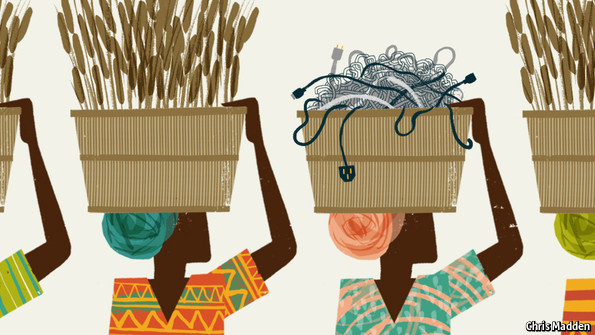 In the absence of electricity, the usual fallback is paraffin (kerosene). Lighting and cooking with that costs poor people the world over $23 billion a year, of which $10 billion is spent in Africa. Poor households are buying lighting at the equivalent of $100 per kilowatt hour, more than a hundred times the amount people in rich countries pay. And kerosene is not just expensive; it is dangerous. Stoves and lamps catch fire, maiming and killing. Indoor fumes cause 600,000 preventable deaths a year in Africa alone. But candles or open fires are even worse—and so is darkness, which hurts productivity and encourages crime.
Africa’s population will nearly double by 2040. The electrical revolution now under way there, and in other poor but sunny places, is coming just in time for all those extra people. It is based on three big technological changes, all reinforcing each other.
The first is the collapsing cost of solar power. The second is the fall in the price of light-emitting diodes (LEDs). These turn electrical power almost wholly into light. Traditional bulbs are fragile and emit mostly heat. The new LED lamps are not only bright and durable but now also affordable. But lamps are needed at night, and solar power is collected in the daytime. So the third, crucial revolution is in storage.
Fleecing the poor
All in all, the capacity needed to produce a watt of solar power (enough to run a small light), which in 2008 cost $4, has come down to $1. The simplest solar-powered lamps cost around $8. That is still a lot for people with very little money, but the saving on kerosene makes it a good investment. Better light enables people to study and work in the evening. As well as powering a lamp, a slightly larger solar system can charge a mobile phone, for which users in poor countries often pay extortionate amounts. Russell Sturm of the International Finance Corporation (IFC), the part of the World Bank group that works with the private sector, cites kiosks in Papua New Guinea where customers pay for each bar of charge shown on the phone’s screen—at a cost than can easily reach a stonking $200 per kWh.
Sales of devices approved by the IFC/World Bank’s Lighting Africa programme are nearly doubling annually, bringing solar power to a cumulative total of 28.5m Africans. In 2009 just 1% of unelectrified sub-Saharan Africans used solar lighting. Now it is nearly 5%. The IEA rather cautiously estimates that, thanks to solar power, 500m people who are currently without electricity will have at least 200 watts per head by 2030.
But lighting and charging phones are only the first rungs on the ladder, notes Charlie Miller of SolarAid, a charity. Radios can easily run on solar power. Bigger systems can light up a school or clinic; a “solar suitcase” provides the basic equipment needed by health workers. A Ugandan company called SolarNow has a $200 low-voltage television set that runs on the direct current (DC) used by solar systems. A British-designed fridge called Sure Chill needs only a few hours of power a day to maintain a constant 4ºC. A company in South Africa has just launched solar-powered ATMs for rural areas with intermittent mains power.
Read more: Africa: A brightening continent
Source: The Economics