
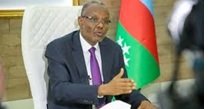
Mogadishu (WDN) – In a rare and revealing account, the former President of Somalia’s South West Administration, Abdiaziz Hassan (Laftagareen), has publicly broken his silence on the circumstances that led to the loss of control over Baidoa, offering a detailed narrative that sheds new light on one of the region’s most politically sensitive transitions.
Speaking in an interview with the Geed-Fadhi group, Laftagareen described a sudden and unexpected shift in the battlefield dynamics that, according to him, left his administration’s defensive strategy exposed and ultimately ineffective.
He claimed that federal government forces entered Baidoa from an unforeseen direction, bypassing established defensive positions that had been carefully set up outside the city limits. These positions, he said, were intended to prevent urban combat and keep fighting away from the civilian population.
“My plan was that fighting would not take place inside Baidoa city,” Laftagareen explained. “That is why we positioned our forces outside the city, in designated defensive areas.”
However, he alleged that the situation changed rapidly when federal air assets came into play. According to his account, aerial surveillance by government aircraft identified weaknesses in the defensive arrangement, allowing federal forces to adjust their approach and enter from an alternative axis.
“Government warplanes observed from above that Federal forces were not in a position to withstand a direct engagement,” he said. “After that, they altered their route and came in from another direction.”
The remarks offer a rare insider perspective on a moment that reshaped the political and security landscape of South West Somalia. While Laftagareen framed the events as a tactical surprise, the account also underscores the broader volatility and shifting power dynamics between regional administrations and federal authorities in Somalia’s contested federal system.
Its important to note, former President Laftagareen served as the deputy chairperson of President Hassan’s Union for Peace and Justice Party (JSP). Although their underlying priorities may have differed, they aligned in pursuing President Hassan’s objective of advancing the constitutional changes and pushing toward a one-person, one-vote election by any means necessary. Just two months before the end of President Hassan’s term, Laftagareen shifted course, once he realized that Villa Somalia is not backing his return to power in South West State.
Nevertheless, the interview is likely to reignite debate over the nature of the transition in Baidoa, where competing narratives continue to shape political legitimacy and control.
WardheerNews