
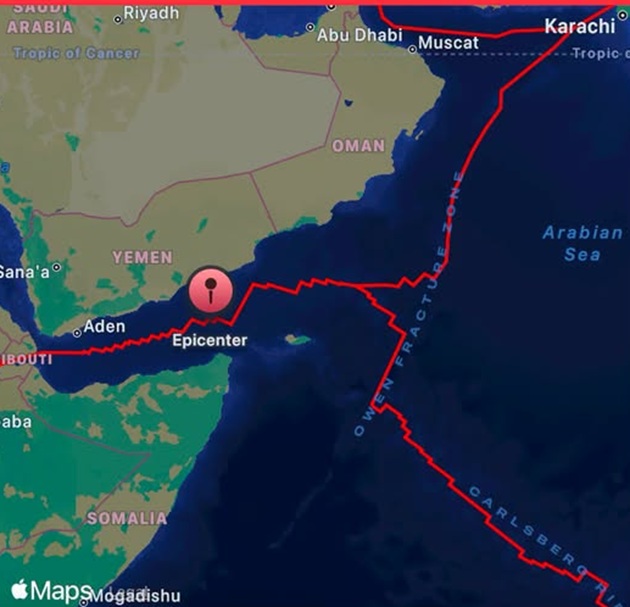
Garowe (WDN) – A powerful magnitude 6.0 earthquake struck the Gulf of Aden early Friday, sending seismic tremors through a region already known for intense geological activity and raising fresh questions about the vulnerability of Somalia’s northeastern coastline.
According to the U.S. Geological Survey (USGS), the earthquake occurred at 12:07 a.m. local time on Friday, August 28, or 21:07 GMT on Thursday. Its epicenter was located approximately 145 kilometers north of Caluula in Puntland, beneath the Gulf of Aden, at a relatively shallow depth of about 10 kilometers.
The quake was strong enough to attract international seismic monitoring, but its offshore location appears to have significantly reduced the immediate risk to populated areas. No deaths, injuries or major structural damage had been reported in the initial assessments. USGS-linked assessments placed the immediate humanitarian risk at a low level.
A Region Built on Moving Tectonic Plates
The earthquake is a reminder that the Gulf of Aden is far from geologically quiet. The area lies along an active tectonic boundary where the Arabian and Somali plates are pulling apart, producing repeated seismic activity beneath the Gulf and around the surrounding coastlines. The geological forces that created and continue to reshape the Gulf of Aden make earthquakes a recurring feature of the region. And Friday’s earthquake was not an isolated event.
On June 25, 2026, a magnitude 5.1 earthquake was recorded in the eastern Gulf of Aden, approximately 152 kilometers north of Caluula, at a depth of 10 kilometers. The proximity of the two events underscores the continuing seismic activity beneath the waters separating Somalia and Yemen.
A magnitude 6.0 earthquake can cause significant damage when it occurs close to densely populated areas, particularly where buildings are poorly constructed. But distance, depth, local geology and construction standards all play a major role in determining the eventual impact.
In this case, the epicenter was offshore and roughly 145 kilometers from Caluula, limiting the likelihood of severe destruction along Somalia’s coast. Initial reports indicated no significant casualties or damage. There was also no immediate tsunami warning associated with the event. The available assessments indicated a low tsunami risk, although authorities and seismic monitoring agencies continue to watch for possible changes and aftershocks.
A Warning Beneath the Surface
For Somalia, however, the significance of the earthquake goes beyond Friday’s relatively limited impact. The country’s northeastern coastline stretches along one of the most geologically active corridors in the region, yet Somalia has comparatively limited earthquake-monitoring infrastructure, public preparedness systems and disaster-response capacity. That creates a potentially serious vulnerability.
A similar earthquake occurring much closer to a populated coastal community could produce a dramatically different outcome—particularly in areas where buildings and infrastructure have not been designed with seismic risks in mind.
The Gulf of Aden is also one of the world’s strategically important maritime corridors, linking the Red Sea and the Indian Ocean. Millions of tonnes of commercial shipping pass through the wider region every year, meaning major geological disruptions could have consequences extending beyond Somalia and Yemen.
The Earthquake After the Earthquake
For now, there is little evidence that Friday’s earthquake has produced a major humanitarian emergency. But scientists continue to monitor the area for aftershocks, which can follow a significant seismic event. The immediate message from the earthquake is therefore one of caution rather than catastrophe.
At magnitude 6.0, the event was powerful. Yet its offshore location appears to have spared Somalia’s northeastern communities from the kind of destruction that such an earthquake could cause if its epicenter were closer to land.
Still, the repeated earthquakes recorded near Caluula this year are a reminder that beneath the waters of the Gulf of Aden, powerful geological forces remain active.
For a country with limited disaster-preparedness resources, the question is not simply whether another earthquake will occur. It is whether Somalia will be prepared when a stronger one strikes closer to home.
WardheerNews
Leave a Reply