
By Abdishakur Mohamed
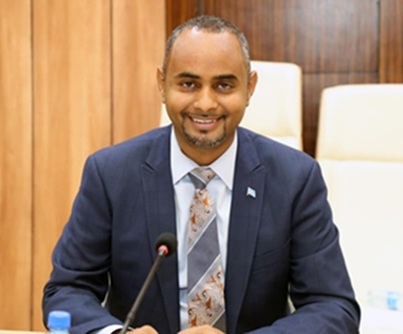
Politics often rewards ambition. Statesmanship rewards preparation. As Somalia edges toward another defining political transition, the race for the Speakership of the House of the People is shaping up to be more than a contest for a prestigious office—it is becoming a referendum on the type of leadership the country’s fragile democratic institutions desperately need. Among the names circulating in Mogadishu’s political circles, one candidate has steadily separated himself from the pack: Abdulqadir Mohamed Nur (Jama), the current Minister of Ports and Maritime Transport.
Behind the scenes, political momentum appears to be building rapidly in his favor. Sources close to ongoing consultations say Villa Somalia has intensified lobbying efforts to consolidate parliamentary support for Nur, with President Hassan Sheikh Mohamud personally engaging lawmakers and influential political figures from Southwest State, the federal member state traditionally allocated the Speakership under Somalia’s power-sharing formula.
His name, according to insiders, has already been quietly presented to key parliamentary stakeholders—a strong indication that the presidency views him as the preferred candidate for one of Somalia’s highest constitutional offices. But politics alone does not explain why Abdulqadir Mohamed Nur has emerged as the leading contender.
His greatest strength lies in something increasingly rare in Somali politics: institutional experience. Unlike many politicians whose careers have revolved around clan alliances or temporary political appointments, Nur has spent years inside nearly every pillar of the Somali state. That breadth of experience has given him a rare understanding of how government functions—and, perhaps more importantly, why it often fails.
His journey through public service has been unusually comprehensive. Before becoming a cabinet minister, Nur served as a senior adviser to the Speaker of the House of the People, where he gained an intimate understanding of parliamentary procedure, legislative drafting, committee work, constitutional practice, and the delicate balance between Parliament and the Executive.
That experience matters. Somalia’s Parliament has too often been criticized for surrendering its constitutional independence, approving controversial legislation without sufficient scrutiny, and failing to exercise meaningful oversight over the Executive. Restoring credibility to the legislature will require a Speaker who understands both the letter and the spirit of parliamentary democracy.
Nur appears uniquely positioned in that regard. Since 2021, he has continuously served in senior cabinet positions, giving him firsthand knowledge of executive decision-making, public administration, budgetary management, and inter-ministerial coordination. Few politicians seeking the Speakership can claim to have worked so extensively on both sides of Somalia’s constitutional divide.
His résumé stretches even further. Long before entering cabinet, Abdulqadir Mohamed Nur built an impressive diplomatic career, serving Somalia abroad for eight years. Rising through the foreign service to become First Counselor and Deputy Head of Mission, he later assumed the role of Chargé d’Affaires at Somalia’s Embassy in Ankara after the ambassador left to join Parliament.
Diplomatic service is often an overlooked qualification in domestic politics, yet it equips leaders with invaluable skills in negotiation, conflict resolution, consensus-building, and representing national interests under pressure—all essential qualities for presiding over a deeply divided Parliament.
Nor is diplomacy his only additional credential. Nur also served in a senior leadership role within Somalia’s National Security Service, exposing him to the complexities of national security, institutional coordination, and crisis management. That experience provides him with a broader understanding of governance than many career politicians possess. Taken together, his background spans diplomacy, national security, executive government, legislative affairs, and public administration—an unusually diverse portfolio in Somalia’s political landscape.
Leadership, however, is measured by more than titles. Those who have followed Nur’s career point out that leadership has been a consistent thread throughout his life. From his student years to his roles in community organizations and national institutions, he has repeatedly been entrusted with positions requiring organization, consensus-building, and administrative competence.
These qualities matter now more than ever. The next Speaker will inherit an institution facing perhaps its greatest credibility crisis since the adoption of the Provisional Federal Constitution. Parliament is expected to navigate contentious debates over constitutional reform, electoral legislation, federal-state relations, security, judicial oversight, and executive accountability—all while attempting to restore public confidence in democratic governance.
The office requires more than ceremonial authority. It demands political maturity, procedural mastery, patience, and the ability to command respect across competing political camps. There is also the political reality.
Under Somalia’s long-standing power-sharing arrangement, the Speakership is widely expected to remain with Southwest State. That narrows the field considerably, and within that field Abdulqadir Mohamed Nur arguably brings one of the strongest combinations of experience, national visibility, and administrative competence.
Support for his candidacy has reportedly grown not only within Mogadishu but also in Baidoa, where political leaders and community elders increasingly view him as someone capable of strengthening Southwest State’s voice at the federal level while safeguarding Parliament’s constitutional role.
Even those who disagree with President Hassan Sheikh Mohamud’s broader political agenda acknowledge that the Speakership requires someone who understands institutions rather than personalities. If Parliament is to regain its independence and credibility, the next Speaker must be willing to uphold procedure, protect legislative oversight, and ensure that constitutional principles take precedence over political expediency.
Whether Abdulqadir Mohamed Nur ultimately fulfills those expectations, should he be elected, will be judged by history rather than campaign promises. Yet based purely on qualifications, experience, and institutional knowledge, his credentials are difficult to dismiss. Somalia stands at another political crossroads. The country can continue to treat the Speakership as merely another prize in the struggle for power, or it can view it as an opportunity to strengthen one of the nation’s most important democratic institutions.
If the goal is competence over patronage, institutional memory over political improvisation, and leadership over symbolism, Abdulqadir Mohamed Nur (Jama) has made a compelling case that he deserves serious consideration. The next Speaker should not simply preside over parliamentary sessions. He should help restore Parliament itself.
Abdishakur Mohamed
Email: abdishakur37@gmail.com