
By Mohammed Hersi
For sixty-three years, a quiet lie sat at the heart of our national story that Kenya had a centre and a margin, a place that mattered and a place that merely existed. The centre got the flags, the stadiums, the presidents and the cameras. The margin the old Northern Frontier District got soldiers, suspicion, and silence.
On the first of June 2026, that lie is being buried in the red soil of Wajir, and not a moment too soon. Madaraka Day means self-rule. Power belonging to the people. It is therefore the most fitting holiday imaginable to bring, for the very first time since independence, to a region that has spent six decades being ruled rather than included.
President Uhuru Kenyatta began the practice of carrying our national days beyond Nairobi. President Ruto continued it, Embu, Kericho, Bungoma, Kwale, Homa Bay, Kitui and now, on the seventh occasion away from the capital, he has done the thing that no government before dared to do. He has brought the Republic to Wajir.
Start with the history, because it demolishes the central myth the notion that Wajir is some remote, forgotten edge of the country. Wajir was founded in 1912 by the British colonial administration, which built a fortified outpost, a boma, to guard the strategically vital shallow wells and to assert control over the Northern Frontier District. That makes it one of the oldest towns in the entire country older than almost anywhere outside the coast.
Nobody plants a garrison in a place that does not matter. Then, during the Second World War, this same town was invaded and occupied by the Italian army and became a point of bitter conflict for more than six months. African, Indian and European soldiers fought and bled here, side by side, as part of the global struggle that decided the fate of nations. Empires did not battle for half a year over an irrelevant patch of desert. They fought over Wajir because Wajir was worth fighting for. Soldiers of three continents understood its value generations ago. It is long past time the rest of us caught up.
Let us be honest about what Wajir has carried. This is a county where, in February 1984, security forces of the state herded thousands of men onto an airstrip and left them to die in the sun. By some accounts close to five thousand sons of this land never walked home from Wagalla. For decades the country looked away so when a president flies in, when the national anthem is sung at a brand-new stadium on Wajir’s own ground, understand what is actually happening: the same state that once arrived here with rifles is arriving with a flag, a parade, and a promise. That is not symbolism, That is repair.

Consider what this county did not have within living memory. Not a single inch of tarmac men and women were born, lived full lives, and were buried having never once seen a tarmacked road, never turned a tap and watched clean water run. To this day Wajir, Mandera and Marsabit are not even wired into the national electricity grid. The same grid that lights Nairobi’s billboards and Mombasa’s hotels. *You cannot lecture a region about patriotism while leaving it in the dark. Belonging is not a speech. Belonging is a road, a hospital, a light bulb, a reason for your children to stay.
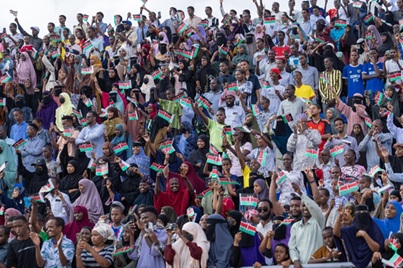
To the critics who say the stadium is misplaced. I hear them, and I reject them. A 10,000-seat stadium has risen here in record time, built by the Kenya Defence Forces, alongside an upgraded airport, new town roads, street lighting that has changed the very face of Wajir at night, and the launch of a fully equipped Level 5 hospital.
The complaint that “a stadium is the wrong priority” misses the entire point. The stadium is not the achievement. The speed is the achievement. If the state can transform a town in a matter of months when it finally decides to, then the only thing that was ever missing in Northern Kenya was the decision. Every excuse we were fed for sixty years too remote, too dry, too hard, too dangerous collapses the instant the will appears. The stadium is proof of concept. It says, this can be done, everywhere, and quickly.
There is a security message here too, and it is meant to be heard loudly. For years, terror groups have treated the North East as a no-man’s-land, a place they could roam as they pleased precisely because the state seemed absent. Planting the Republic’s flag in the centre of Wajir, parading the nation here, investing here, is a direct answer to them. Wajir is not a buffer zone. Mandera is not a frontier to be contested. Marsabit is not negotiable. These counties are Kenyas fully, permanently, non-negotiably Kenya and a population that feels it truly belongs is the strongest counter-terror force any government could ever deploy.
Let the doctors fill that Level 5 hospital. Let the roads keep coming until a child in Habaswein can travel as easily as a child in Nairobi. Let the grid finally reach Mandera and Marsabit. Let this stadium host not one national day but a hundred tournaments, festivals and conferences, giving the young a reason to build their futures here instead of joining the long, sad march to the slums of the capital. Halting rural-to-urban migration does not begin with a lecture. It begins with giving people a homeland worth staying in.
History is not being written in Wajir today. It is being corrected* Every Kenyan who believes this is one country, indivisible, should be proud to say so out loud from Nairobi to Mandera, from Mombasa to Wajir.
Wajir was never the edge of Kenya. Today, at long last, we stop pretending it was. As always I choose to remain an optimist and happy madaraka day to my fellow kenyans.
God bless kenya God bless Africa.
Mohammed Hersi
Email mohammed.hersi@outlook.com