
Mogadishu –(WDN) – The United Kingdom, which officially reopened its embassy in Mogadishu, Somalia on April 25, 2013, became the first European Union and Western nation to re-establish a permanent diplomatic presence in the country since 1991. At the ceremony, then Foreign Secretary William Hague stated, “We should be under no illusions as to the sustained efforts that will be required, in Somalia and from its international partners, to ensure that Somalia continues to make progress.” He added that ” the reopening of the embassy was a testament to the strength of UK–Somalia bilateral relations.”
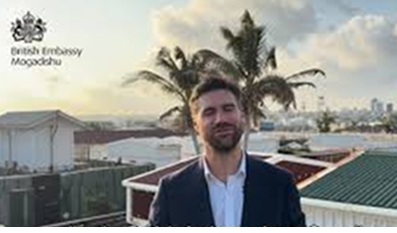
More than a decade later, the contrast is striking. Speaking candidly about his daily reality, the current UK Ambassador Charles King has described Mogadishu as one of the most dangerous diplomatic environments in the world—an assessment that stands in sharp contrast to repeated government assurances that the city is safe and stable. His account is not abstract; it is personal—and deeply unsettling.
The ambassador revealed that he moves through the city in armored, military-style convoys and routinely wears protective gear. Even his mornings, he noted, begin not with the routine of ordinary life, but with the distant roar of fighter jets. “Instead of waking up to an alarm clock, I wake up to the sound of F-16s,” he said—an image that captures the fragile and militarized reality of life in the capital.
Beyond security, the ambassador outlined the core mission of the UK Embassy: safeguarding stability, delivering humanitarian assistance, and maintaining international cooperation. He also highlighted that the British mission was among the first Western embassies to reopen in Somalia, resuming operations in 2013—a sign, at the time, of cautious optimism about the country’s recovery. But more than a decade later, his remarks suggest a far more complicated picture.
While the government of President Hassan Sheikh Mohamud continues to promote Mogadishu as a city on the path to normalization, the reality on the ground tells a different story. Persistent insecurity is compounded by rising allegations of land disputes, forced evictions, and land grabbing—issues that disproportionately affect the most vulnerable.
According to these claims, public land has largely been exhausted, and attention is now shifting toward privately owned properties, including those backed by legal documentation. Such accusations remain contested, but they continue to fuel political tension and public debate.
WardheerNews