
By Abdijaliil Osman
“He is no longer the spy chief. He is not in the cabinet. He holds no formal portfolio. Yet everywhere sovereignty is being negotiated, Sanbaloolshe is in the room.”
I. The scene in Kismayo — and what it told us
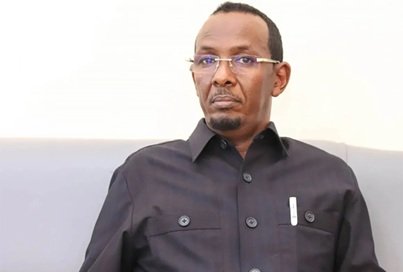
The last time I saw Abdullahi Mohamed Ali “Sanbaloolshe” in person, it was not in Mogadishu. It was not inside the headquarters of the National Intelligence and Security Agency that he had led — not once, not twice, but three times. It was in Kismayo. In the VIP section of Sayid Mohamed Abdulle Hassan International Airport.
President Hassan Sheikh Mohamud had just landed for what was his first visit to the city in close to a year, the culmination of a period of deep, at times dangerous, rivalry between Villa Somalia and Jubbaland’s administration. The handshakes were political theatre, carefully choreographed. But there, unmistakably, standing in the sovereign space of a rival administration’s stronghold, was Sanbaloolshe. Not as NISA chief. Just… there.
The question that hung over that airport reception has not gone away. Months later, last week he reappeared at Villa Somalia during one of the most sensitive rounds of talks between the federal government and the Somali Future Council, Mahad Mohamed Salad, the actual NISA director — was present. Cabinet ministers were present. And yet again, Sanbaloolshe was not merely watching. He was participating. He was consequential.
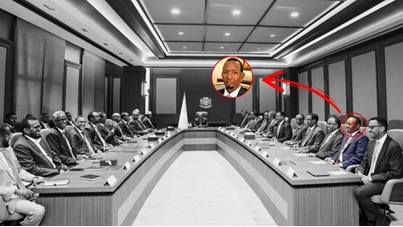
Future Counsel, Villa Somalia Mogadishu
For Somali observers trying to map formal power in their country, Sanbaloolshe represents a deeply uncomfortable anomaly: a man officially removed from the apex of the security state, yet structurally impossible to remove from the interior of political decision-making.
This piece attempts to explain why.
II. The architecture of a career: Three tenures, one pattern
To understand what Sanbaloolshe means to Hassan Sheikh Mohamud and to Somalia’s external patrons, one must first understand the unusual shape of his biography.
Abdullahi Mohamed Ali “Sanbaloolshe” is the only individual in Somali political history to have served as Director of the National Intelligence and Security Agency (NISA) on three separate occasions. He was first appointed in July 2014 by Hassan Sheikh Mohamud during his first presidential term. He was reappointed by President Farmaajo in April 2017, despite the ideological distance between the two men — a signal that his utility transcended political alignment. And in April 2024, Hassan Sheikh, now returned to Villa Somalia for a second term, brought him back again, replacing the outgoing Mahad Mohamed Salad.
He brings a wealth of experience, having held the position twice before, and has also served as a minister, a member of Parliament, and an ambassador. That official framing from the Cabinet understates the point. What Sanbaloolshe possesses is not simply technical experience. It is network capital — the accumulated trust, intelligence, and leverage that accumulates only through decades of operating at the precise intersection of security, politics, and foreign relations.
His third stint at NISA, however, ended abruptly. Somalia’s federal cabinet reappointed Mahad Mohamed Salad as director of NISA in June 2025, replacing Sanbalooshe. Sources close to the presidency indicated that growing tensions over operational direction, leadership style, and internal disagreements ultimately prompted the decision.
The official language was courteous. The political reality was something sharper.
III. The paradox: Why Hassan Sheikh removed him — and why he cannot release him
The removal of Sanbaloolshe from NISA in June 2025 was not a sign of his diminished power. If anything, it was a confession of it.
Sources with proximity to Villa Somalia’s inner circle suggest the decision followed a pattern Hassan Sheikh has deployed before: when a figure accumulates too much institutional weight, too many weapons, too many sub-clan loyalties reinforced through security appointments, too many direct lines to foreign capitals, the president moves them out of the apparatus before they become a parallel power centre.
The calculus here is not complicated. Sanbaloolshe’s political base is in Hiran and the Hawadle clan network, situated within Hirshabelle State. The problem for the federal government is that because of the multiple entities claiming to represent Hawadle interests in Hiran, bargaining with any one group is difficult as other groups may turn to Ethiopian support. A NISA director with deep clan roots, weapons distribution authority, and direct access to foreign intelligence partners, specifically Ethiopia and the UAE — represents, in the logic of Mogadishu’s political marketplace, not just an asset but a latent threat.
The concern, multiple sources indicate, is Hirshabelle. Specifically: the fear that Sanbaloolshe was positioned to build what would effectively become a third autonomous power bloc in Somalia, a militarily capable, externally sponsored Hirshabelle that could challenge Villa Somalia from the inside, in the same way Jubbaland and Puntland challenge it from the periphery. A well-armed, Ethiopia-backed regional strongman in the heart of the country, that is the scenario Hassan Sheikh needed to pre-empt.
And yet,here is the paradox — the same qualities that made him dangerous as a NISA director make him indispensable as a free agent. Removing him from the institution does not neutralise his network. It merely relocates it. And a powerful network operating outside formal structures, if not kept close, will inevitably be captured by those who wish to deploy it against you.
Hassan Sheikh is keeping Sanbaloolshe under his wing not out of affection. He is doing so out of strategic necessity. In Somali political theory, there is a concept worth invoking here: the man you cannot kill, you must feed.
IV. The foreign dimension: Ethiopia, the UAE, and the politics of gatekeeping
To understand Sanbaloolshe’s staying power, one must look beyond Mogadishu to Addis Ababa and Abu Dhabi. This is where the deeper architecture of his influence becomes visible.
Somalia’s political marketplace has long operated through a system of what analysts describe as externally-sponsored gatekeepers, local elites who serve as reliable interfaces between foreign powers and Somali political outcomes. Somalia is an arena in which multiple external disputes and tensions play out. Throughout the lifespan of the federal arrangement, some federal member states have also maintained international relations on their own terms and often to the displeasure of the federal government.
Ethiopia and the UAE, despite their often divergent strategic interests in the broader Horn of Africa, share one operational interest inside Somalia: maintaining reliable asset to Somali political decision-making through figures they trust. As the older generation of their preferred interlocutors fades, both Addis Ababa and Abu Dhabi face a structural challenge: their traditional circles of influence are contracting.
Sanbaloolshe, according to well-placed sources, represents one of the few figures who maintains credible standing with both capitals simultaneously. His relationships are not merely transactional. They are historical, built through intelligence cooperation, political patronage, and shared strategic interests over more than a decade of intelligence leadership.
This is what explains one of the most revealing episodes of recent Somali diplomacy. When Hassan Sheikh Mohamud’s government severed all agreements with the United Arab Emirates, annulling deals spanning key port operations, security cooperation and defence, citing “harmful actions” that undermine the country’s unity and sovereignty — it was not a career diplomat who was dispatched to Abu Dhabi to manage the fallout. It was Sanbaloolshe. An MP with no formal portfolio. The message he reportedly carried was a request: stop sidelining the federal government. The UAE’s reported response was conditional: “Reverse the decision.“
That episode tells us everything about what Sanbaloolshe is to Hassan Sheikh in the current architecture of Somali foreign policy: he is a back-channel diplomat who operates beneath the threshold of official accountability, making him both more flexible and more effective than any formal envoy in sensitive negotiations with Gulf partners who distrust the current Mogadishu leadership.
V. The Jubbaland connection — and what it means for federal authority
There is another dimension to Sanbaloolshe’s regional leverage that has received insufficient attention: his relationship with Jubbaland President Ahmed Mohamed Islam.
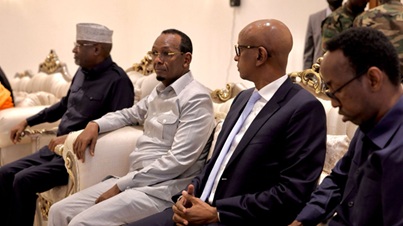
The two men are described by sources close to both as friends, a relationship that cuts across the formal antagonism between their institutional positions. Madobe is, by any credible analysis, the leader most closely associated with resistance to federal government authority in recent years.
For Hassan Sheikh, the Sanbaloolshe-Madobe relationship cuts both ways. On one hand, it represents a potential vulnerability: a figure within his orbit who maintains warmth toward his most troublesome federal member state president. On the other hand, it represents an asset: when Hassan Sheikh needs a message delivered to Kismayo that cannot travel through official channels without being read as aggression, Sanbaloolshe can carry it.
The Kismayo airport visit was not incidental. It was operational.
VI. The JW Marriott question — money, security, and political exile in Nairobi
Political power in Somalia does not sit exclusively in Mogadishu. It circulates through Nairobi, through Dubai, through Addis Ababa. Those who understand this geography of influence understand how Somalia actually functions.
Sources indicate that when Sanbaloolshe is in Nairobi, his accommodation of choice is the JW Marriott Westlands, a property priced at approximately $400 per night, with the security infrastructure, discretion, and international-class amenities that the Somali political elite has come to regard as the standard for serious off-record conversations.
This is not incidental. The choice of venue — beyond what it suggests about resources — is a statement of operational culture. Serious conversations, in the world Sanbaloolshe inhabits, do not happen in Mogadishu hotels or government offices. They happen in neutral, well-secured, internationally connected spaces where foreign intelligence services, regional intermediaries, and political brokers can meet without the theatrical complications of formal protocol.
The fact that Sanbaloolshe continues to occupy this operational infrastructure even after his NISA departure is one of the clearest signals that his removal from the institution did not constitute removal from the game.
VII. The Hirshabelle ambition — and the line Hassan Sheikh drew
One chapter of this story has not yet been formally reported. According to sources with knowledge of internal Villa Somalia discussions, the precipitating concern behind Sanbaloolshe’s removal from NISA was not merely operational friction. It was a longer-term threat assessment.
The concern: that Sanbaloolshe was pursuing a quietly ambitious project in Hirshabelle, weaponising his sub-clan networks, securing Ethiopian military and logistical support, and positioning himself as a future power broker of a strengthened Hirshabelle State. In the geography of Somali politics, a strong Hirshabelle, located in the country’s agricultural heartland, astride the Shabelle River basin, adjacent to the capital, is not a peripheral threat to federal authority. It is a central one.
Ethiopia and the UAE both have a documented strategic interest in sustaining what researchers describe as a system of competitive federalism in Somalia, a structure in which no single actor, including the federal government, accumulates unchecked authority. The multiple entities claiming to represent Hawadle interests in Hiran create a situation where bargaining with any one group is difficult as other groups may turn to Ethiopian support.
The concern in Villa Somalia was structural: that Sanbaloolshe, if allowed to consolidate power in Hirshabelle with external military backing and regional financial networks behind him, could evolve into a federally unmanageable regional power centre, one capable of resisting federal authority and effectively vetoing national decisions from within the system.
Hassan Sheikh moved before that architecture could be completed. He removed Sanbaloolshe from NISA. But he did not — could not — remove the architecture itself. The networks remain. The foreign relationships remain. The clan capital remains. The weapons reportedly distributed through intelligence channels do not disappear when the director’s chair is vacated.
This is the bind Hassan Sheikh now lives with: he removed a man he feared, but the removal did not neutralise the fear. It merely changed its location.
VIII. Strategic takeaway — what this means for Somalia’s sovereignty
At its deepest level, the story of Sanbaloolshe is not merely a story about one man. It is a story about the structural condition of sovereignty in Somalia.
The International Crisis Group, Chatham House, and academic researchers at the London School of Economics have all documented a consistent pattern: Somalia’s federal arrangement has been shaped, from its inception, not purely by the preferences of Somali citizens, but by the overlapping interests of neighbouring states and Gulf powers who require reliable access points within Somali political structures. Somalia’s political settlement was based on an elite bargain structured around a federal system, with the federal government as the highest authority. However, throughout the lifespan of this federal arrangement, some federal member states have maintained international relations on their own terms and often to the displeasure of the federal government.
Sanbaloolshe is not an anomaly within this system. He is its clearest living expression. He is what the system produces when foreign interests, clan capital, intelligence infrastructure, and political survival instinct are combined in a single individual across three decades of operation.
The question for Somalia’s reformers, whether in parliament, in civil society, or in the diaspora — is not simply “why does Hassan Sheikh keep Sanbaloolshe close?” The more structurally important question is: why does the system keep producing men like Sanbaloolshe, and what would it take to build institutions strong enough that no single individual could accumulate this kind of unaccountable, unelected, externally-funded structural power?
Until that question receives a serious answer, Sanbaloolshe, or whoever succeeds him in this structural role, will remain exactly where he is: not in any official portfolio, but in the room where the decisions are actually made.
Abdijaliil Osman
Email: abdijalilosman@gmail.com
————
Abdijaliil Osman is the Founder and Host of The Abdijaliil Show, Somalia’s leading podcast. A former BBC producer and award-winning journalist, he has been reporting on Somali politics and geopolitics for 10 years.
________
Related Articles
Muqdisho blasts: Tears were our only hope By WardheerNews
MP Gurey’s threat over Sanbaloolshe’s dismissal By Ahmed A. Yusuf