
By Abdullahi A. Nor
As Somalia’s leadership grows increasingly insulated, the gap between perception and reality is widening, raising fears of institutional breakdown at a critical national moment. When power stops listening, history suggests the fall is not gradual, it is sudden.
There is an old story from the era of the Buyid dynasty. A prince fell into a delusion, convinced he was a cow. He refused food, demanded to be slaughtered, and rejected anyone who tried to bring him back to reality. The more people insisted on the truth, the further he drifted from it.
It was only when the great physician Ibn Sina changed strategy—entering the prince’s reality rather than confronting it—that recovery began. By working within the illusion, he gradually guided the prince back to reason. It is a story about the fragility of perception. Today, it feels less like history and more like a warning.
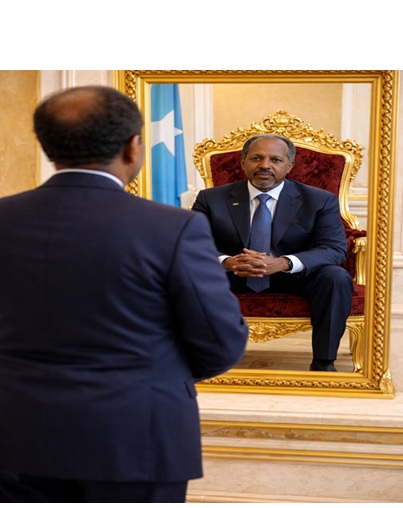
Somalia now stands at a moment where perception and reality risk drifting dangerously apart. Under the leadership of Hassan Sheikh Mohamud, critics argue that governance is increasingly shaped by insulation rather than inclusion.
A presidency surrounded by its own narrative. A system that reinforces itself. A political environment where dissent is treated as disruption, not dialogue. When federal states push back, they are framed as obstacles. When opposition voices raise alarms, they are dismissed as political noise. When citizens question direction, they are met with silence—or force. This is how distance forms—not geographical distance, but political and psychological distance between leadership and reality. And history shows that such distance is rarely harmless.
Throughout modern history, there have been moments when leaders—whether through illness, isolation, or unchecked power—lost touch with the realities they governed.
In the final years of Robert Mugabe’s rule in Zimbabwe, decision-making became increasingly detached from economic reality. Policies continued long after their consequences—hyperinflation, mass unemployment, and institutional collapse—were evident to everyone else. What remained was not control, but the illusion of it.
In another context, Ferdinand Marcos presided over a system where loyalty replaced accountability. Surrounded by a tight inner circle, dissenting voices were excluded. Over time, governance ceased to reflect the country’s reality and instead mirrored the narrative of power itself—until the system collapsed under the weight of its own contradictions.
Even in more extreme historical cases, such as Adolf Hitler in the final days of World War II, the consequences of detachment became catastrophic. Military decisions were made based on imagined capabilities rather than actual conditions. Advisors feared contradiction. Reality itself became negotiable—until it could no longer be ignored.
These examples are not identical to Somalia’s situation. But they illustrate a consistent pattern: when leadership becomes insulated, reality becomes optional—and that is when systems begin to fail. Somalia today shows early signs of that dangerous drift.
The mandate of the House of the People expired on April 14, 2026, leaving a constitutional vacuum at the center of the state. President Hassan Sheikh Mohamud’s term is set to end on May 15, 2026. Two pillars of governance—legislative and executive—are approaching expiry within weeks of each other, without a clear or agreed transition. This is not just a legal technicality. It is a structural fault line.
Beyond Mogadishu, the federal system is visibly fracturing. South West State has been effectively sidelined, while other regional administrations are either operating outside the federal framework or consumed by internal disputes. What was designed as a balanced federal arrangement now appears increasingly fragmented.
At the core lies an unresolved constitution. Without agreement on the rules, every political process becomes contested. Elections—arguably the most critical mechanism of legitimacy—remain undefined. There is no shared framework, no consensus, not even clarity. And when the rules are unclear, power fills the gap. For ordinary Somalis, these failures are not theoretical.
In Mogadishu, vulnerable communities have been displaced as bulldozers clear land once called home. Families who had little are left with nothing. Across the country, unemployment and economic hardship are no longer temporary conditions—they are structural realities. Trust in institutions, already fragile, continues to erode.
At the same time, Somalia’s external environment is becoming more complex. The northern regions are increasingly exposed, attracting competing interests from actors such as Israel, Ethiopia, the United Arab Emirates, and Taiwan. Each engagement may carry its own logic. But collectively, they highlight a deeper issue: a state struggling to assert unified control over its own strategic space.
There is a reason political thinker have long warned about the dangers of unchecked power and isolation. The philosopher Montesquieu once wrote, “Constant experience shows us that every man invested with power is apt to abuse it.” It is not a moral judgment—it is a structural observation. Power, without balance, bends toward excess.
Similarly, Lord Acton’s famous line remains relevant: “Power tends to corrupt, and absolute power corrupts absolutely.” But corruption here is not only financial—it is also perceptual. It alters how leaders see the world, and how the world is presented to them.
When those in power hear only affirmation, reality becomes filtered. When institutions fail to correct course, errors compound. And when that happens, decline often appears gradual—until it suddenly is not. Somalia has lived through that kind of moment before.
The collapse that followed the fall of the military government—the Somali Civil War—did not arrive without warning. It was preceded by years of institutional erosion, political fragmentation, and a widening gap between leadership and the governed. Today’s Somalia is not a repetition of that history. But the structural echoes—constitutional uncertainty, political division, weakened institutions—are difficult to ignore.
This is where the lesson of Ibn Sina becomes relevant again. He did not defeat illusion through confrontation. He understood that reality must sometimes be restored indirectly—through engagement, patience, and strategy.
For Somalia, the challenge is not simply to argue over who is right or wrong. It is to rebuild a shared sense of reality—a common understanding of the rules, the process, and the direction of the state. That requires something increasingly rare in the current climate: listening. Not selective listening. Not performative dialogue. But genuine engagement with voices beyond the inner circle of power. Because governance, at its core, is not about asserting control—it is about maintaining trust.
Somalia now stands at a narrowing crossroads. The coming weeks—marked by constitutional deadlines and rising political tension—will be decisive. Whether the country moves toward consensus or deeper confrontation remains uncertain. But the risks are clear.
When constitutional order collapses, authority becomes contested. When authority is contested, fragmentation deepens. And when fragmentation deepens, instability becomes systemic. The illusion, in such moments, is that control can be maintained through force or denial. History suggests otherwise.
The composition of Somalia’s current national army—drawn largely from Mogadishu-based Hawiye clans—raises a concern that cannot be ignored: in a moment of political rupture, the risk of fragmentation along clan lines is real, not remote.
There is precedent. The “Badbaado One” protest, led in part by the current president while in opposition, demonstrated how quickly political disputes can take on a militarized, clan-inflected dimension. Security forces were not immune to those pressures then—and there is little evidence they would be now.
Today, opposition figures appear to be calculating along similar lines, anticipating that clan loyalties within the ranks could translate into defections should tensions escalate—what some are already informally describing as a potential “Badbaado two” in the making.
In 2021, a crisis was ultimately defused when former president Mohamed Abdullahi Mohamed stepped back and offered concessions, easing the immediate confrontation. Whether a similar de-escalation is possible this time—and whether the current leadership would choose that path—remains an open question.
What is clear is this: when political conflict begins to map onto the structure of the security forces, the line between state authority and factional allegiance becomes dangerously thin.
Somalia still has that chance. But time, like reason, is not unlimited. And the longer illusion is allowed to stand—unchallenged or uncorrected—the harder it becomes to return. Because when the curtain finally falls, it does not wait for readiness.
Abdullahi A. Nor
Email: abdulahinor231@gmail.com
Leave a Reply