
By Abdiqani Haji Abdi
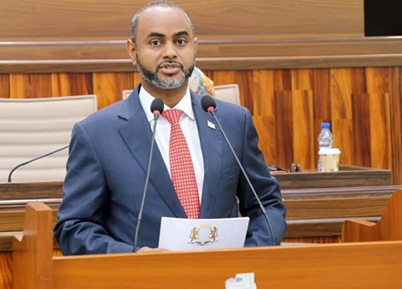
Abdulkadir Mohamed Nur (Jaamac), the newly Speaker of Somalia’s Federal Parliament selected on 10 August 2026, has risen rapidly through the country’s political ranks, having held various positions under the administrations of both former President Mohamed Abdullahi Farmaajo and President Hassan Sheikh Mohamud. His elevation to the speakership followed what appears to have been a carefully orchestrated political plan led by Hassan Sheikh, under which Nur was controversially fast-tracked into Parliament and subsequently positioned to assume the Speaker’s seat.
The speed and apparent ease with which he secured the powerful position have raised serious questions about the political calculations behind his rise and the extent to which parliamentary leadership has become a product of executive influence rather than an independent, transparent process.
Jaamac has increasingly involved himself in matters that fall outside the scope of his official responsibilities. He wants the Federal Government to hold African Union peacekeepers accountable for losing territory in South West State. He also wants neighboring Kenya to act against people he describes as terrorists who allegedly continue to live openly in the country.
But before Jaamac lectures peacekeepers and neighboring governments about their responsibilities, he should answer a more uncomfortable question: what responsibility does he bear for the political decisions that helped bring South West State to the brink of war?
The crisis did not emerge from a political vacuum. It developed amid a struggle over who has the authority to govern South West State, who determines its political future and whether Mogadishu can effectively decide who leads a region whose people have their own political interests, institutions and aspirations.
Jaamac’s critics accuse him of being a driving force behind the removal of the administration led by former South West President Abdiaziz Hassan Mohamed Lafta-Gareen. They argue that the political transition served President Hassan Sheikh Mohamud’s interests by opening the way for a more compliant regional administration—one that could help the Federal Government secure its preferred political outcomes, including support in the coming election.
These are serious facts, and the precise roles, motives and electoral calculations involved wait to be seen in the near future. But the fundamental political issue cannot be brushed aside: a regional administration cannot secure lasting legitimacy simply because Mogadishu wants it in power.
South West State is not a political possession of the Federal Government. Its people are not spectators in a contest between national politicians. They have a legitimate interest in determining who governs them and how their political institutions are constituted.
When that principle is disregarded, resistance should hardly come as a surprise.
The Consequences of Imposing Political Authority
The people of South West State have endured years of insecurity, political uncertainty and the devastating effects of conflict. They have little to gain from another struggle in which competing political leaders use armed forces to settle disagreements over authority.
Yet the dispute over the region’s leadership has become increasingly militarized. The Federal Government has deployed forces into a politically contested environment, while armed forces aligned with Lafta-Gareen have advanced in parts of the region. Reports of territorial changes and clashes in Bay, Bakool and Lower Shabelle underline the danger facing civilians.
Supporters of Lafta-Gareen describe the mobilization as a liberation struggle against federal interference. They argue that the movement reflects local opposition to an administration they regard as imposed from Mogadishu, and they point to reports of residents welcoming its forces in areas where federal-aligned forces have withdrawn.
The scale and meaning of that public support require needs no verification as the elders and the residents of the concerned liberated districts were marching hand in hand with the liberation forces. Nevertheless, the political grievance at the heart of the conflict deserves to be taken seriously rather than automatically dismissed as terrorism.
If Jaamac and other federal leaders helped drive a political transition that a substantial section of the population rejects, they cannot expect military deployments alone to erase that opposition. Nor can they reasonably demand that peacekeepers solve a political problem that political leaders themselves helped create.
The central mistake was to treat control of the regional administration as a prize to be secured in Mogadishu, rather than a question requiring legitimate political consent in South West State.
When Every Opponent Becomes a Terrorist
One of the most damaging features of Somalia’s political crisis is the growing tendency to portray opposition to the Federal Government as synonymous with terrorism.
Al-Shabaab is a terrorist organization, and the fight against it remains essential to Somalia’s security. But that does not mean every armed opponent of the Federal Government belongs to Al-Shabaab, nor does it mean every political challenge to President Hassan Sheikh’s authority constitutes a terrorist threat. Those distinctions matter.
When the government labels its opponents as terrorists without presenting credible evidence, it risks turning counterterrorism into a political weapon. It also undermines the credibility of genuine operations against Al-Shabaab, whose violence has caused immense suffering among Somali civilians.
The forces aligned with Lafta-Gareen must be judged by evidence of their affiliations and conduct, not simply by their opposition to Mogadishu. Equally, their claims to represent a popular liberation movement is tested against the long duration and their treatment of civilians up to now is even more than one can expect in war situation.
The Federal Government cannot claim the moral authority to defend Somalia’s people while treating every challenge to its preferred political order as an enemy to be crushed. Opposition is not proof of terrorism, and federal authority is not a substitute for political legitimacy.
If Jaamac believes particular individuals or armed groups are involved in terrorism, he should present credible evidence and support lawful investigations. Political labels cannot replace proof, and accusations cannot become a license for military action against communities whose principal grievance may be who governs them.
Why Is Jaamac Demanding Accountability From Peacekeepers?
Jaamac has questioned why areas where peacekeeping forces were present subsequently fell to armed groups. His demand for answers is legitimate in principle. International missions must explain their performance, and any failure to fulfil their responsibilities should be examined. But accountability cannot be selective.
The African Union Support and Stabilization Mission in Somalia (AUSSOM) has a mandate focused on supporting Somali security forces, combating Al-Shabaab, protecting civilians and contributing to stabilization. It is not supposed to determine the political leadership of Southwest State or become an instrument in the Federal Government’s domestic disputes.
If peacekeepers failed to protect a particular locality, the facts should be established. The loss of territory alone, however, does not prove that they deliberately abandoned it or acted in support of one faction. More importantly, international security partners should not be expected to compensate indefinitely for the consequences of political decisions made by Somali leaders.
Jaamac’s demand for accountability would carry greater weight if it were accompanied by an equally serious examination of the decisions that brought South West State into its present crisis.
A politician who helped create the conditions for a conflict and then present himself as merely an observer of its consequences. That is the political question Jaamac must confront.
Foreign Military Power Must Not Become a Tool of Domestic Politics
The South West crisis also raises concerns about Somalia’s reliance on foreign military support. AUSSOM’s role should be assessed according to its mandate and conduct. The same standard must apply to Türkiye and every other foreign partner involved in Somalia’s security affairs.
Turkish-supported military operations have caused civilian casualties, failed assassination of opposition leaders and that military capabilities have been used against political opponents. Such actions that resulted the burning of the Turkish Flag in the SWS and Jubaland can’t be excused by Speaker Jama if he has an iota of empathy for his people. The Turkish actions raise an important principle: foreign military assistance intended to protect Somalia must not become a means of determining which Somali political faction prevails.
A foreign partner’s strategic relationship with Mogadishu cannot exempt its conduct from scrutiny. Nor should international forces be drawn into a conflict over regional leadership unless their actions are clearly justified by their lawful mandate.
The purpose of international assistance should be to protect civilians, combat genuine security threats and help establish conditions for political stability—not to enforce a contested political arrangement.
Somalia’s sovereignty means more than the authority of the Federal Government to issue orders. It also means that the country’s political institutions must operate within legitimate constitutional arrangements and respect the political rights of its people.
The Electoral Calculation Behind the Crisis
The dispute becomes even more consequential when viewed against Somalia’s wider political transition. Opponents of President Hassan Sheikh argue that securing a more compliant administration in South West State would help the Federal Government influence the coming electoral process and secure political support from the region’s representatives. They see the removal of Lafta-Gareen not as an isolated regional dispute but as part of a broader struggle over the institutions and political alliances that may determine the next national leadership.
The reality that the transition was designed to manufacture one-sided electoral support enjoys the belief of the masses of SWS. Nevertheless, it points to a serious risk: when regional administrations are treated as instruments for securing national political advantage, the electoral process itself becomes a source of conflict.
Elections are supposed to resolve disputes through agreed rules and legitimate procedures. They cannot fulfil that purpose if political leaders attempt to settle the contest in advance by reshaping regional authority to their advantage.
If President Hassan Sheikh’s government wants its electoral process to be accepted as legitimate, it must demonstrate that the rules are fair, that regional political institutions are not being manipulated for partisan purposes and that opposition groups can participate without being treated as security threats. Military control cannot manufacture electoral consent.
South West State Must Not Pay for Mogadishu’s Political Ambitions
The most important voices in this crisis are those of the civilians living through it. They face the consequences when armed forces advance, towns change hands, families flee their homes and public services collapse. Their interests cannot be reduced to the competing claims of federal politicians or regional factions.
If the people of South West State reject an administration they believe has been imposed upon them, the answer must be a credible political process that allows their grievances to be heard and their leadership to be determined through legitimate means. That process must also protect minorities, prevent reprisals and respect the rights of communities that support different political positions.
Lafta-Gareen-aligned forces, federal forces and every other armed actor must be held accountable for abuses against civilians. No claim of liberation, federal authority or counterterrorism can justify unlawful violence.
But lasting peace will remain elusive if the Federal Government insists that military pressure can settle a dispute rooted in political legitimacy.
Mogadishu must recognize that Southwest State is not a territory to be administered according to the preferences of the president. It is a community whose people have a legitimate stake in choosing their leaders.
Jaamac Must Answer for the Political Choices He Helped Advance
Jaamac’s latest remarks focus on the responsibility of peacekeepers and the presence of alleged terrorists in Kenya. Yet the more pressing issue is the responsibility of Somalia’s own political leaders for the crisis unfolding in South West State.
If Jaamac played the decisive role his opponents attribute to him in removing Lafta-Gareen’s administration, he must explain why that course was pursued, what legitimate political process supported it and how the resulting confrontation was anticipated to be avoided.
If the Federal Government believed the political transition was necessary, it must explain how the process respected the rights and political choices of South West communities. And if the authorities believe the forces opposing them are terrorists, they must provide evidence rather than rely on labels that blur the distinction between terrorism and political resistance.
The burden of responsibility is particularly heavy for those who exercise state power. The Federal Government controls national institutions and commands forces that must serve the public, not merely the interests of the incumbent administration.
It is therefore not enough to demand that international partners contain the consequences of a domestic political crisis. Somali leaders must be prepared to examine their own decisions and accept that an administration’s political survival cannot take precedence over the security and rights of the people it claims to govern.
South West State does not need a government imposed by Mogadishu and defended by force. It needs legitimate leadership, political consent and security institutions that protect its people.
Jaamac’s call for accountability should begin with a frank examination of how the crisis developed—and of the responsibility borne by those who helped bring it about. Until that happens, demands for military intervention and accusations of terrorism risk deepening the very conflict they claim to resolve. The people of South West State should not have to fight another war simply to make their political voices count.
Leave a Reply