
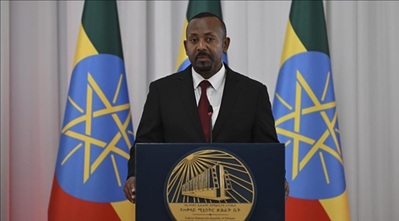
ADDIS ABABA (WDN) — Ethiopian Prime Minister Abiy Ahmed has claimed that Jigjiga, the capital of Ethiopia’s Somali Regional State, has overtaken Eritrea’s capital, Asmara, in its current state of development. His remarks highlight Jigjiga’s growing profile while sharpening the contrast he draws between Ethiopia’s regional development and Eritrea’s economic difficulties.
In a reported interview, Abiy said Eritrea had more than 300 factories when it was part of Ethiopia and that its cities were once known for their beauty and development.
“Before independence, when Eritrea was part of Ethiopia, it had more than 300 factories. Eritrean cities were very beautiful, but today they look like villages,” he said, according to the reported remarks.
Abiy cited Asmara as an example of what he described as Eritrea’s decline, arguing that the city now compares unfavourably with Jigjiga.
Jigjiga’s Growing Profile
Jigjiga has undergone visible urban development in recent years, with investment in roads, public spaces, commercial facilities and other infrastructure. These projects have strengthened its role as the Somali Region’s administrative centre and an increasingly important hub for business and public services.
Its transformation reflects wider efforts to develop Ethiopia’s regional capitals and expand economic activity beyond the country’s largest urban centres. However, Jigjiga’s progress should be considered alongside developments in other regional cities, including Hawassa, Bahir Dar, Adama and Mekelle, each of which has its own economic strengths and development challenges.
Determining which city is more developed requires reliable comparisons of industrial activity, employment, infrastructure, public services and living standards. Urban appearance alone cannot establish overall economic performance.
Eritrea’s Economic Challenges
Eritrea has a long industrial and urban history, shaped by Italian colonial rule and its subsequent period under Ethiopian administration. Its economic trajectory since independence has been affected by conflict, prolonged military mobilisation, restrictions on economic activity and limited access to international investment.
However, Abiy’s historical figure of more than 300 factories requires independent verification, as does any assessment of how many remain operational today. Asmara also retains considerable architectural and historical significance, even as Eritrea faces broader economic challenges.
His comparison is therefore best understood as a political assessment of the two cities’ development trajectories rather than conclusive evidence that Jigjiga surpasses Asmara across all economic and social indicators.
Development Amid Regional Tensions
Abiy’s remarks come amid strained relations between Ethiopia and Eritrea, with disagreements over regional security, the legacy of the Tigray conflict and Ethiopia’s pursuit of access to the Red Sea adding to tensions.
The two governments have exchanged accusations over security and support for armed groups, raising concerns about the possibility of renewed confrontation in the Horn of Africa.
Against this backdrop, the comparison between Asmara and Jigjiga carries significance beyond urban development. It allows Ethiopia’s prime minister to contrast the progress he attributes to an Ethiopian regional capital with the difficulties facing neighbouring Eritrea.
Ultimately, Jigjiga’s progress should be judged by whether urban investment produces lasting benefits: more jobs, stronger public services, improved infrastructure and better living standards.
Jigjiga’s growing prominence reflects the potential of Ethiopia’s regional cities. But the scale of that progress—and how it compares with Asmara—must be established through evidence, not political rhetoric alone.
WardheerNews
Leave a Reply