
By Aden M. Ismail
Introduction.
This essay is prompted by another published in WardheerNews on the “Incomparability” of Turkey’s relations with Somalia by Omar A Shire. Its argumentative spine is that Somalia’s recovery cannot be outsourced, just as its collapse cannot be entirely blamed on external factors. The problem is a chronically underdeveloped local political culture always looking to externalities to fill the inherent emptiness of its actors. The essay condenses three parts into two headlines. The first is an itinerary of the “lost century,” a procession of Somalia’s political failures; the second concurrently examines how Turkey’s involvement is not distinct from preceding foreign interventions but only rides on a deft sophistication; and the final section offers a few suggestions on pivoting Somalia’s political trajectory lest the society inherits another miserable century. Throughout, the essay avoids moderation to fit academiness, because moderation is too often a euphemism for evasion or worse, proxyism—habits that have come to characterize a burgeoning Somali intellectual community.
The Mechanics of the Lost Century
In a century-long continuum of political history, Somali society has been caught between a traditional order that failed to achieve internal political consolidation and adaptation crises to external innovations meant to fill the void. In pre-colonial times, the clan elders, as the traditional wielders of power, failed, due to provincialism, to organize the nation, individually or through consensus, into an overarching patrimonial polity capable of subsequent institutional evolution. At the same time, they deprived the religious camp of political agency and confined it to ritual and moral functions. This meant a dual limitation that ensured that neither lineage nor religious authority could scale into a unifying political order. As a result, Somali society effectively bypassed —or was disrupted from—a critical formative stage that societies who achieved indigenous political maturation have historically passed through.
This structural malnourishment was later only symptomatically managed by colonialism, which facilitated the rise of a state that was less a practical response to societal needs than an expression of a momentary abstract passion, with actors who were the proverbial sheep in a leopard’s skin. Its administration was bequeathed to politico-military establishments which, despite inheriting the coercive apparatus of power, were disinclined to wean themselves off hollow traditionalism, much less jumpstart modernisation. The result was a superstructure under which politico-military, clan, and clerical actors, with financial and foreign interests often interluding, coexist in a stagnant equilibrium. Their alternating and at times mutually reinforcing competition has rendered the Somali political space a disordered arena resistant to any institutionalized political order.
The causal factors of its rise notwithstanding, an aberration has been the proto-nationalist Sufi clerical movement under Sayyid Muhammad attempting to wrest political power from the clan patriarchs colluding with encroaching colonial powers. The Dervish disrupted the patriarchal order through uniting tribally diverse men on an ideological rather than genealogical basis to momentarily redirect the impulses of Somali political mobilization. The movement was thus far more consequential than the reductive ‘resistance’ label assigned by colonial literature, but represented an embryonic attempt at internal political reordering that emancipated the clerics from confinement to ritualism and propelled them toward founding what might have indubitably become a theocratic Somalia, only had history been left to its natural course. Its defeat left the colonial victors with an uncontested leeway to design the foundational contours of Somali politics and elevated illiterate clan elders and semi-educated youth to manage the complexities of a state beyond their comprehension.
The absence of a principled and intellectually grounded political class created a permissive space for patriarchal figures in the post-independence decade. Ever nostalgic for antiquated lordship, and further conditioned by colonial accommodation, the elders retained unchecked political influence by enabling politicians to mobilize grassroots through clan sentiments, aborting democracy at its inception. A subsequent military regime, though relatively less beholden to patriarchal and clerical authority and animated by a form of transcendental nationalism, was crippled by its depositing of a Judeo-Germanic intellectual haemorrhage on a society whose bulk could barely scribble names with mother tongue, along with tyrannical excesses and systemic storms. At the height of its rule, it encountered an adversarial revolutionary political Islam sweeping across much of the Muslim world, offering an alternative moral source of legitimacy to societies governed with secular outlook.
The regime’s domestic oppression, loose relation to traditional centers, and clash with militant political Islam subjected it to a crisis of legitimacy that precipitated its downfall. Then, in a familiar recurrence of the cycle, albeit in a different ideological fashion, a clerical order bulldozed its way into power centers. To the profound shock of many, the defining flaw of the Salafi order, unlike its Sufi predecessor, was its attempt to remake society not within the confines of its identity, but under an eschatological Islam incompatible with the society’s ethno-nationalist psychological makeup. Nonetheless, whatever might have become of it, a coalition of clan elders, remnants of the military regime, and a novel civil-war political class negotiated the federal system externally.
On this basis, the federal arrangement did not arise from organic political development, but from a convergence of situational social anxiety, group opportunism, and external pressures to manage Somalia’s woes. In essence, it marked a resurgence of the post-independence decade political clientelism, in which elders legitimize while politicians govern a skeleton-like state. Only that this time, the arena has been widened vast enough to accommodate every identity marker, including clerico-materialists and foreign patrons as new stakeholders in a system that has converted Somalia into a corporate enterprise and kept the society in a state of ‘igar/igadh’ — stimulated just enough to yield to the illusion, but always denied full regeneration.
Thus, Somalia has survived a century of external experiments layered upon an internally unconsolidated socio-political base, making the society ever politically adrift and postponing maturation. Somali political discourse, therefore, goes deeper than the minimalisms of constitution-making, leadership flaws, electoral crises, and divisions over federalism, centralism or secessionism—debates that reflect clan reactionalism than coherent political discourse. They are only surface manifestations that deflect attention from the structural malaise of a society whose untapped potential to develop an endogenous political order makes it operate in the shadow of externalities, and in the process, lose touch with its historical mission. This foundational dislocation is the central paradox of Somalia’s lost century, and still inevitably bound to be repeated consciously or unwittingly.
The Transition of Two Illusions and the Exit Gate
At present, two externalities are exchanging hands on the Somali political stage, different in form but identical in substance. The federal experiment midwifed by Ethiopia with Western bankrollers, and fused traditionalism with sham institutionalism, has exhausted its legitimacy to kleptocratic pluralism. It failed even on its basic test of inclusion and service devolution, instead accommodating predatory networks whose relevance depends on Somalia’s irrelevance. Abandoned by the mass of society and many of its foreign sustainers, what remains of federalism is a hollowed-out space of cliques next to outcasts, both at the center and in the regions. Similarly, the Salafi-jihadi project typified Al Shabaab, mortgages itself to universal utopianism essentially irreconcilable with the Somali socio-political aspirations, though it constitutes a force in the near term. In the place of the two, a centrally coordinated synthetic political Islam is taking shape.
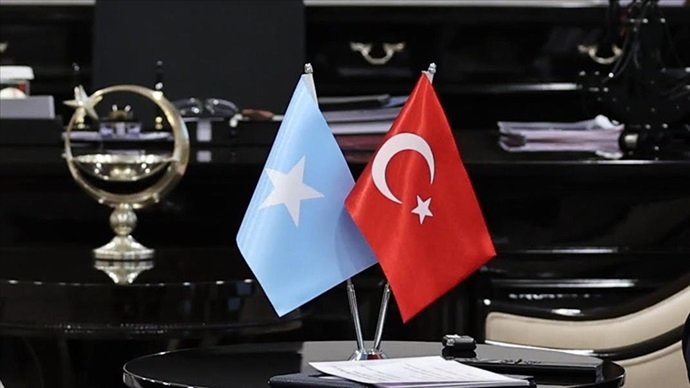
Masterminded by Turkey, which appears to have secured a carte blanche from traditional patrons of Somalia’s political landscape, it binds feeble nationalism, religious, commercial, and foreign interests in one lamination. From the outset, it is a projection of Turkey’s partisan political Islam domestically constrained by Kemalist social inertia. The ruling party seems to be using Somalia, alongside Syria, as a laboratory to experiment with a “pragmatic” synthesis of global Islamism and Turkish nationalism, cast as an acceptable alternative to both the decayed secular-statist nationalism prevalent in Turkish, Somali and Arab societies and the jihadism that has despaired the latter two. In Somalia, it accommodates Salafi clerics seeking rehabilitation, Al-Shabaab defectors, business elites, and the ever-present transactional political class. While it dispenses incentives to incorporate these actors, it is simultaneously advancing a subtle campaign of the Turkification of the social fabric, which is indicative of a long-term strategy to preempt potential barriers of Somali national revulsion.
Locally, it relies on advertisements that appeal to nationalist sensibilities by projecting an image of sovereign recovery. These are through curated aesthetics of inflated investment figures, magnified development imagery, selective infrastructure showcases, symbolic inaugurations, pretty media narratives, and polished humanitarian gestures. To the people, such visual instruments translate external dependency into a performative narrative of national resurgence. So, they exert a powerful sedative effect on a society long accustomed, from the decade before independence through the military era, to foreign ego-massaging of its national aspirations. This effect is amplified by widespread social anguish that desperately looks to any source of hope, however superficial.
The most glaring flipside of this model is that it perpetuates the embedded double-decker character of Somali politics. Since colonial times, when external powers began to co-opt elders and manufacture political and financial groups, Somali governance has been structurally top-down. The grassroots were consistently excluded from meaningful roles in shaping the country’s direction. Thinking and decisions were reserved for the upper echelons, where all the glamours of life were also concentrated. The bottom was always politically inert and socially abandoned to the torments of poverty, ignorance and diseases. This continued through the clientalist post-independence decade mediated by elders, the military politburo, the Salafi “Shura” councils, and the consociationalism of federalism. In each one, legitimacy has flowed downward from external validation through compliant domestic intermediaries. The Turkish project repeats this logic almost exactly.
It reproduces a vertically mediated political order in which power and legitimacy are outsourced and channeled through a narrow layer of gatekeepers. At both central and regional levels, the removal or installation of leaders is determined by the degree of subservience to this gatekeeping model. This perpetuates the personalization and factionalization of the state, which explains why, in moments of crisis, the public retreats into clan and factional solidarities rather than rallying around common ideals. It inverts the logic of state consolidation since the more power and resources are concentrated in particularistic central actors by external patrons, the more intensely peripheral groups mobilize along tribal lines, incentivized to also seek their own benefactors. This trend can ultimately freeze into the more insidious Korea pattern, with each segment of Somalia tethered to an external sponsor to gradually terminate any residual sense of shared political destiny.
Moreover, the Somali political center, Mogadishu, has never been set against the peripheries. It has functioned as a gravitational pole whose political weight lies in its capacity to attract peripheral political subjects, rather than pursuing them. This idea is as old as the Somali statehood, which rests on an abstract unity voluntarily forged in the shared imagination of a society that found the first historic convergence of its own accord in Mogadishu. It is even the sole organizing principle that gives the dreaded federalism its minimal coherence and so embedded it is that any future centralizing authority can only prudently come from the periphery. The opposite would hold if the center had historically been constructed as a coercive force imposing itself on the rest, rather than its current pilgrimage point for an already imagined national whole. It is then inevitable that with clan sentimentalism in the mix, Mogadishu’s coercive proxy disposition to the countryside spreads a repellent infection on national unity, both in its present loose form and in its future manifestations.
However, while the pros and cons of Turkey’s involvement in Somalia’s internal affairs can be debated endlessly, it’s most consequential limitation lies in its regional posture. Turkey’s neo-imperial approach is defined less by an appreciation of the Horn’s historical sensitivities than by transactionalism that accounts only for how much geopolitical and commercial leverage it can extract at the expense of all or one. This comes across plainly from the triangular configuration of Ankara’s relations with Ethiopia and Somalia, crystallized in the Ankara Declaration and in its conspicuous mutedness toward Ethiopia’s regional imperial revivalism. Though presented as a diplomatic triumph that averted immediate conflict, the declaration has in reality given Ethiopia space to disguise its ambitions, set Somalia on a path of incremental dispossession, and drawn Turkey into the classic Horn trap of attempting to ride two permanently divergent chariots at once.
No matter how weak one is at a given moment, how cleverly the other masks its intentions, or how skillfully a patron attempts to balance sides for its interests, Somali–Ethiopian relations lack any equilibrium point. One is shaped by an enduring territorial anxiety that can only be remedied by the reversal of a century of a continuous dispossession, or at minimum, dispel any suspicions of deterioration; the other by an inveterate expansionism which, the more it extracts from one Somali generation, the more it seeks from the next. To assume that such a configuration can be harmonized through theatrical brokerage is a fundamental naivety of seating a lifelong arsonist and a fire victim at the same table and calling it a safety arrangement. History, like human character, cannot be reengineered but only temporarily suppressed at the cost of forceful return. That was a lesson learned too late by Soviet Russia during its imperial heyday in the Red Sea theatre, and it seems a similar tri-relational illusion is being reproduced in Ankara. In the end, unless a conscious historical revision occurs in the Horn, a Turkish fallout with Somali national aspirations is not a question of if, but of when.
Weighting the internal and external dynamics against each other for posterity’s sake, the uncomfortable truth one arrives at is that Somalia’s ostensibly ‘new’ direction is never a break from the patterns of the lost century but their reconfiguration under a more external sophistication. The external patron may have changed but the dynamics are still as receptive as a prostitute is ever to a new client. The structure of continuously outsourcing authority and periodically reassembling proxies at the expense of autonomous political order is still in place. Change is stylistic rather than substantive. Thus, Somalia is not moving toward resolution but refined repetition. The question, therefore, that should be consuming every conscious Somali person should not be which marriage between an external suitor and a domestic pride is suitable to preside over the next century, but how society can eternally break free from this savage cycle. That will not come as a ripe fruit but has to be forced into existence.
The struggle is two-staged and mutually reinforcing. The first is the objection of the walled hierarchies that have monopolized Somali political life for a century: clan patriarchies that utilize lineage as a veto power, clerical establishments that have turned faith into an instrument of social pacification rather than emancipation, and their protégé, the comprador political class that is a conduit to foreign intrusion. Not only in Somalia, but across the Somali peninsula, patriarchy remains the lord of backwardness; nowhere is this starker than in northern Kenya, which, despite being spared the chronic violence that has ravaged Somalia and afforded decades of stability and state support, still wallows in poverty and social stagnation precisely because clan elders monopolize political initiative. In Somalia, the trio are the systemic distortions that metamorphose— reappearing in new forms every political shift. Because of this character, confronting them cannot be cosmetic. It requires consciously orchestrated social insurgency geared to transcending narrow particularisms as its political capital. We can call this insurgency the People’s Column, and should not assume that such a force can originate from within the very structures it seeks to dismantle.
Instead, it must emerge from the wretched grassroots: the IDP camps, the street dwellers, families dispossessed by cartels, the bereaved, the unemployed youth and above all, the womenfolk, whom traditionalism has treated as a commodity, and whom contemporary Somali politics has placed in the lowest depths of social and political existence. All of these are not just victims of a long-running unjust system, but have no stake in anything to be preserved at the moment. Their future has always been deferred indefinitely. What is required is the politicization of their deplorable living conditions as a means to an organized political agency, in a struggle that is framed as a historical emancipation, and conducted with a fortitude no less resolute than prisoners breaking through their chains.
Ordinarily, a society destined for monumental shifts begins with class rivalry. Since Somali society lacks the material conditions for such a struggle, the ferment is generational. A numerically smaller older generation, entrenched in political power yet incapable of transmitting livable conditions across decades, is pitted against a far larger, younger, more agile, and more educated one, with the central contested issue being the locus of loyalty; whereas the former is loyal to the preservation of personal and factional interests, the latter is propelled by collective existential pressures it refuses to pass to its offspring—making its loyalty inherently futuristic. The latter must therefore rebel against everything that gives the former relevance, first by overcoming tribal binaries, then its insurances, association with competing sectarianism, and above all by collectively amplifying every form of dissenting voice that may contain a revolutionary spirit, particularly emerging feminist voices, not just as a question of gender but as anti-establishment imperative, given that women, in the classic sociological term, possess sharper instincts for collective survival. In all, the first stage is to make those at the margins of society conscious of themselves as the center of political imagination. The post–civil war generation with its own prophet and digital space as the principal instrument should be the drivers of this reconstitution.
Digital spaces are incubators of ideas that enable a generation unbound by any orthodoxy to construct new forms of association and political mobilization that cut across all divisions. To that end, public debates should be rewired from surface-level discourses to the foundational principles on which a future political order must rest, because too often, daily noise diverts attention from the future, which arrives unnoticed, and this state of distraction persists indefinitely. Central to creating a potent political discourse is not to talk about the awful actions of political actors, but more about the underlying political impulses that enable such behavior, and how they can be altered. For instance, one cannot question nepotism or advocate meritocracy without confronting the politics of clan quotas; cannot decry clan violence without being averse to the patriarchs that embody the logic of the violence; just as one cannot speak of ending Al-Shabaab without addressing the animating ideology that thrives in the mosque. Above all, foreignophilism can be remedied less by the outward confrontation of foreigners themselves than by the inward disciplining of politics—that is, by denying an incentive space that gives the intermediaries the legitimacy to remain at the helm.
History offers no shortage of parallels on where massive social awakenings culminate. Thus, for a durable Somali political order to materialize which, by virtue of Somalia being the parent state, would radiate across the wider Somali world, the decisive resource must be a popular insurrection, whose participation is not defined by geographic origin or any narrow affiliation but a total sense of Somaliness. Insurrection not in the narrow view of episodic violence or elite contests for power, but as a society-wide rebellion against the entire guardrails of the Somali political establishment, with a rallying call grounded in life, civic egalitarianism, dignity, justice, and the full realization of everything that defines a decent human existence.
Ultimately, it will translate a spontaneous, subtle insurgency into a monstrous political force capable of penetrating the deepest layers of social life—the habits, loyalties, and inherited logics that have, across time, impeded collective progress, and then systematically deconstructing them. Such a transformation does not stop at the visible structures of power but extends into the unseen norms that sustain them. The enduring lesson of history is that societies which advance by leaps and bounds do not merely replace regimes but interrogate and dismantle the underlying systems, reconstructing the moral and social fabric upon which authority itself rests. Without this depth of transformation, change remains superficial and reversible. In the end, only through such a total reorientation, regardless of the number and strength of obstacles, can a genuine historical evolution of the Somali nation begin. One that shatters the repetitive cycle of misery and allows it to finally begin a progressive march toward its historical mission of existence to posterity.
Aden M. Ismail
Email: aden.mohedi@gmail.com
——-
Aden is a graduate of International Studies at the University of Nairobi’s Department of Diplomacy and International Studies (DDIS), with academic and professional interests in diplomacy, international security, and strategic studies.”