
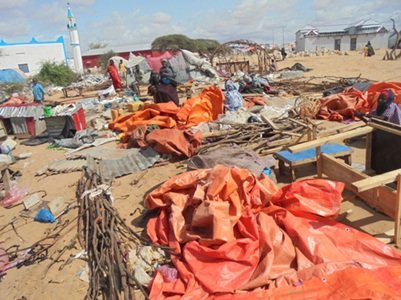
Heritage Institute report says more than 2.1 million people were forcibly evicted between 2017 and September 2026, raising serious questions about the fate of public land, the proceeds from its sale and the government’s failure to resettle displaced families.
MOGADISHU (WDN) — The forced eviction of IDPs and the illegal seizure of public land without due process continue to undermine the rule of law and deepen the suffering of vulnerable communities.
More than 2.1 million people in Somalia were forcibly evicted from their homes between 2017 and September 2026, according to a report by the Heritage Institute for Policy Studies, with the Banadir region accounting for nearly two-thirds of recorded cases.
The figures highlight a deepening displacement crisis in Mogadishu and surrounding areas. But beyond the scale of the evictions, serious questions remain over the fate of public land cleared by government authorities, reports that some of the vacated properties were subsequently sold to business interests, and whether the proceeds were deposited into the public treasury.
Equally troubling are concerns that displaced families were left without adequate alternative accommodation or meaningful government assistance.
The report identifies Banadir as the epicentre of forced evictions, accounting for 64 per cent of recorded cases. More than one million people in the region were reportedly forced from the places where they had been living.
The figures raise fundamental questions about the government’s responsibility to protect vulnerable citizens, manage public property transparently and ensure that urban development does not become a vehicle for dispossession.
Public land, private interests and unanswered questions
A particularly contentious issue is the clearance of land and buildings owned by the state. Public property is held for the benefit of the public, and any decision to sell or transfer it should be supported by a clear legal basis, transparent procedures and proper financial accounting.
Where public land cleared of occupants is subsequently sold to private business interests, authorities should disclose who authorised the transactions, who purchased the properties, how much was paid and where the money went.
If proceeds from the sale of public assets were not deposited into the national treasury, the government should explain how the transactions were accounted for and whether any investigation has been conducted. These questions are especially urgent when the people displaced from the same properties have received neither alternative housing nor adequate compensation.
The available report figures do not, by themselves, establish that every cleared property was sold, or that sale proceeds were diverted. Those allegations require documentary evidence, including land-transfer records, sale agreements, treasury receipts and official financial accounts. Nevertheless, the reported scale of displacement makes independent scrutiny essential.
Families evicted with little warning
The Heritage Institute recorded 84 protests against forced evictions between April 2025 and March 2026, of which 78 took place in Mogadishu. Some demonstrations reportedly resulted in arrests and injuries, while deaths occurred in certain incidents.
The report also recorded 143,548 people facing forced eviction across Somalia in 2025 alone. Approximately 44 per cent of those affected were living on government-owned land.
One prominent example occurred in July 2025, when an operation cleared the former Ministry of Health compound in Mogadishu, reportedly displacing nearly 120 families without adequate warning. Some families had lived at the site for more than 14 years.
For households already struggling with poverty and displacement, losing shelter can mean losing access to work, education, healthcare and the fragile support networks on which survival depends. Without alternative accommodation or compensation, eviction can push families into deeper insecurity and expose them to repeated displacement.
Government accountability cannot stop at eviction
The state has a legitimate interest in recovering public land and enforcing lawful property arrangements. But the exercise of that authority must be transparent, proportionate and consistent with the law. Public ownership should not become a justification for dispossessing vulnerable families without safeguards, nor should the recovery of public property leave unanswered questions about its subsequent commercial use.
The government should publish an independently verifiable account of public properties cleared of occupants, identify any assets sold or transferred to private parties, disclose the prices and buyers, and confirm whether all proceeds were paid into the treasury. It should also explain what measures were taken to provide displaced families with alternative accommodation, compensation or other appropriate assistance.
Where allegations of irregular sales or missing public revenue arise, an independent audit and investigation would help establish the facts and identify any wrongdoing.
Somalia’s displacement crisis is not simply a housing problem. It is also a test of public accountability, property rights and the integrity of government institutions.
The central question is stark: if public land was cleared, sold to business interests and the displaced families were left without accommodation, who benefited from the transactions—and where did the money go? The public deserves documented answers, not silence.
WardheerNews