
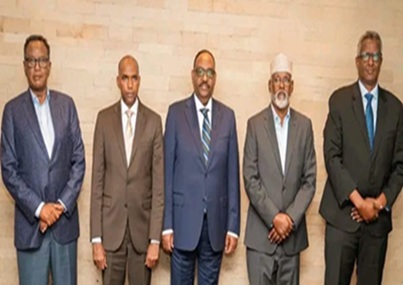
Future Council Takes Somalia’s Electoral Crisis to the UN as Political Rupture Spreads Across the Federal States
Mogadishu (WDN) — Somalia’s political crisis is no longer confined to a confrontation between Mogadishu and its most outspoken opponents. It is now spreading into the heart of the federal system, with Hirshabelle and Galmudug increasingly drawn into the same electoral and constitutional disputes that have already fractured relations with Puntland, Jubaland and South West State.
The warning could hardly be more stark. The Somali Future Council has taken the country’s political crisis directly to the United Nations Security Council, arguing that repeated attempts to negotiate an electoral settlement have failed and that Somalia is approaching a dangerous constitutional and political confrontation.
In a letter addressed to Security Council President Jérôme Bonnafont, the opposition coalition called for international mediation, independent monitoring and an inclusive political agreement covering elections, constitutional arrangements and relations between the Federal Government and the federal member states. The letter was dated September 11, according to reporting on its contents.
The significance goes beyond the opposition’s immediate demands. It exposes a federal system increasingly divided over who controls the electoral process, who determines the rules and whether regional governments can legitimately be elected through a process designed or heavily influenced by Mogadishu.
The Crisis Moves Into Hirshabelle
The most immediate flashpoint is now Hirshabelle.Political leaders and traditional figures in Hiiraan have rejected the planned regional election unless a prior political agreement is reached. Hirshabelle Vice President Yusuf Hagar Dabageed has warned that an election cannot proceed in Hiiraan without broad political consensus.
The confrontation intensified after President Ali Abdullahi Hussein Guudlaawe was selected as the ruling Justice and Unity Party’s candidate for another term.
Opponents in Hiiraan argue that the next Hirshabelle presidency should be determined through a political agreement involving the region’s principal constituencies.
Dabageed has separately accused President Hassan Sheikh Mohamud of abandoning an alleged understanding that the Hawadle community would be considered for the Hirshabelle presidency. That allegation has been reported by Somali media but remains a claim by Dabageed rather than an independently established fact.
The result is a potentially explosive contradiction: Mogadishu is pressing ahead with a regional electoral timetable while a significant political constituency in one of Hirshabelle’s two constituent regions says the process lacks the necessary agreement.
Galmudug Is Also Under Pressure
Hirshabelle is not the only federal state facing political uncertainty. Galmudug has also been drawn into the national electoral dispute, with disagreements over its forthcoming leadership election and competing political interests surrounding the process. Earlier this year, reports described a serious political dispute over the future leadership of Galmudug and tensions involving figures close to the federal government.
President Hassan Sheikh has reportedly maintained that national electoral discussions should follow regional elections in Galmudug and Hirshabelle, a position that places enormous political importance on the outcome of those two state-level contests.
That sequencing is contested by the opposition, which argues that the national electoral framework itself must first be negotiated among the major political actors.
The dispute therefore becomes circular: Mogadishu wants regional elections to move forward before a broader national settlement, while its opponents want a national political agreement before the regional electoral process becomes irreversible.
Puntland and Jubaland Already Outside the Political Centre
The Future Council’s appeal comes against a backdrop of an increasingly fractured relationship between Mogadishu and Puntland and Jubaland, whose leaders have been among the strongest opponents of the Federal Government’s approach to elections, constitutional reform and federal power-sharing.
The two administrations have been outside normal political cooperation with Mogadishu for an extended period, while their leaders participate in the Future Council.
Puntland separately submitted its own letter to the Security Council this month, calling for greater international engagement with the federal member states and an inclusive political dialogue.
The combined effect is striking: the dispute is no longer simply between a federal government and a conventional opposition bloc. It increasingly involves competing centres of political authority across Somalia’s federal map.
South West State Shows How Quickly the Crisis Can Turn Violent
South West State provides an even more alarming precedent. The political confrontation between Mogadishu and Baidoa has already produced a severe rupture, with the federal government and South West authorities becoming locked in a dispute over political control and the electoral process.
The experience has become a warning for other federal states: an argument that begins over electoral rules can quickly become a confrontation over security forces, territorial authority and control of government institutions.
That is precisely why the developing disputes in Hirshabelle and Galmudug are attracting such attention.
The Bigger Problem: One Election, Multiple Political Systems
At the centre of Somalia’s crisis is a deceptively simple question: Who gets to decide the rules of the next election?
The Federal Government has pursued constitutional and electoral changes that it presents as part of a transition toward a new political system. Its opponents argue that fundamental changes to the electoral framework require agreement among the federal government, federal member states and other major political stakeholders.
The Future Council says it has proposed a transitional model combining direct elections with the 4.5 power-sharing formula as a compromise intended to bring competing camps back to the negotiating table.
The government has a different position. The disagreement has already contributed to failed rounds of political talks, while international mediation efforts involving Turkey and other international partners have yet to produce a comprehensive settlement.
A Country Divided Over the Rules of Politics
The danger is therefore larger than any individual presidential contest. If elections in different federal states are perceived as being determined by competing political centres rather than by negotiated rules accepted by the principal stakeholders, Somalia could end up with multiple governments claiming democratic legitimacy at the same time.
That is the deeper fear now hanging over Hirshabelle and Galmudug. The political rupture with Puntland and Jubaland has not been resolved. South West State has experienced its own confrontation with Mogadishu. Now Hirshabelle is entering an increasingly bitter dispute, while Galmudug faces its own contested electoral process. The result is a federal system under extraordinary pressure.
The UN Is Being Asked to Step In
The Future Council is now asking the Security Council to intervene before the political dispute becomes even more deeply entrenched.
Its proposals include an inclusive political dialogue, international mediation and guarantees for any agreement reached, as well as independent monitoring of political and security developments.
The timing is significant. The UN Transitional Assistance Mission in Somalia is scheduled to complete its transition on October 31, 2026, while international support for Somalia’s security architecture is itself being recalibrated. The United States recently agreed to extend the period for ending UN support to AUSSOM, underscoring the continuing international concern over Somalia’s political and security fragility.
The most unsettling feature of Somalia’s current crisis is that the country is not facing one political dispute. It is facing several disputes that are beginning to overlap — elections, constitutional reform, federal authority, regional leadership, security forces and political legitimacy.
Puntland and Jubaland remain locked in confrontation with Mogadishu. South West State has experienced a dramatic rupture. Hirshabelle is now approaching its own electoral crisis. Galmudug faces growing political pressure.
The Future Council’s appeal to the Security Council is therefore more than another opposition complaint. It is a warning that Somalia’s federal political bargain is beginning to fray across multiple fronts at once.
Whether that fragmentation remains political or develops into further security confrontation may depend on one unresolved question: Can Somalia agree on the rules of the next election before competing authorities begin treating their own electoral processes as the only legitimate path forward?
WardheerNews