
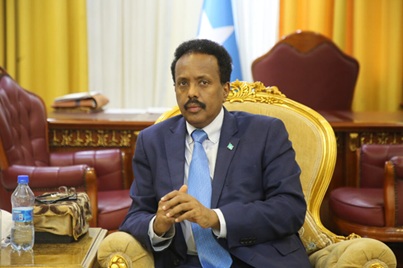
Former President Says Election Disputes, Constitutional Deadlock and Federal Tensions Risk Creating Competing Centres of Power
Mogadishu (WDN) — Somalia is facing a deepening political crisis that could leave the country increasingly divided into competing centres of power, former President Mohamed Abdullahi Mohamed “Farmaajo” has warned, urging President Hassan Sheikh Mohamud to reopen national dialogue and reach agreement on the rules for the next election.
Farmaajo’s intervention comes as Mogadishu remains locked in disputes with opposition groups and several federal member states over constitutional reforms, federalism, political mandates and the electoral system.
Puntland and the Somali Future Council have separately taken their concerns to the United Nations, highlighting the widening political divide.
The Crisis Is Bigger Than an Election
Farmaajo argues that Somalia’s political stability depends on four pillars: a broadly agreed constitution, completion of the federal system, timely and inclusive elections, and dialogue and compromise. All four are under pressure.
Negotiations over the next electoral framework have yet to produce an agreement acceptable to all major political actors, while relations between Mogadishu and several federal member states have deteriorated.
The dispute is therefore no longer simply about an election date. It is increasingly about who sets the rules, who controls political institutions and who determines Somalia’s political order.
If the deadlock continues, federal institutions and regional administrations could increasingly operate according to competing political mandates, leaving Somalia formally united but increasingly divided in practice.
The Human Cost
The political crisis is unfolding alongside a severe displacement and housing crisis in Mogadishu. EUAA reporting, based on UN and other humanitarian data, estimated that more than 1.1 million people were living in verified IDP sites in the capital as of July 2025.
Forced evictions added to the pressure, with 143,548 evictions reported during 2025, including 63,132 people removed from government properties.
Opposition figures and rights groups have also alleged that some properties cleared through evictions were subsequently transferred or sold without adequate legal process or transparency. Those allegations remain contested, but the scale of displacement is documented.
The political crisis is therefore being felt beyond government institutions — it is affecting families whose access to land and shelter remains uncertain.
Farmaajo’s intervention comes with the experience of Somalia’s previous electoral crisis still fresh.His presidential term expired in February 2021 without an agreed election. Parliament subsequently approved a two-year extension, triggering intense opposition and armed clashes in Mogadishu before the extension was abandoned and political leaders returned to negotiations.
That episode remains a reminder of how disputes over political mandates can escalate when dialogue breaks down.
Farmaajo’s Three Demands
Farmaajo is calling for three immediate steps. First, he wants Hassan Sheikh to lead a genuine national dialogue involving the country’s principal political stakeholders.
Second, he calls for agreement on the electoral framework before the next election. Third, he wants an inclusive election held within a short timeframe to end Somalia’s prolonged political uncertainty.
He also argues that Somalia’s political disputes should ultimately be resolved through a Somali-led process rather than determined by external actors.
The Central Question
The Federal Government maintains that its constitutional and electoral reforms are intended to strengthen Somalia’s democratic institutions. Its opponents argue that fundamental changes require broader political agreement.
That disagreement lies at the heart of the current crisis. The question is no longer simply who will contest the next election. It is who will agree on the rules under which that election takes place — and whether those rules will be accepted by Somalia’s principal political actors.
Without such an agreement, the country risks deeper institutional confrontation and increasingly competing centres of political authority.
Farmaajo’s warning comes at a critical moment. Somalia’s political leaders face the challenge of restoring a negotiated process before disputes over elections, constitutional authority and federalism become even more deeply entrenched.
For a country already confronting insecurity, displacement and institutional fragility, the stakes extend far beyond the next presidential contest.
WardheerNews