
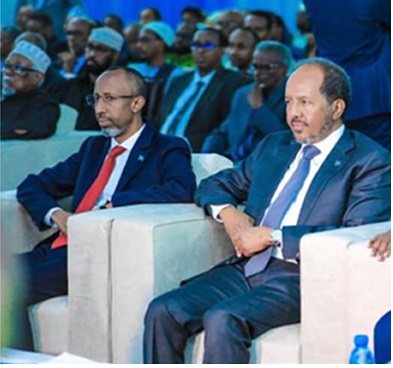
Education Minister Farah Sheikh Abdulkadir dismisses warnings that Al-Shabaab could exploit the withdrawal of foreign troops as an insult to Somalis. But the more pressing question is whether a deeply divided federal government has the political legitimacy, territorial reach and institutional capacity to defend a country whose state structures are increasingly fragmented.
MOGADISHU (WDN) – Somalia’s Education Minister, Farah Sheikh Abdulkadir, has criticised warnings that Al-Shabaab could seize power following the eventual withdrawal of African Union forces, describing such predictions as an insult to the intelligence of the Somali people.
Speaking at a discussion organised on Thursday by the Higher Institute for Security and Strategic Studies (HISS) in Mogadishu, the minister insisted that Somalia’s security institutions were capable of defending the country against the militant group. He argued that national security was not the responsibility of the federal government and armed forces alone, but a collective obligation shared by all Somalis. “Security belongs to the Somali people. It is financed through their taxes and protected through their collective strength,” he said.
The minister also accused politicians and public commentators of exploiting political grievances to spread fear of state collapse and an Al-Shabaab takeover. He maintained that similar predictions had circulated since 2010, despite continued efforts by Somali security forces to confront armed groups.
But dismissing such warnings as an insult does not answer the questions behind them. The threat facing Somalia is not simply whether its security forces can fight Al-Shabaab. It is whether the country still possesses the political cohesion, constitutional legitimacy and functioning federal institutions necessary to sustain a national security system.
A federal government with diminishing political authority
Under President Hassan Sheikh Mohamud, Somalia’s federal project has become increasingly fractured. Relations between Mogadishu and important federal member states have deteriorated, while Puntland and Jubaland remain outside meaningful political cooperation with the federal government. Disputes with other regional administrations, including Hirshabelle, have further exposed the fragility of the federal arrangement.
The result is a government whose authority and political reach are far more limited than its national title suggests. Mogadishu may remain the seat of the Federal Government, but governing from the capital is not the same as exercising legitimate authority across the country.
The federal government has yet to secure a broadly accepted political agreement on the constitutional framework, the electoral system and the distribution of powers between Mogadishu and the federal member states. Without such agreements, the institutions intended to hold the federation together risk becoming instruments of political competition rather than foundations of a functioning state.
The question is therefore unavoidable: what exactly is the federal government defending when the political arrangements underpinning the federation remain contested?
Displacement and the credibility gap
The government’s claims of national responsibility are also difficult to reconcile with the suffering of civilians displaced by demolitions and evictions in Mogadishu.
Large numbers of residents have lost homes and livelihoods during urban land disputes and clearance operations. Opposition figures and affected communities have alleged that public land and property have been appropriated or transferred for private benefit. The scale of displacement has been widely disputed, and the allegation that more than one million people have been made homeless requires independent verification. Nevertheless, the humanitarian consequences of forced evictions demand accountability, transparent land administration and effective protection for vulnerable residents.
A government cannot credibly invoke national unity while citizens question whether public institutions protect their homes, property and rights. Nor can it expect public confidence in the state when allegations of corruption and the private appropriation of public assets remain unresolved.
The Al-Shabaab threat is not an insult; it is a security reality
The minister’s remarks come at a particularly sensitive moment. Somalia is preparing to assume greater responsibility for national security as the African Union Support and Stabilization Mission in Somalia (AUSSOM) proceeds with its planned transition and the eventual reduction of foreign forces.
Uganda, one of the major contributors to previous African Union operations in Somalia, has recently announced the withdrawal of troops deployed under a bilateral arrangement. Other AUSSOM contingents are also subject to planned adjustments.
These developments raise legitimate questions about whether Somali forces can independently secure strategic towns, supply routes and territories that have long depended on international military support.
Al-Shabaab continues to conduct attacks across south-central Somalia, despite years of military operations by government forces and their allies. The danger is compounded by political fragmentation, inconsistent security arrangements and the absence of a unified national strategy supported by all major federal stakeholders.
Opposition leaders have warned that the weakening of political cohesion and the concentration of national security institutions in the service of political interests could leave the country increasingly vulnerable. Their warnings should be examined on their merits, not dismissed as politically motivated rhetoric.
There is a further danger: when national institutions become entangled in political disputes, security personnel may increasingly identify with clan, regional or factional loyalties rather than a unified national command. That is precisely the kind of fragmentation that an insurgent movement can exploit.
National security requires legitimate government
Somalia’s security crisis cannot be separated from its political crisis. Military operations alone cannot compensate for the absence of constitutional consensus, functioning federal relations and public trust. A national army needs more than weapons and foreign assistance; it requires a legitimate political authority, reliable financing, professional command structures and the confidence of the population it is meant to protect.
President Hassan Sheikh must therefore confront the political failures undermining his administration. That means rebuilding relations with federal member states, resolving constitutional and electoral disputes through genuine negotiation, strengthening judicial independence and ensuring that security institutions serve the country rather than the interests of the government of the day.
The federal government should also provide transparent answers about its security transition plans, the readiness of Somali forces, the deployment of troops and the arrangements for protecting communities as foreign forces draw down.
Minister Farah Sheikh may regard predictions of an Al-Shabaab takeover as an insult to the Somali people. But Somalis have every right to ask difficult questions about the security of their country and the competence of those governing it.
The greatest danger is not that Somalis are discussing the possibility of state collapse. It is that their leaders may mistake warnings about a deteriorating state for insults, while failing to address the political divisions, institutional weaknesses and security gaps that make those warnings credible.
WardheerNews
Leave a Reply