
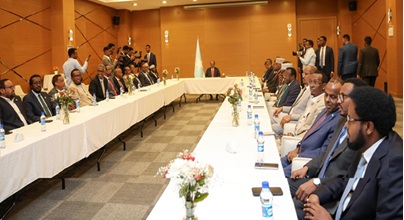
Opposition leaders accuse President Hassan Sheikh Mohamud of behaving as though the Constitution places no limits on his authority, warning that his attempt to remove the Supreme Court Chief Justice represents a dangerous attack on judicial independence and the country’s constitutional order.
MOGADISHU (WDN) – Somalia’s political crisis has taken a more dangerous turn, with the Somali Future Council accusing President Hassan Sheikh Mohamud of mounting an assault on the Supreme Court and attempting to bring the country’s judiciary under presidential control. The opposition coalition describes the president’s actions as an attempted institutional coup by a leader whose constitutional mandate expired on 15 May 2026.
At a press conference in Mogadishu on Sunday, representatives of the Future Council issued a strongly worded statement condemning the president’s attempt to dismiss Supreme Court Chief Justice Baashe Yusuf Ahmed and what they described as the subsequent campaign of intimidation against the Chief Justice and other Supreme Court judges.
Mohamed Adan Jimale (Koofi), secretary of the Future Council, said the coalition regarded the president’s intervention as an unconstitutional seizure of an independent institution.
“The Future Council condemns the assault and attempted coup by the president, whose term has expired, against the Supreme Court, as well as the persecution of the Chief Justice and the country’s Supreme Court judges,” Koofi declared.
The statement reflects growing alarm among opposition leaders that President Hassan is increasingly treating constitutional institutions as subordinate to his personal authority. Rather than accepting the judiciary’s constitutional independence, the president’s actions, according to the opposition, suggest an executive increasingly unwilling to recognise institutional checks on presidential power.
Defying the judiciary and undermining constitutional government
The Future Council welcomed the Supreme Court’s recent ruling declaring that the mandates of the federal government’s principal institutions had expired and calling for an agreed electoral process within 90 days.
According to Koofi, the court’s decision provides an opportunity to resolve the political deadlock through an election agreed upon by all major political stakeholders.
“The Somali Future Council welcomes the Supreme Court ruling, which determined that the mandates of Parliament, the presidency and the government have expired, and called for an agreed election to be held within 90 days,” he said.
The opposition coalition considers the judgment an important constitutional opportunity to end the political uncertainty surrounding the federal electoral process. It argues that the government’s responsibility should now be to facilitate a negotiated political transition rather than undermine the institution entrusted with interpreting the law.
The confrontation over Chief Justice Baashe Yusuf Ahmed has consequently become a defining test of whether Somalia’s constitutional institutions can operate independently of presidential influence.
A president cannot claim to uphold constitutional government while disregarding judicial safeguards whenever they challenge his decisions. Nor can the executive legitimately substitute presidential decrees for procedures established to protect the independence of the judiciary.
A presidency increasingly accused of authoritarian conduct
The Future Council’s statement raises a fundamental concern about the concentration of power in Villa Somalia. The opposition argues that President Hassan’s handling of the Supreme Court demonstrates an alarming disregard for the separation of powers and the constitutional limitations governing the presidency.
The danger is not confined to the removal of one Chief Justice. If the head of the Supreme Court can be dismissed through presidential intervention without following the constitutionally prescribed procedures, every judge becomes vulnerable to political pressure.
Such a precedent would undermine the independence of the entire judicial system and weaken the constitutional protections available to citizens against arbitrary government action.
The coalition also warned that the consequences of the escalating confrontation would ultimately rest with President Hassan, holding him politically responsible for the instability arising from the dispute.
Its warning comes as Somalia faces mounting uncertainty over the legitimacy of federal institutions, the electoral process and the future relationship between the federal government and opposition political forces.
November dialogue faces a credibility test
The latest confrontation unfolds as President Hassan prepares to host another round of national consultations in Mogadishu from 14 to 18 November 2026.
The president has invited the Nabad iyo Nolol political party, the Somali Future Council, the National Unity Forum and civil society organizations to participate in the proposed consultations.
However, the opposition’s latest statement raises serious questions about the credibility and substance of the proposed dialogue, particularly as fundamental disputes remain unresolved. These include the controversy surrounding the Supreme Court, contested and unilateral elections in South West State, Galmudug, and Hirshabelle, among a host of other critical political and constitutional issues.
The contradiction is difficult to ignore: the presidency is inviting political stakeholders to negotiate a national settlement while simultaneously facing accusations of undermining the country’s highest judicial institution.
For the opposition, meaningful dialogue must be grounded in respect for constitutional institutions, judicial independence and an agreed electoral framework. Political consultations cannot become a substitute for constitutional compliance, nor can negotiations be credible if one side continues to exercise disputed authority over institutions whose independence is essential to resolving the crisis.
Somalia is therefore approaching another critical political moment. The November consultations could provide an opportunity to address the country’s institutional deadlock, but their success will depend on whether the government is prepared to respect constitutional limits and accept a negotiated political settlement.
The central issue is no longer simply whether Hassan Sheikh Mohamud can secure another political agreement with his opponents. It is whether he is prepared to accept that the presidency is bound by the Constitution and that no elected leader, regardless of political authority, stands above the law.
A constitutional republic cannot function when its president expects obedience from the judiciary rather than accountability to it. If the Supreme Court can be subordinated to the executive, the separation of powers becomes an empty constitutional promise, and the country risks drifting towards government by presidential decree rather than the rule of law.
WardheerNews
Leave a Reply