
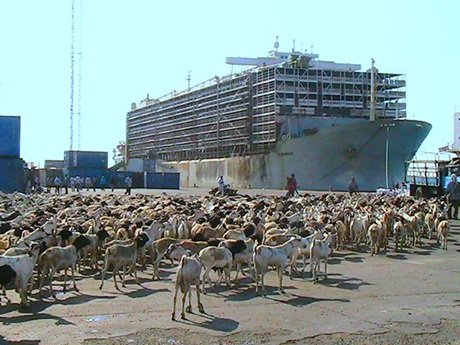
Mogadishu-(WDN) — Somalia is exploring Libya as a potential new destination for its livestock exports, as the two countries seek to expand trade and deepen economic ties. But while the proposal offers an attractive new market on paper, security risks, the enormous maritime distance and the cost of transporting livestock through the Suez Canal could make the route commercially difficult to justify.
The proposal was discussed during a meeting between Somalia’s ambassador to Libya and officials from the General Union of Libyan Chambers of Commerce, where the Somali side highlighted investment and trade opportunities, particularly the country’s livestock sector.
If implemented, the arrangement could give Somali livestock exporters access to a potentially important North African market while providing Libya with an additional source of sheep, goats and other livestock.
For Somalia, the attraction is obvious. Livestock remains one of the country’s most important economic sectors, supporting millions of livelihoods and generating substantial export revenues. More than 20 million sheep and goats were reportedly exported from Somalia between 2018 and 2024, underscoring the scale of the industry. But turning Libya into a major destination presents a very different logistical challenge from serving Somalia’s traditional livestock markets in the Gulf.
The Geography Problem
The most obvious obstacle is distance. A maritime shipment from Somalia to Libya would require a long voyage around the Horn of Africa and through the Red Sea and Suez Canal before reaching the Mediterranean. The route would involve additional sailing time, fuel, port charges, canal fees, insurance and other logistical expenses.
For livestock exporters, time is money—and, in this case, time can also mean animal welfare and additional operating costs. Every additional day at sea increases expenditure on feed, water, veterinary supervision and crew, while also increasing the risks associated with transporting live animals over long distances.
The Suez Canal presents another unavoidable cost. Ships using the canal must pay transit fees, adding another layer of expense to an already lengthy journey. This raises a fundamental commercial question:
Can Somali livestock compete in Libya after absorbing the cost of one of the world’s longest and most expensive livestock shipping routes? The answer may depend heavily on market prices, vessel capacity, economies of scale and whether Libya is prepared to offer favorable import arrangements.
There is also a second major concern: security. Libya remains politically and militarily fragmented, with competing authorities, armed groups and persistent instability despite years of international efforts to stabilize the country. For a livestock exporter, the risks do not end when a vessel reaches the Mediterranean. Ports, customs facilities, quarantine centers, roads and distribution networks all require predictable security and functioning institutions.
A commercially viable livestock trade requires more than a willing buyer. It requires reliable ports, transparent customs procedures, veterinary certification, quarantine facilities, secure transportation corridors and a stable regulatory environment. Any disruption along that chain could quickly turn a profitable shipment into a financial loss.
A Market Worth Exploring—but Not at Any Cost
Despite these obstacles, Libya should not necessarily be dismissed as a potential market. The proposed trade could generate opportunities well beyond the sale of live animals, including shipping, veterinary services, quarantine facilities, animal feed, meat processing, cold-chain logistics and related agricultural services.
The two sides have also discussed strengthening links between business communities, exchanging economic delegations and identifying new investment opportunities. But Somalia should approach the proposal with commercial realism rather than diplomatic enthusiasm alone.
Before committing exporters to the Libyan market, authorities and businesses would need to conduct a detailed feasibility assessment covering shipping costs, Suez Canal fees, insurance, voyage duration, port charges, animal mortality risks, veterinary requirements, quarantine regulations, security conditions and final market prices.
The crucial issue is not whether Libya needs livestock or whether Somalia has livestock to sell. The real question is whether Somali livestock can reach Libya at a price that remains competitive after the extraordinary cost of getting there. If the numbers do not work, diplomatic agreements and trade delegations will not make the route commercially viable. Somalia therefore has an opportunity—but also a warning.
Opening Libya as a market could diversify Somalia’s livestock exports. But unless the logistics, security and economics are carefully addressed, the long journey from the Somali coast, through the Suez Canal and into the Mediterranean could consume the very profit the trade is intended to generate.
WardheerNews