
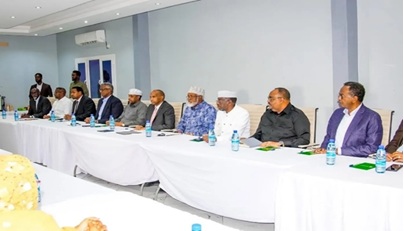
Mogadishu (WDN) – In a development that has surprised ordinary Somalis and political observers alike, the opposition coalition long known for their vocal criticism of controversial elections, constitutional changes, and term-extension efforts has remained conspicuously silent as South West State selected its next president.
The silence comes despite mounting concerns over the credibility and independence of an electoral process that has been heavily influenced by the Federal Government in Mogadishu. The election resulted in the victory of Speaker of Parliament Aden Mohamed Nur “Aden Madoobe,” a candidate enjoyed strong political backing and direct support from federal authorities.
The apparent certainty surrounded the outcome has fueled growing debate among Somalis about whether the contest represents a genuine democratic exercise or merely the formal ratification of a predetermined political arrangement. Political analysts note that the absence opposition’s voice to share with the public of their take, is particularly striking, given their consistent opposition to electoral processes they have previously described as lacking transparency, inclusiveness, or constitutional legitimacy.
“This is precisely the type of election that would normally provoke a strong reaction from the opposition,” remarked one political observer in Mogadishu who spoke with WardheerNews. “Instead, there has been near-total silence.”
Questions have also been raised regarding the broader political environment in which the vote took place. Critics argue that the significant presence of federal security forces and the influence of central government institutions have created an atmosphere that falls short of the free and competitive conditions expected in a democratic election.
Several presidential contenders have previously expressed concerns about the management of the electoral process, including allegations regarding voting procedures and the neutrality of institutions overseeing the contest. Opposition candidates have also questioned whether sufficient safeguards exist to guarantee the secrecy and independence of parliamentary voting.
Adding to the controversy is the candidacy of Aden Madoobe himself. Some rivals have argued that his continued position as Speaker of the Federal Parliament while contesting the presidency of South West State creates the appearance of a conflict of interest, potentially undermining public confidence in the fairness of the process.
Beyond South West State, the election carries significance for Somalia’s wider political landscape. Many view it as a potential model for future electoral processes in other federal member states, including Galmudug and Hirshabelle, where leadership transitions are expected in the coming months. For that reason, the stakes extend far beyond Baidoa.
Many warn that the manner in which this election is conducted could shape public perceptions of future state-level elections and influence the evolving balance of power between the Federal Government and regional administrations. Yet perhaps the most remarkable aspect of the unfolding political drama is not the controversy surrounding the election itself, but the reaction—or lack thereof from Somalia’s opposition movement.
For years, opposition leaders have positioned themselves as defenders of constitutional order, electoral integrity, and federalism. Their decision to refrain from publicly addressing the South West election has therefore generated widespread speculation about their political calculations and strategic priorities.
Some analysts suggest that opposition leaders may be seeking to avoid becoming entangled in disputes involving individual federal member states. Others argue that continued silence risks creating the impression of selective engagement, where concerns about democratic standards are raised in some cases but overlooked in others.
As voting proceeds and attention turns toward the expected outcome, one question continues to dominate political discussions in Mogadishu and beyond: Why has Somalia’s opposition chosen to remain silent on one of the country’s most closely watched and controversial state elections?
The answer may have implications not only for South West State but for the future credibility of Somalia’s opposition politics as a whole.
WardheerNews