Mogadishu (WDN) — In yet another display of institutional overreach, Somalia’s already controversial federal electoral apparatus has crossed a line that even its critics say exposes the true governing culture of President Hassan Sheikh Mohamud: rule without restraint, and power without constitutional limits.
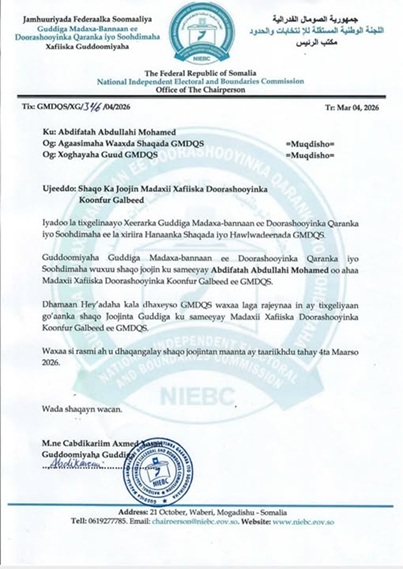
At the center of the storm is the “Independent National Electoral and Boundaries Commission” a body widely dismissed by opposition figures and legal experts as lacking both legitimacy and consensus. In a move that has triggered outrage across political circles, its head, Abdikarim Ahmed issued a letter suspending the head of the South West State Electoral Office.
The problem is not just the decision. It is the precedent. Because even under the most generous constitutional interpretation, a federal electoral body has no authority to interfere in the internal electoral mechanisms of a Federal Member State. That boundary is not ambiguous; it is foundational to Somalia’s federal system.
Yet it has now been crossed casually, and without consequence.
“This is not governance. This is encroachment,” a SWS member of parliament told WardheerNews. “And it reflects a presidency that no longer feels bound by the very framework it is supposed to protect.”
But if the action itself raised alarm, the document behind it deepened the concern and exposed something even more troubling: a level of unprofessionalism at the heart of a body tasked with managing the nation’s electoral future.
The letter, which should have been dated April 4, 2026, instead carried the incorrect date of March 4, 2026. A simple clerical error? Perhaps.
But in the context of an already disputed commission exercising powers it does not legally possess, it is emblematic of a deeper problem: carelessness, incompetence, and a disregard for institutional standards.
For many observers, the issue is not the typo itself but what it represents: a commission operating without rigor, without oversight, and without the discipline expected of a constitutional body.
“You cannot claim authority over national elections and fail at the most basic administrative accuracy,” one analyst remarked. “It tells you everything about the seriousness or lack of it behind the institution.”
And the questions only multiply. Why issue such a directive now? Why target a regional electoral body? And how does a contested institution assume powers it does not legally possess while failing to meet even basic professional standards?
For critics, the answer lies not within the commission but above it. This, they argue, is the governing style of President Hassan Sheikh Mohamud: a steady dismantling of institutional boundaries, replaced by a centralized system where authority flows not from the constitution, but from proximity to Villa Somalia.
South West State has become the most visible testing ground of this approach. Once a federal member state with its own administrative structure, it is now increasingly treated, critics say, as an extension of the federal executive, its autonomy eroded, its institutions overridden, and its leadership reshaped through force and political engineering.
What we are witnessing is the normalization of unconstitutional behavior. Today it is South West. Tomorrow, it could be anywhere. The implications are profound.
Federalism, by design, is a system of shared power, fragile, negotiated, and dependent on mutual respect between the center and the regions. When that balance is broken, the entire structure begins to fracture. And in Somalia, that fracture is no longer theoretical.
It is unfolding in real time through decrees without authority, institutions without legitimacy, and decisions lacking even the most basic standards of professionalism.
Because in the end, this is no longer about a single suspension or a single commission. It is about a pattern. A pattern in which the constitution is treated not as a binding framework, but as an obstacle to be bypassed.
A pattern in which legality is replaced by expediency. And a pattern in which power, once unchecked, begins to consume the very system that created it.
For a country still struggling to rebuild its institutions, the cost of that pattern may prove far greater than any single political dispute.
It may define the future of the Somali state itself.
WardheerNews