
By Abdullahi A. Nor
In a disturbing escalation of political repression in Puntland, the regional administration is facing accusations of using its administrative machinery to prevent public and oppositions from exercising their fundamental constitutional rights, including the right to assemble, express political opinions and demand public consultation on proposed amendments to the Puntland Constitution.
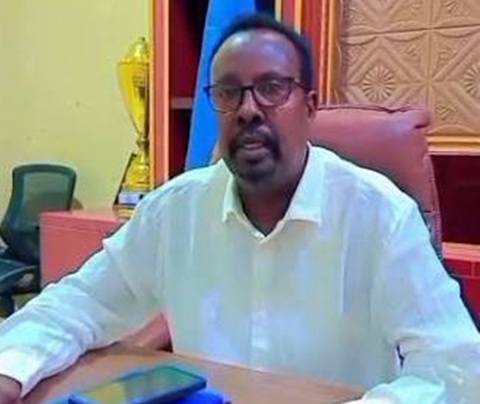
A directive issued by the Office of the Governor of Garowe, Abdiqadir Osman Samatar, popularly known as Foodcade, has triggered outrage among opposition politicians and civil society figures. The letter, reportedly wrongly dated November 19 instead of 18, was circulated to universities possessing conference facilities and hotels with conference halls, notifying them that they must not rent their premises to opposition political parties without the governor’s prior approval.
As authenticated, the directive represents an extraordinary attempt to place political activity under the personal permission of a regional government official. It effectively gives the governor the power to determine whether political opponents may meet, deliberate and engage the public on matters of constitutional importance.
Opposition leaders across Puntland have expressed astonishment and anger, questioning the legal authority under which a regional governor can impose such restrictions on their constitutional freedoms. They argue that the government cannot simultaneously initiate amendments to the Constitution and deny citizens and political stakeholders the opportunity to debate those amendments.
The controversy comes at a particularly sensitive moment. The Puntland government has submitted proposed amendments affecting nine constitutional articles to the House of Representatives. The proposals, submitted on September 21, 2026, concern fundamental matters ranging from citizens’ rights and elections to political parties, executive powers, the judiciary and local government. Parliament subsequently established a special committee to review the proposals and gather public views.
As reported by the media on November 10, the government is pursuing amendments to Articles 37, 41, 44, 47, 74, 81, 90, 113 and 126 of the 2023 Puntland Constitution. These are not minor administrative adjustments. They concern the institutional architecture, political representation and constitutional rights of the people of Puntland. Their implications extend well beyond the tenure or political interests of the current administration.
The Constitution does not belong to the government
The fundamental question is straightforward: Who owns the Constitution of Puntland?
The answer is equally straightforward. It belongs to the people, not the president, not the cabinet, not the parliamentary leadership or the governor of Garowe.
Puntland’s Constitution establishes a political order based on consultation, equality, social justice, popular sovereignty and democratic competition. Article 1 identifies consultation as a founding purpose of the state, while Article 3 establishes popular rule, good governance, consultation and multiparty competition as fundamental principles.
Article 3(1) makes the position unmistakable: all political authority derives from the people and is delegated to their leaders in accordance with the law. Those leaders are servants of the people, not proprietors of the state.
Article 3(2) further prohibits any individual, group or section of society from monopolising governmental authority.
These provisions leave little room for the notion that an incumbent administration can exercise unrestricted authority over political debate or determine which political organisations may meet. The Constitution also explicitly protects the freedoms necessary for democratic participation.
Article 14 – Freedom of Expression: Everyone has the right to hold and publicise opinions. Censorship is forbidden, and individuals may express their views through speech, media, writing and other lawful means.
Article 15 – Freedom of Association: Everyone has the right to form, join and participate in organisations, subject to the law.
Article 24 – Freedom of Assembly: Every person has the right to organise and participate in peaceful demonstrations in accordance with the law.
Article 46 further recognises Puntland’s multiparty political system and provides for electoral competition among qualifying political parties.
These protections cannot reasonably be interpreted as privileges that the government may grant to its supporters and withdraw from its critics. They are constitutional guarantees intended to protect citizens precisely when their political opinions differ from those of the authorities.The relevant constitutional provisions can be consulted in the Puntland Constitution.
Article 139 makes public debate a constitutional requirement
Perhaps the most damaging aspect of the reported directive is its apparent contradiction with the constitutional procedure governing amendments.
Article 139 establishes the process for amending the Puntland Constitution. It permits proposals from the Council of Ministers, at least one-fifth of the members of the House of Representatives, or a petition signed by at least 5,000 eligible voters. However, the provision does not give the executive an unrestricted mandate to amend the Constitution behind closed doors.
Article 139(2) requires a special parliamentary committee to examine proposed amendments before they are debated by the House. More importantly, Article 139(3) explicitly requires the House of Representatives to initiate a programme of public information and debate to inform citizens about all proposed constitutional amendments. This is a crucial safeguard. The Constitution does not envisage constitutional amendments as an exclusive conversation between the executive and its parliamentary majority. It requires an organised public information and debate process.
Article 139(4) further establishes a minimum period of one month before the proposal is submitted for ratification by a two-thirds parliamentary majority. Consequently, opposition politicians, academics, lawyers, traditional leaders and civil society organisations have every legitimate reason to demand that the proposed amendments be subjected to meaningful public scrutiny.
The government cannot invoke Article 139 to justify its right to initiate amendments while disregarding the same constitutional framework’s requirement for public information and debate. Indeed, suppressing opposition meetings at the very moment when the Constitution requires public debate would undermine the spirit and purpose of the amendment process.
The Puntland Constitutional Amendment Analysis published by the Puntland Development Research Center (PDRC) offers an important historical perspective. Its examination of the 2023 amendments highlights the controversies surrounding procedural compliance, public notification, parliamentary scrutiny and the consequences of insufficient political consensus.
Puntland has experienced the consequences of constitutional disputes before. It should not repeat those mistakes.
What authority does the governor possess?
The directive raises a fundamental question about the limits of regional administrative authority. The governor of Garowe is a public official whose responsibilities derive from the Constitution and applicable laws. Article 121 establishes the office of regional governor and outlines its administrative and coordination responsibilities.
It does not establish the governor as the political gatekeeper of Puntland or grant him an unrestricted power to approve or prohibit opposition political meetings. More importantly, Article 138 establishes the supremacy of the Constitution and provides that any law, regulation or administrative order contradicting the Constitution is null and void.
Article 129 also requires public officials and civil servants to serve the public impartially, prohibits favouritism towards political parties or individuals, and expressly forbids the use of public office to pursue personal or political interests.
The directive is authentic and its purpose is to prevent oppositions from exercising lawful political freedoms, its compatibility with these constitutional provisions is seriously questionable.
A governor cannot manufacture constitutional authority through an administrative letter. Nor can a government transform political disagreement into an administrative offence simply because its opponents wish to organise a public meeting.
Hotels, universities and other private institutions should not be turned into instruments for enforcing political exclusion. Any legitimate restrictions on public gatherings must have a clear legal basis, pursue a constitutionally permissible objective and be applied proportionately and without political discrimination. Administrative convenience or fear of political criticism is not sufficient justification.
Opposition warns against repeating Puntland’s violent constitutional history
The controversy is particularly troubling because Puntland’s political history offers painful reminders of the consequences of constitutional disputes handled through confrontation rather than dialogue.
In an open statement dated November 13, the Council of Puntland Politicians and Intellectuals addressed the House of Representatives, the Presidency, the Constitutional Court, traditional leaders and the wider public. The council welcomed constitutional reform in principle but insisted that amendments must follow comprehensive and inclusive consultation to avoid political conflict and social fragmentation.
The statement specifically called on the parliamentary leadership to honour its earlier invitation to politicians, intellectuals and other stakeholders, both inside Puntland and abroad, to contribute their views on the government’s proposed amendments.
It also raised concerns about the political implications of the emergence of SSC-Khaatumo and the constitutional disagreements surrounding Puntland’s territorial and institutional arrangements. The council argued that those who participated in the establishment of Puntland should be brought together for a broader constitutional dialogue.
Most significantly, the council warned that rushing constitutional amendments without meaningful consultation could reproduce the tragic events of 2023, when political confrontation resulted in deaths, injuries and extensive destruction of property. Among the 29 signatories were former ministers, parliamentarians, academics, lawyers and prominent political figures, including former foreign minister Ahmed Isse Awad, former minister Farah Ali Shire, former minister Ali H. Warsame and several other senior public figures.
Their intervention was not a rejection of constitutional reform. It was a demand that reform should be legitimate, inclusive and accepted by the people whose political future it will determine. That distinction deserves recognition.
Opposition politicians are not demanding the right to veto every government proposal. They are demanding the right to participate in a constitutional process that directly affects their political rights and the future governance of their state.
The Constitutional Court must defend the Constitution
The Council of Puntland Politicians and Intellectuals should consider challenging the governor’s unconstitutional directive before Puntland’s Constitutional Court. The Court should accept the case, hear its merits, and fulfill its constitutional responsibility to uphold the rule of law and hold executive authority accountable.
Article 95 provides the Constitutional Court with authority to declare laws, regulations and executive decrees null and void when they violate the Constitution. It also empowers the Court to adjudicate claims involving violations of citizens’ constitutional rights and disputes between state institutions over their respective constitutional powers.
Article 95(1) expressly gives any citizen standing to petition the Court for the invalidation of an unconstitutional measure. This provision is particularly relevant if the governor’s letter constitutes an executive administrative order that unlawfully restricts constitutional freedoms.
The Constitutional Court should establish whether the governor has any legal authority to impose such restrictions, whether the directive violates the freedoms of expression, association and assembly, and whether it unlawfully interferes with the constitutional amendment process.
The Court should also examine whether public institutions are being used selectively to obstruct opposition political activity. Its responsibility is not to protect the incumbent administration from criticism. It is to protect the Constitution from violations by any branch or level of government.
A constitution that protects citizens only when they agree with those in power is not a meaningful constitution.
Puntland cannot afford another political confrontation
President Said Abdullahi Deni’s administration should understand that constitutional reform requires political legitimacy, not merely parliamentary arithmetic or executive determination. The government’s responsibility is to facilitate an environment in which all political stakeholders can examine, debate and challenge proposed amendments without intimidation or administrative obstruction.
The House of Representatives must also demonstrate that it is an independent legislative institution representing the people of Puntland rather than an extension of the executive.
The governor should immediately clarify the legal basis of the reported directive and withdraw it if it has been issued to obstruct lawful opposition activities. The universities and hotels addressed by the letter should not be forced into choosing between complying with questionable political instructions and respecting the lawful rights of their customers.
Ultimately, the issue extends beyond the Council of Puntland Politicians and Intellectual or any oppositions. It concerns every Puntland citizen who expects to enjoy constitutional freedoms regardless of political affiliation. Puntland was established through political consultation, collective sacrifice and a commitment to a system of governance in which authority is exercised under the law. Its institutions cannot preserve that legacy by silencing dissent.
The Constitution is not the private property of President Deni or his administration. It is the collective political compact of Puntland’s people. The right to question, debate and demand consultation over its amendment is not a favour to be granted by Governor – Food Cade. It is an essential element of constitutional democracy. If those entrusted with protecting the Constitution instead use administrative authority to suppress its defenders, then the danger to Puntland’s democratic foundations comes not from the opposition demanding accountability, but from the government attempting to silence them.
Abdullahi A. Nor
Email: abdulahinor231@gmail.com
Leave a Reply