
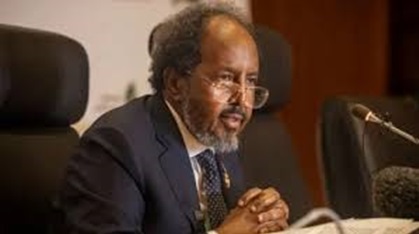
Mogadishu (WDN) – Former President Hassan Sheikh Mohamud has once again returned to a familiar political refrain: blaming the opposition for resisting his government’s electoral and constitutional agenda while insisting that his administration remains committed to introducing one-person, one-vote elections and a multi-party political system.
In an appearance on the Miisaan Podcast, the former President argued that the central dispute between the Federal Government and the opposition is not about personalities or power, but about competing visions for Somalia’s future.
According to former President Hassan, the opposition wants to preserve Somalia’s long-standing indirect electoral model, while his government is determined to move the country toward direct elections and party-based democracy. This is a message Somalis have heard repeatedly over the past several years and position that contradicts his position before he became president.
The former President again emphasized that his administration will not abandon its plans for universal suffrage, describing it as an essential pillar of modern state-building. He also dismissed calls to revert to the 2012 Provisional Constitution, arguing that Somalia has already moved beyond that phase of its political development.
“We are not creating a new constitution,” the former President insisted. “We are merely completing and reviewing the existing constitutional process as required by the constitution itself.”
Yet despite the confident rhetoric, the political stalemate remains largely unchanged. The same arguments, the same accusations, and the same promises continue to dominate Somalia’s political landscape, while consensus among key stakeholders remains elusive.
Many believe that the former President views the presidency less as a national trust and more as a vehicle for consolidating power and advancing the interests of a narrow circle of political allies and family members.
The former president further claims that he has repeatedly challenged opposition leaders to present a credible alternative roadmap, maintaining that no clear proposal has been put forward to replace the government’s vision.
Many ordinary citizens and opposition figures alike, however, reject that characterization, arguing that the real issue is not the absence of alternatives but the lack of meaningful compromise and inclusive dialogue from Villa Somalia.
Despite his rhetoric, the former president has often governed in a highly centralized manner, prioritizing political control over consensus-building.
The opposition maintains that the dispute is not about opposing democracy, but about concerns over legitimacy, consultation, constitutional procedure, and the timing of major political changes in a deeply divided country
What has increasingly caught the attention of political observers is the cyclical nature of the debate. Every few months, the nation appears to return to the same crossroads: the government presses ahead, the opposition objects, negotiations stall, and political tensions rise before outside actors quietly step in to encourage compromise.
That pattern has led many Somalis to ask a question that remains unanswered. Where is the international community role, as increasing reports suggest that some diplomatic missions are considering relocating their embassy operations to Nairobi amid growing concerns over the political and security situation?
For years, international partners have played an active role in helping Somalia navigate political crises, often stepping in when local mediation efforts failed to produce meaningful outcomes. Whether disputes threatened the constitutional order, electoral processes, or national stability, external actors frequently served as key facilitators, helping bridge political divides and prevent crises from escalating into broader instability.
Today, however, the response has been noticeably muted. As Somalia edges deeper into another political impasse, many observers are beginning to wonder whether international actors are deliberately adopting a hands-off approach or whether a broader strategy is unfolding behind closed doors.
The silence has fueled speculation across the political spectrum. Some believe international partners are allowing Somali leaders to resolve their differences independently. Others suspect that foreign stakeholders may be waiting for a decisive political moment before re-engaging. Still others question whether an undisclosed political roadmap exists that has yet to be revealed to the public.
Whatever the explanation, the absence of the robust international intervention seen during previous constitutional and electoral disputes has become one of the most discussed aspects of the current crisis.
Meanwhile, former President Hassan remains unwavering. He continues to insist that Somalia will not return to the 2012 constitutional framework and that the government will push forward with its electoral and constitutional agenda.
The question many Somalis are now asking is no longer whether the former President will repeat his position. He has done so consistently. The real question is whether repeating the same message without achieving broader political consensus can break the deadlock—or whether Somalia is once again heading toward a familiar cycle in which compromise arrives only after the political temperature reaches its boiling point.
Until then, the country remains suspended between competing visions, unresolved constitutional disputes, and an international community whose unusual silence has become almost as significant as the political arguments themselves.
WardheerNews
Leave a Reply