
By Abdullahi A. Nor
What began as a technical vacancy has, in a matter of days, morphed into one of the most revealing episodes in Somalia’s current political cycle—an episode that exposes not just procedural irregularities, but a deeper, more troubling pattern: the relocation of power away from institutions and into improvised political arenas.
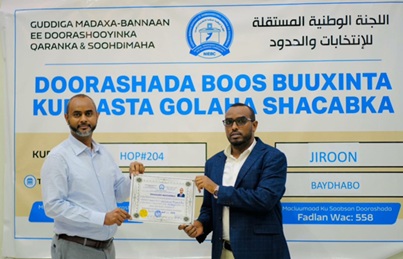
The story turns on a single parliamentary seat—HOP204, but its implications stretch far beyond it. The Minister of Ports and Maritime Transport, Abdulqadir Mohamed Noor (Jama), has been declared the winner of that seat following an election held not in Mogadishu, within the formal confines of parliament, but in Baidoa. That detail alone might have passed unnoticed in calmer times. It does not now.
Because the vacancy that triggered the election did not emerge through a transparent parliamentary process. It was not debated on the floor. It was not adjudicated through a visible institutional mechanism. Instead, it was pronounced—suddenly, and outside the capital on the grounds that the sitting MP, Isaaq Ali Subag, had failed to attend more than two consecutive sessions.
On paper, that accusation invokes Article 59(1)(d) of the Provisional Federal Constitution, which provides for disqualification under such circumstances. In practice, however, the manner and timing of its application raise immediate questions.
Hon. Subag’s absence was not hidden. It was known, tolerated, and, crucially, politically sanctioned. Since 2023, he has been serving as a minister in the South West State administration—an appointment that did not occur in defiance of the system, but within it, reportedly with the knowledge and acceptance of parliamentary leadership.
For nearly two years, this dual role did not trigger alarm. Until now.
The sudden invocation of constitutional disqualification—just days before the expiration of the current parliamentary term on April 15, 2026, has therefore landed less as a routine enforcement of rules and more as a calculated intervention at a politically sensitive moment.
Hon. Subag himself has leaned into that interpretation.
“It is shameful and deeply troubling corruption that none of the MPs from Galmudug who are serving as minister of Finance and minister of Environment have had their seats touched, while I alone have been targeted,” he said. “I believe the reason is that my Federal Member State has become one that is under the control of the Federal Government by force, where its people and leadership are being manipulated as desired.” Listen and see Hon. Subag on TV (20+) Facebook
His argument is not that the law does not exist. It is that it is not being applied equally. And that distinction is critical. Because selective enforcement is more destabilizing than non-enforcement. It signals that rules are not neutral constraints, but instruments—activated when convenient, ignored when not.
Hon. Subag’s claim gains traction when placed against precedent. He pointed to figures in Galmudug who have held ministerial positions while retaining parliamentary roles without consequence. He referenced the case of Ahmed Macalin Fiqi, who served in a regional cabinet while still a federal MP during a previous Parliament (10).
Whether these comparisons are legally identical is almost beside the point. Politically, they are persuasive. They suggest inconsistency—and in fragile systems, inconsistency quickly becomes grievance.
The election that followed has only deepened that perception. Conducted in Baidoa by the so-called Independent National Electoral and Boundaries Commission—a body whose credibility is itself contested—the vote delivered a decisive outcome. Abdulqadir Mohamed Noor secured 96 votes, a margin that would ordinarily signal overwhelming support, but its staged and the process that produced it has drawn more attention than the result itself.
His sole opponent withdrew before the vote. Not dramatically, not contentiously, simply withdrew. The explanation offered is familiar: political negotiations, quiet agreements, undisclosed understandings. In Somalia’s political lexicon, such phrases often serve as placeholders for decisions made elsewhere.
The effect was immediate. What could have been a competitive race became a formality.A ballot was cast, but the outcome appeared prearranged. And the location matters.
Baidoa is not just a regional capital; it is currently the epicenter of a high-stakes political contest over the presidency of South West State. Competing factions are maneuvering for control, alliances are shifting, and federal involvement in shaping outcomes is widely debated.
Within this volatile context, Abdulqadir Mohamed Noor’s sudden transition from minister to MP is being read less as coincidence and more as coordination.
Reports suggest a broader strategy in motion: an alignment that could see Speaker Adan Madoobe repositioned as President of SWS, opening a pathway for Noor to pursue the speakership himself.
If accurate, the implications are significant. Because it would mean that HOP204 was not simply filled.It was acquired—with purpose. That purpose, however, collides with another reality: timing.
Parliament 11 is days away from the end of its term (April15,2026). The window for legislative action is closing. Under normal circumstances, such a late-stage intervention would carry limited practical value. Unless, of course, it is not about legislation. But about positioning. The reaction from within parliament reflects this unease.
A group of lawmakers, identifying themselves as the “Free Parliament,” has rejected the process outright, declaring the seat allocation illegal. Their statement underscores a growing perception that institutional procedures are being bypassed or reinterpreted to serve immediate political ends. Please
At the same time, public debate has shifted toward another layer of controversy: clan allocation.The seat is said to belong to the Jiroon clan, and its reassignment to Abdulqadir Mohamed Noor has sparked accusations that it was effectively appropriated. Noor has dismissed these claims, stating that the clan itself endorsed him as its representative.
In Somalia’s clan-based political architecture, such endorsements carry weight—but they are rarely uncontested.
What emerges from this episode is not a clear narrative of legality or illegality, but something more ambiguous and more consequential: a system in which formal rules exist, but their application is fluid; where institutions function, but their authority is questioned; where outcomes are decisive, but their legitimacy is debated.
Even the most basic sequence—vacancy, election, victory—has been disrupted by the manner in which each step unfolded. A seat declared vacant outside parliament. An election held in a contested political arena. A candidate running unopposed after a sudden withdrawal.
Individually, each element can be explained. Together, they tell a different story. One in which process is overshadowed by intent. And intent, increasingly, is shaped not by institutional norms but by shifting political calculations.
The surprise is not that Abdulqadir Mohamed Noor won. It is how seamlessly the path was cleared for him to do so. And in a system where outcomes appear increasingly predictable, it is not the result that draws scrutiny—but the machinery that delivers it.
Abdullahi A. Nor
Email: abdulahinor231@gmail.com