
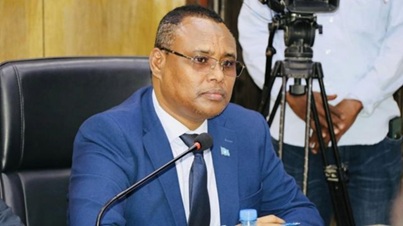
Baidoa (WDN) — If there were any lingering hopes that the newly installed interim leader in South West State Jibril Abdirashid, might project competence, restraint, or even a semblance of public accountability, they were shattered within hours.
The first major appointment has done exactly what the public and critics feared: confirm that power, once seized, is now being distributed not on merit but along family lines.
Multiple sources report that the individual appointed today by President Hassan’s Interim Leader, is not just politically aligned, but personally connected. Some accounts go further, stating that the appointee is a close relative, even a cousin.
The appointment of Ali Abdullahi Isaaq as Director General of the Presidency has already ignited backlash, not only for what it represents, but for what it openly confirms: a leadership culture rooted in nepotism and cronyism, not governance.
For many observers, the move carries an unmistakable sense of déjà vu. It resurrects earlier remarks attributed to the same leadership figure, who once openly declared that if entrusted with power, his first priority would be to appoint close relatives. Watch the evidence.
What was once dismissed as political rhetoric has now materialized into administrative reality—swiftly, and without hesitation.
” This is not a misstep; it is a declaration of intent. This marks the beginning of President Hassan’s long-term strategy to install a vice president from his clan, along with many other calculated moves,” Siyad Sh. Omar, a founding member of South West State, told WardheerNews.
“In functioning systems, power is used to build institutions. Here, it is used to reward loyalty—and increasingly, blood ties,” Siyad added.
And the timing could not be more telling. At a moment when South West State is already engulfed in political controversy, questions of legitimacy, and accusations of external imposition, the decision to prioritize kinship over competence sends a message that critics say is both reckless and revealing.
Further compounding the controversy is the background of the appointee himself. Ali Abdullahi Isaaq is not new to the system, he previously served as head of the South West State intelligence agency. His re-emergence in such a powerful administrative role raises additional concerns about the recycling of familiar figures within an already contested power structure.
His clan affiliation, has also entered the political conversation, underscoring the delicate and often volatile intersection of clan dynamics and state appointments in Somalia’s federal framework.
But beyond the individual, it is the pattern that is drawing the strongest reaction. A leadership installed under heavy political pressure. A legitimacy crisis still unresolved.
And now, a first act defined by alleged nepotism.
For critics, the conclusion is unavoidable: this is not the beginning of reform—it is the continuation of a deeply entrenched political culture where public office is treated as private entitlement.
As South West State enters this uncertain chapter, the message from its new leadership appears unmistakably clear: The rules have not changed. Only the beneficiaries have.
WardheeerNews