
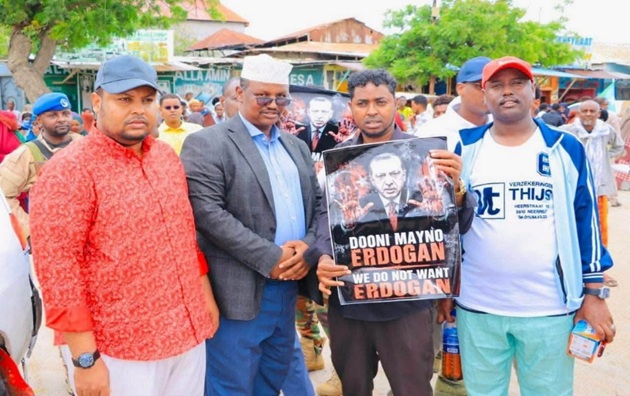
Kismaayo (WDN) — Streets in Kismaayo and Doolow have become the latest stage for Somalia’s deepening political confrontation, as protesters rallied against the Federal Government and expressed anger toward Turkey, a country that has spent more than a decade building one of Somalia’s closest and most consequential foreign partnerships.
Demonstrations were held in Kismaayo on Friday in an event reportedly organized with the involvement of the Jubaland administration. Similar protests were also reported in Doolow and Garbahaarey, following the attack two nights earlier on the residence of General Mahad Abdirahman “Shub.”
The demonstrations reflected growing anger over the Doolow incident, which has become politically charged amid competing claims about who was responsible. The Federal Government has denied that the attack was carried out by an aerial strike. However, protesters in Jubaland reportedly expressed the belief that Turkey was involved, a view that appears to have been reinforced by statements from political figures aligned with Jubaland.
The anger directed at Turkey is particularly striking because Ankara has developed an unusually deep relationship with Somalia since opening its major diplomatic mission in Mogadishu in 2011. Over the years, Turkey has become a major partner in Somalia’s humanitarian assistance, infrastructure development, education, health services and security sector. Turkish institutions have built schools and hospitals, provided humanitarian assistance and trained Somali security personnel.
Turkey has also become one of the Federal Government’s most important security partners, making its military relationship with Mogadishu particularly sensitive whenever Somalia’s internal political disputes become intertwined with security operations. That is what makes the scenes in Kismaayo, Garbaharey and Doolow so significant. A country that once became one of Somalia’s most warmly received international partners is now seeing its national flag publicly rejected in Jubaland.
From Friendship to Political Controversy
The demonstrations demonstrate how quickly Somalia’s internal political divisions can spill over into attitudes toward foreign partners. For years, Turkey’s presence in Somalia was widely associated with development, humanitarian assistance and reconstruction. Its growing military role, however, has increasingly placed Ankara closer to the center of Somalia’s political and security disputes.
The Doolow incident has brought that tension sharply into view. Protesters believe Turkey was connected to the attack, but those allegations have not been independently verified. The Federal Government has rejected claims that the incident involved an aerial bombardment. The competing narratives have nevertheless created a politically explosive environment in which Turkey’s role is becoming part of the wider dispute between Mogadishu and Jubaland.
Perhaps the most unusual feature of the demonstrations was also the reported appearance—and burning—of the Egyptian flag, despite Egypt not being directly identified in the dispute described by the protesters. The unexpected symbolism has prompted speculation among political observers about whether outside actors could be attempting to influence or exploit the demonstrations.
Some analysts have raised suspicions about possible Ethiopian involvement in the organization of the protests. There is, however, no independently verified evidence presented here establishing that Ethiopia organized or directed the demonstrations. The presence of an Egyptian flag therefore raises questions rather than providing answers.
A Wider Regional Rivalry
The episode is unfolding against a broader regional landscape in which Somalia has become an arena for competing strategic interests involving Turkey, Ethiopia, Egypt and other regional and international powers. Somalia’s location along the Red Sea and Gulf of Aden gives its political stability and security relationships importance far beyond its borders. For Turkey, Somalia represents one of Ankara’s most important footholds in Africa. For Ethiopia, developments inside Somalia have direct implications for border security and regional influence.
Egypt, meanwhile, has its own strategic interests in the Horn of Africa and its long-running rivalry with Ethiopia. That makes any visible sign of foreign influence in a Somali political protest particularly sensitive. The protests in Kismaayo and Doolow should therefore not be viewed simply as isolated demonstrations over one security incident. They reflect a deeper question about how Somalia’s foreign partnerships are being perceived by different political constituencies inside the country.
Turkey’s relationship with Somalia has survived governments, crises and changing political circumstances. But its increasingly visible security role means that Ankara can no longer easily remain outside Somalia’s political controversies. The irony is striking. Turkey built much of its influence in Somalia through an image of friendship, development and solidarity at a time when few other countries were visibly engaging with the country. Today, that same relationship is becoming entangled in Somalia’s increasingly bitter political and security disputes.
The Doolow attack remains surrounded by competing accounts, and allegations of Turkish involvement require credible independent evidence. But the political symbolism of the protests is already clear.
When Somali citizens begin burning the flag of a country that has spent years presenting itself as one of Somalia’s closest friends, the issue is no longer simply about one attack. It is a warning that even the deepest foreign partnership can become politically vulnerable when it is perceived as taking sides in Somalia’s internal struggles.
WardheerNews