
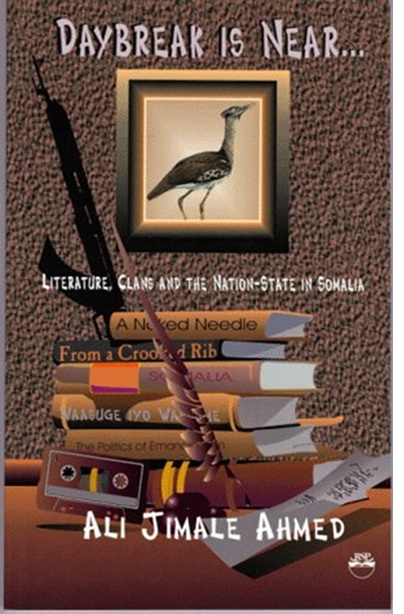
Reviewed by: Abdulkadir Osman Farah
Author: Ali Jimale Ahmed
Publisher: Red See Press
Year: 1997
Pages: 176
Once, an exiled scholar in history and literature returns to his ancestral region (town). Hoping to access, learn and research more about ancestral history, culture and heritage. As soon as the scholar arrived, his thrilled close relatives received him with expectations and enthusiasm. With decades long absence from the society, the scholar requested a calm, quieter place to work and concentrate. Declaring his aims of becoming a valuable returnee for all members of the society. Serving, not necessarily and exclusively for his close relatives, but for the entire community. With emphasis on independently studying and verifying the history and development of his ancestral town. On their part, the relatives insisted that under no circumstances will they permit him to move around town as an ordinary person. For the task, they designated a couple of energetic youth to accompany, keep an eye and provide him with whatever he needed in his work. The elders also suggested, and eventually requested, that their returned accredited academic son should prioritize and elevate the specific history and narratives glorifying his close ancestors and their heroic contribution and achievements in the ancestral town.
Astonished, the scholar agreed to see the case, while not promising much to his cousins. Soon after, other elders, who heard the arrival of the town’s prominent transnational son, came to the scholar and demanded concrete profiling of their version of history. Specifically, aspects pointing to current leaders of the town accessing reign and privilege illegitimately. They claimed to have concrete documentation for that neglected history that current elites of the town were not the real adherents to govern. Days after, a third angrily agitating community constituent rushed to the scholar’s temporary working place. They suggested the two most dominant constituents of the town, whom he earlier met and listened to, were indeed in the past people of humble subordinate background. Adding that despite their current excluded sociopolitical conditions, they were the real historically superior and glamorous people of the town. They demanded that history has to be re-written, re-evaluated, recorded and disseminated, so the truth comes forward.
After several months of interviews, research and meetings, the scholar was confused and frustrated, overwhelmed by the outpouring emotions and distortions. Particularly, the deep egocentrism and selfishness of the town’s people. He invited them to a public gathering. Declaring that with their superficial non-caring irrational attitudes and behaviour, they deserve neither balanced documentation of history, nor substantial present or prosperous future.
He, then, in their bewilderment publicly burned the research notes he so far compiled. Announcing to his ancestral people his regretful decision of returning to exile. Under conditions, he at least imaginatively and nostalgically, could speculate a collective past with a potentially prosperous present and future.
As a prominent scholar Ali Jimale Ahmed, though confronting similar challenges of navigating among diverse competing Somali constituents, he never abandoned caring and studying the Somali society from multiple perspectives. Deeply listening, engaging as well as mediating not just the diverse, often quarreling constituents and perspectives among his people, but also among diverse communities around and across the world. He often critically sees ideas and practices from within, around, across and beyond often publicly presented unidimensional projections. However, If he has to position himself, he prefers situating himself among the subordinated and excluded/ sidelined communities/constituencies. Not because they remain at the bottom of existing dominating hierarchies, but because the excluded, in comparison to the included, act authentically and less superficially. Their voices provide genuine explanations of both the existential life-world as well as that of the systematic failures of institutional frames. Ali Jimale associates himself with the subaltern voices (mustadcafiin) instead of constituents accessing state privileges and their supporting propaganda machinery. This implies the significance and the legitimation of Somaliness lies not with state and power mechanisms but on actual Somali practices through community resilience and solidarity. Such consolidation of continuity goes back to ancient times. In comparison, the imposition of bureaucratic and systematic hierarchies arrived more recently and remains either absent or fragile from the ordinary routine daily lives of the people.
Furthermore, Ali Jimale’s work partially resembles the work of renowned German European intellectual Jürgen Habermas. In the 1960s, Europeans held the view that the foundation of progress for people and societies mainly lay with the efforts of administrations, leaders, the actions of the upper class, and the state. At the time, Habermas offered a different perspective. In the book “The Structural Transformation of the Public Sphere “ (1962), he analyzes the rise and decline of the “bourgeois public sphere”—as space for rational-critical debate independent both from the state and upper class structures. Through his research, Habermas discovered that true social and political change originates from the middle and from lower struggling classes. He studied the history of literacy in Europe and found out that as people began reading newspapers and books, they started actively participating in politics and nation-building efforts differently. This led to the formation of what he called the “Public Sphere”—a communal space where public opinion is exchanged and refined. Habermas’s studies later concentrated on the idea of “filtering” public discourses from emotions, simplifications, falsehoods as well inaccurate proclamations. He also aimed to integrate those publicly produced perspectives and ideas into the structure of the state for wider dissemination and implementation.
Read more: Hopeful Renewal (Maalin walba Waabarigeed) Celebrating 30 years with “Daybreak is near”
Dr. Abdulkadir Osman Farah
Email: osmanfaraha@gmail.com
————-
Dr Abdulkadir is a vvisiting Research Professor, Somali National University ; Associate Aalborg University, Denmark-Migrant Solidarity and Hospitality in Global Perspective; Research and Innovation Associate, Tshwane University of Technology, Pretoria, South Africa.