
By Abdulkadir Osman Farah, PhD
Once, two Somali diaspora friends met in a major Somali city. The first returned to the homeland decades earlier. Witnessing people’s suffering and helping them recover from a devastating civil war. The second returned periodically also offering his people qualified support. One day, during a casual conversation over coffee, the near-permanent returnee advised the temporary returnee: “Ku soo noqo dalkaaga/dadkaaga inta aysan qurabaha lugaha kaaga banjarin” (Return to your homeland and your people before exile leaves you physically or mentally immobile).
The phrase “lugo banjar” evokes punctured wheels or tires. Suggesting the loss of movement across spaces. Human beings, of course, remain more valuable/incomparable to automobiles. Yet the phrase urges a friend to return while still energetic and capable. The mindful alert also implies a ticking biological clock. Somalis who migrated as young people during the start of the civil war now confront aging. Biological experts observe, “the worst that can happen to people’s health is to get old.” “lugo banjar” therefore confirms gradual physical decline.
Involuntary exit
In most cases, people do not choose exile freely. Upheavals force them to leave the homeland. People seek safety where they find peace enabling them to express their abilities. Many confronted injustices at home, pressuring them to seek shelter and sanctuary elsewhere. Above all, they quest for dignified and worthwhile life.
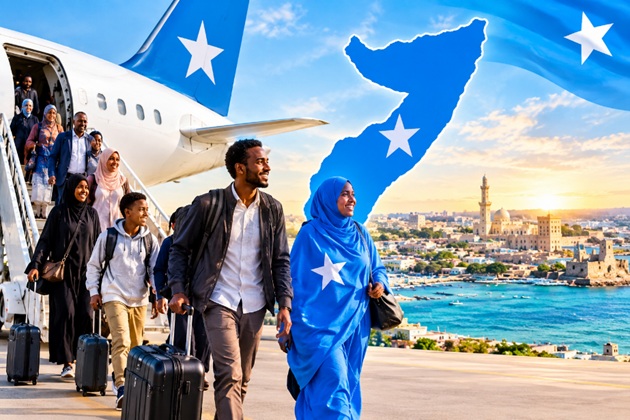
Likewise, returning to the homeland signifies more than people moving across borders. It involves shaping identity and opening to new possibilities. People do not simply wander but act upon serving and preserving life.
Returning diasporas carry social, political, economic, and cultural values. They bring with them practical experience from exile. Log-term displacement does not fully detach them from the homeland. The homeland lives in their minds, bodies and hearts. People seek more than territory. They seek meaning, values, and dignity. They do not only find homes. They also create them, both real and imagined. For that reason, though avoiding “lugo banjar” matters, cultural memory, intergenerational conviction, and care for community sustains diaspora communities.
Networks
The two friends discussing in the Somali city do not act in a social and political vacuum. Diaspora members belong to complex national and transnational networks. These networks can help them cooperate and collaborate. At times, they can also hinder them achieving their goals. Long-term returnees often become more pragmatic after absorbing realities on the ground. They learn to navigate a civil war-torn society/nation.
In contrast, periodic returnees may feel anxious under such unpredictable informalized settings. They often lack familiarity with prevailing local conditions. Jeebleh, the protagonist in Links by Nuruddin Farah, shows this cultural livelihood tension. A Somali diaspora professor in the United States. Jeebleh returns due to family emergency. Subsequently confronting psychological and moral challenges.
On one hand, he believes he belongs to the homeland. On the other, his long absence makes him an outsider. After decades of relative comfort in the United States, he finds the society in his memory no longer exists. To survive, he learns the new social, cultural, and political codes. Institutionalized civil war subversive realities. A believer of a noble Somali nationalism and civic responsibility, Jeebleh encounters a destroyed civil society with almost no visible rules. An incident of a militia attack on close relatives pushes him to abandon the passive detachment. Actively participating in the civil war, in the messy factional clan warfare.
A situation in which a merciless strongmen and warlords took traditionally accommodating Somali social contract and heritage hostage. Abandoning any form of civic and moral responsibility. Meanwhile, locals occasionally consider returning diasporas as privileged outsiders. People who left during intense need and suffering. Years later returning with dollars, arrogance and snobbishness.
The myth of returning
Returning to the homeland is not a simple one-way journey. This is especially true for those who left decades ago with pain and suffering. Many of them carry private memories and legacies. They often have few people with whom they can share these experiences. Returnees also keep parts of the lives they built in host societies. They maintain families, associations, businesses, and political networks. In the current digitalized connected world, they also work and link across borders. Transnational communities differ by generation, class, legal status, education, and memory. Returning from the Middle East, for example, differs returning from Scandinavia.
Research documents “the myth of return.” A myth referring to migrants and diaspora persistently believing that “life in host societies is temporary”. Yet new generations grow up with different and sometimes conflicting wishes. The original homeland return research is more than four decades old. Today, transnational and global structures connect the world more deeply. People can now belong to several countries and remain active in them without returning. Multiple belongings and citizenships create a life more complex than a simple divide between here and there.
More people, including many young people, now live in this interconnected life. Attachment to one place can offer rootedness and belonging. Transnational belonging provides opportunities across several spaces. The homeland link may strengthen identity, culture, history, memory, and belonging. The host society may provide legality, economic security, and education. For many people, the issue is, therefore, not choosing one nation over another. It is accessing possibilities from several places simultaneously.
State-diaspora successes
Today, China, India, and Turkey benefit strongly from a connected, transnational, and globalized world. These states do not treat their diasporas as separate from homeland societies. They treat them as citizens with rights and obligations toward the homeland.
By contrast, Africans, including Somalis, have suffered disconnection/disruptions due recurring civil wars. African nations also suffer from continuing “brain drain.” Particularly, Somalis struggle to turn “brain drain” into “brain gain”. One major obstacle concerns the lack of justice and fairness in the homeland. This is not only a matter of comfort or economic priority. Today, Somalis prefer assembling into transnational hubs such as Nairobi, Kenya. Increased number of Somali diasporas prefer settling there, only about a one-hour flight from homeland. This is certainly related to the existence of “rule of law” in the country and the opportunity of living and moving around peacefully.
Under such transnational circumstances, Somali communities create a form of a “third hybrid space”. A space that could not be squarely described as geographical. This is an alternative location that holds images, memory, culture and faith. Communities work carefully, step by step, creating what Edward Said called “imaginative geography.” A form of belonging and commitment that exceeds what single states and nations can grasp, capture, or dominate.
Diasporic commitment
Recurring questions often inquire: whom do transnational diaspora communities serve? Do they act as economically and politically driven opportunity seekers? Do they settle wherever “cagaaran, doog leh oo uu mar walba roobku ka dao!” Or do they act as accountable people who accept moral, civic, and human responsibility? Do they help others and reduce suffering wherever they live? Certainly, not many people willingly migrate from a place with relative public justice, fairness, and opportunity. This reality leads to yet another common question: “Why not courageously return to the homeland and actively contribute to favourable social, political, and economic environment?”
Examples of committed Somali diaspora members, who did their best, include the late Somali literary intellectuals and composers Axmed Naaji Sacad and Axmed Cali Cigaal. In their actions, the Somali artists exemplified diasporic life is far from categorical. Through their cultural commitments, enlightenment, and performances, they demonstrated Somalis remain undefeatable “unpuncturable” (Ummad aan lugaheeda la banjarin karin). They imagined a global and interconnected nation seeking dignity and accomplishing better prospects for people. A vibrant nation stretching across homeland, hostland, and the spaces between. Sadly, these two cultural leaders, like many other prominent Somali diasporas, did not had the opportunity to permanently return to the homeland. Let us hope and pray that Somalis will soon overcome the persistent avoidable/unnecessary social and political elite disputes. A hopeful process that could prevent “lugo banjar” by letting Somali diasporas, similar comparable diasporas, resettle, develop and expand the material and non-material resources of their homeland:
“Haddii aynu nahayee qurba joogta Soomaaliyeed, dunida hareeraheeda halkii aynu joognaba, hoygii aan ku dhallannay hilmaami meynee, had iyo jeerba kal iyo labtaan ku heynaayo hilmaami meynee, dalkii hooyo hilmaami meynee. Horumarkii waddankeenna, himaladii shicibkeenna, had iyo jeer ku hammineynaayoo, ka hari meynee. Hiigsiga israaceenna, giddi waan u hiilineynaa. Halyeeyadeeniyo waxgaradkeenuba, haween iyo raggeenuba horseedayaasha oo idil, hambalyaanu leenahay Horumarkii dalkeennee, horukacii dadkeennee horuwadaay, horuwadaay, walaalayaalow, horuwadaay, ha noolaatee” (Axmed Naaji Sacad & Axmed Cali Cigaal).
“If we are the Somali diaspora, wherever we may be across the world, we will not fail our homeland, where we were born; we will always hold it in our hearts and minds and never forget it. We will not forget our motherland. We will always aspire to the progress of our country and the hopes of our people, and we will not abandon them. We will stand for the goal of our unity. To all our heroes and intellectuals, to our women and men, and to all our leaders, we offer our congratulations. For the progress of our country and the advancement of our people, keep moving forward, my brothers and sisters. And let it live and prosper.” (Ahmed Naji Saad & Ahmed Ali Egal).