
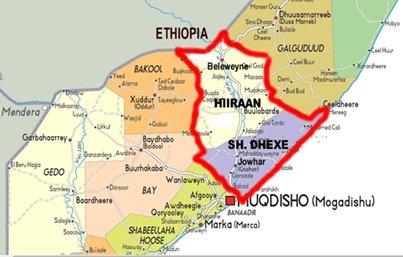
Beledweyne, Somalia (WDN) — HirShabelle’s disputed election process has been thrown into fresh turmoil after armed men reportedly seized a voter-registration center in Beledweyne, turning a political dispute over the credibility of the vote into a direct security challenge.
The incident comes as the National Independent Electoral and Boundaries Commission moves ahead with plans to hold HirShabelle’s regional parliamentary and local council elections on September 30, 2026.
The commission says the preliminary voter-registration list will be published on September 2, with registration and polling locations to be announced on September 15. But in Beledweyne, the dispute has already moved beyond political rhetoric.
Abdulqadir Yusuf Elmi, who identified himself as leader of the armed group, told Universal TV that the men occupied the facility to protest what they described as an unfair electoral process. He alleged that parliamentary seats were effectively being assigned to predetermined individuals rather than decided through genuine competition.
Former HirShabelle President Ali Abdullahi Osoble has also separately called on MPs from Hiiraan to oppose what he described as the commission’s electoral plans or resign.
A Credibility Crisis
The confrontation comes amid mounting questions over the independence of the national electoral commission. Critics accuse the commission of operating too closely to the Federal Government and President Hassan Sheikh Mohamud, raising questions over whether it can function as a neutral referee in an increasingly polarized political environment.
Those concerns have been intensified by the commission’s handling of the recent Galmudug elections, which were subsequently annulled by Somalia’s Supreme Court. The court ruled that the July 30 process failed to comply with the Constitution and national electoral law.
That decision leaves a difficult question hanging over HirShabelle: Can the same electoral machinery deliver a credible process when its previous regional election has already faced judicial annulment?
The crisis in Beledweyne exposes deeper tensions between Hiiraan and the HirShabelle administration over political representation and the distribution of power. The seizure of an electoral facility is particularly significant because it shows how quickly political disagreements can acquire a security dimension when communities believe an electoral outcome is being predetermined.
The danger is not simply a disputed vote. A process rejected by significant political and community actors could produce competing claims to legitimacy, deepen federal tensions and further weaken public confidence in Somalia’s electoral institutions. The September 30 timetable therefore answers only one question: when the vote is supposed to take place. The more important question is whether HirShabelle can produce an election that voters, candidates and political stakeholders regard as legitimate.
If that confidence is absent, the ballot box risks becoming another arena for Somalia’s political conflict rather than a mechanism for resolving it. Beledweyne may be the first warning that electoral scheduling without political consensus can create instability rather than democratic legitimacy.
WardheerNews