
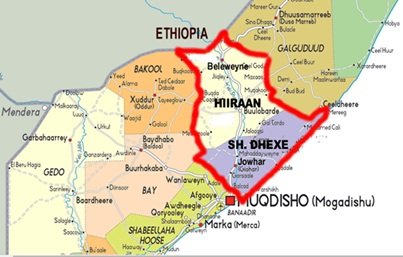
Hirshabelle’s deputy president, Yusuf Dabageed, has denounced the election in Jowhar as an exclusive political exercise serving President Hassan Sheikh Mohamud and his allies. His defiance, coupled with Hiiraan’s rejection of the process, raises fresh questions about the federal government’s authority and the viability of the president’s political project.
BALADWEYNE (WDN) — The political confrontation over the election taking place in Jowhar has escalated after Hirshabelle Vice President Yusuf Dabageed rejected the process, declaring that it lacked inclusivity and violated the constitutional and legal frameworks governing Somalia and the federal member state.
Dabageed’s intervention from Baladweyne, the capital of Hiiraan region, represents a direct challenge to the political process being pursued in Jowhar. He argued that the election was not a genuine exercise in political representation, but a process controlled by President Hassan Sheikh Mohamud and his allies.
“We make it clear that what is being described as an election in Jowhar is an affair confined to Hassan Sheikh and his group. It violates the laws and regulations of the country, beginning with the constitutions of the Federal Government of Somalia and Hirshabelle,” Dabageed said.
The deputy president has previously opposed the federal government’s political plan and has established his political base in Baladweeyne, placing him at the center of Hiiraan’s resistance to the Jowhar process.
His position goes beyond criticism of the election’s conduct. Dabageed has made clear that Hiiraan will not accept the outcome as binding on the region, further widening the rift between the authorities in Jowhar and political leaders in Baladweyne.
“Any outcome resulting from this fraudulent exercise has no relevance to Hiiraan. Anyone who attempts to cooperate with it will be responsible for the consequences,” he said.
His declaration underscores the depth of the dispute, although the legal status of any attempted withdrawal from Hirshabelle would depend on the applicable constitutional and institutional procedures which are at this juncture ignored by the FGS.
Hiiraan’s defiance threatens Hirshabelle’s cohesion
The dispute exposes a fundamental problem for Somalia’s federal system: what happens when a regional election proceeds without the acceptance of a significant part of the population and political leadership it is supposed to represent?
Hirshabelle’s stability depends on cooperation between its constituent regions and the legitimacy of its governing institutions. If Hiiraan’s leaders reject the Jowhar process and refuse to recognize its outcome, the consequences could extend beyond the selection of regional officials to the authority and cohesion of the entire administration.
The confrontation also raises questions about the federal government’s role. If the process is perceived as being engineered to favor a particular political camp, it risks deepening mistrust between Mogadishu and regional actors rather than strengthening the federal system.
For President Hassan Sheikh, the challenge is especially serious because the dispute adds to broader tensions over elections, constitutional arrangements and relations between the federal government and federal member states.
The political arithmetic is turning against Hassan Sheikh
The crisis in Hirshabelle has wider implications for the president’s political standing. Puntland and Jubaland have remained prominent opponents of his approach to federal politics, while South West State has also experienced serious tensions with Mogadishu. Hiiraan’s rejection of the Jowhar election adds another complication to the president’s efforts to consolidate political authority through the federal system.
If these regional disputes persist, Galmudug could become the only federal member state firmly within Hassan Sheikh’s political orbit. That would represent a strikingly narrow base of support for a president whose political programme requires cooperation across Somalia’s federal institutions.
The distinction between formal government recognition and political alignment is important: the disputes do not, by themselves, alter the legal status of the federal member states. But they do raise a broader question about whether the president can secure national agreement on the rules of political competition.
Hassan Sheikh’s confrontational slogan, “I will not stop for anyone,” has come to symbolise, for his critics, a governing style that prioritizes the pursuit of his agenda over compromise. The widening resistance from regional actors raises the possibility that this approach is producing the opposite of its intended result: rather than consolidating authority, it may be accelerating political fragmentation.
The test is whether the presidency can change course and pursue an electoral settlement that commands wider acceptance—or whether it will continue pushing forward despite mounting opposition.
Warning signs of a wider security crisis
The political tensions have also prompted warnings about the risk of armed rebellion. General Abdirahman Mohamed Turyare, Somalia’s representative to the Islamic Military Counter-Terrorism Coalition, has warned that Hiiraan, Middle Shabelle and Bay could see the emergence of armed movements resembling insurgencies operating in Ethiopia.
“Armed movements similar to those fighting in Ethiopia—Tigray, Amhara and Oromo—could emerge in Bay, Hiiraan and Middle Shabelle, and align with Al-Shabaab,” Turyare said.
The general urged authorities to act before the situation deteriorates and warned politicians who might lead such movements against risking their lives.
His remarks are a warning about a possible future scenario, not confirmation that such insurgencies have already formed or that their leaders intend to cooperate with Al-Shabaab. Nevertheless, the warning highlights the dangers of allowing political grievances to deepen in areas already facing serious security challenges.
When communities lose confidence in political institutions, disputes over representation and authority can become more difficult to resolve. If grievances are ignored or met with coercion, the risk of confrontation can grow, creating opportunities for armed groups to exploit divisions.
The federal government and regional administrations therefore have a shared interest in preventing political disputes from turning into another source of insecurity.
A choice between compromise and deeper fragmentation
The Jowhar election dispute has become a test of whether Somalia’s federal system can accommodate political disagreement without breaking down. Dabageed’s rejection of the process demonstrates that the authorities in Jowhar cannot assume that an election will automatically confer legitimacy simply because it has been held.
A sustainable resolution would require transparent electoral procedures, meaningful political participation and a credible mechanism for addressing the objections raised by Hiiraan’s leaders. The federal government should avoid treating opposition to its preferred process as disloyalty, while regional leaders should pursue their grievances through peaceful and lawful means.
The stakes are national. Somalia continues to face security threats, humanitarian pressures and the challenge of building institutions capable of serving a divided population. A prolonged struggle over political control risks diverting attention and resources from those priorities.
The message from Baladweyne is clear: an election that lacks broad acceptance can deepen a crisis rather than resolve it. If Hassan Sheikh’s political project continues to alienate federal member states and influential regional constituencies, his government may find that the pursuit of power without consensus leaves it increasingly isolated.
Somalia’s future depends not on one leader’s determination to press ahead, but on the willingness of its political leadership to reach agreements that protect the federal system, preserve constitutional order and prevent political rivalry from pushing the country towards further fragmentation.
WardheerNews