
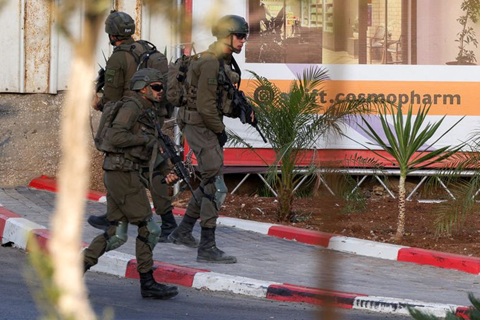
With Benjamin Netanyahu fighting to retain power, a shooting near Hebron has triggered sweeping security restrictions across the occupied West Bank. But beneath the election drama lies a more disturbing question: can Israeli politics offer Palestinians a future beyond occupation, settlement expansion and denied statehood?
HEBRON, West Bank — Israeli authorities have imposed a lockdown on Hebron following a gun attack just days before a closely contested election in which Prime Minister Benjamin Netanyahu is fighting to remain in power. The incident has placed security at the center of the campaign, but its wider significance reaches far beyond the immediate response: it has renewed questions about the future of Palestinians living under Israeli occupation.
According to Al Jazeera’s report on the West Bank arrests and rising attacks on farmers, the security operation comes amid heightened tensions across the occupied territory.
For Palestinians, the central question is not simply whether Netanyahu survives the election. It is whether a change of government would alter the policies that have kept Palestinian statehood out of reach for generations.
The positions of the leading contenders offer little immediate cause for optimism.
An election with profound consequences
A recent poll reported by The Times of Israel found the main political blocs locked in a tight contest, with neither projected to win a parliamentary majority. Coalition negotiations with smaller parties could therefore determine the next government’s direction, particularly on settlements and relations with the Palestinians.
The implications could extend across the region. As analysts discussed in Chatham House’s assessment of Israel’s election, the result could have significant consequences for Israel’s neighbors and international partners.
Yet the central contradiction is striking: the contest for political power is intense, but the political space for Palestinian independence remains extraordinarily narrow.
Both leading candidates oppose the creation of a Palestinian state, according to Reuters’ analysis of how a Netanyahu election defeat could affect Israeli policy. Their approaches may differ on specific policies, but neither has offered a clear path to Palestinian sovereignty.
Replacing Netanyahu might change the tone of Israeli politics or constrain some settlement policies. But such adjustments would fall well short of resolving the fundamental dispute over Palestinian self-determination, territory and political rights.
Settlements: the dividing line
Israeli settlements in the occupied West Bank remain one of the most consequential issues in the election. Settlement expansion affects the geography of any future Palestinian state, the movement of Palestinian communities and the possibility of establishing a contiguous territory under Palestinian authority.
Netanyahu has relied on far-right political partners who favour aggressive settlement expansion and, in some cases, annexation. His opponents have criticised aspects of settlement policy, although opposition to Palestinian statehood among leading candidates raises questions about how far a new government would depart from the existing approach.
As the Financial Times reported in its examination of the election’s stakes, a Palestinian-Israeli lawyer described the moment as “existential.”
That word captures the stakes for Palestinians. Settlement policy is not merely a domestic Israeli political disagreement. It has direct consequences for land, mobility, security and the feasibility of an independent Palestinian state.
Even a more restrained settlement policy, however, would not by itself deliver Palestinian independence. The fundamental question is whether Israel’s leadership is prepared to accept genuine Palestinian sovereignty rather than an arrangement in which Palestinians exercise limited self-government while Israel retains decisive control over security and territory.
Hebron and the human cost of the conflict
The lockdown in Hebron brings these questions into immediate focus. Security restrictions can disrupt daily life for Palestinian residents, affecting travel, commerce, access to services and families’ ability to move freely. The scale and duration of the impact depend on how broadly and how long the restrictions are enforced.
Israeli authorities argue that security operations are necessary to prevent further attacks. The safety of civilians must be taken seriously, and attacks on civilians cannot be justified. But the protection of Israelis cannot be separated from the rights and safety of Palestinians living under occupation.
For Palestinian families, repeated closures, settlement expansion and violence contribute to a prolonged sense of insecurity. Preventing the next attack is essential, but lasting security also requires political conditions that allow both peoples to live without recurring cycles of violence, coercion and fear.
A strategy centred exclusively on security measures, without a credible political horizon, risks managing the conflict indefinitely rather than resolving it.
A Palestinian cause larger than any Israeli election
The Palestinian cause remains a defining test of international diplomacy. Governments continue to debate a two-state solution, while settlement expansion, fragmented Palestinian territory and the absence of a political agreement raise increasingly urgent questions about whether a viable Palestinian state can still be achieved.
International declarations supporting Palestinian self-determination will carry limited weight unless they are accompanied by sustained diplomatic engagement and practical measures to uphold international law.
The election also matters for Israel’s relations with neighboring Arab states. Regional partnerships may be strengthened by security and economic cooperation, but the unresolved Palestinian question remains a source of tension. Attempts to build wider regional arrangements while sidelining Palestinian aspirations risk leaving one of the region’s central conflicts unresolved.
For Palestinians, the danger is that their future becomes a secondary consideration in a political contest dominated by Israeli security, coalition arithmetic and the survival of political leaders.
A change of government is not necessarily a change of direction
A Netanyahu defeat could weaken the influence of far-right figures who advocate annexation and accelerated settlement expansion. It might also create room for a different diplomatic approach. But if the leading contenders continue to reject Palestinian statehood, a change of prime minister should not be mistaken for a commitment to Palestinian independence.
The international community must look beyond the personalities competing for power in Jerusalem. The decisive questions are whether settlement expansion will be curbed, whether Palestinian rights will be protected, whether Gaza can move towards reconstruction and accountable governance, and whether negotiations can lead to genuine sovereignty rather than an indefinite interim arrangement.
The shooting near Hebron and the resulting lockdown are immediate security developments. The deeper crisis is political: decades of diplomacy have yet to produce a settlement that fulfils Palestinian aspirations for freedom and self-determination while guaranteeing security for Israelis.
The real test of Israel’s next government will not be whether it can win an election or impose another lockdown. It will be whether it can help end a conflict that has denied Palestinians a secure political future for generations.
If Palestinian statehood remains unacceptable to the principal contenders, the election may change the leadership in Jerusalem without changing the fundamental reality facing Palestinians.
WardheerNews
Leave a Reply