
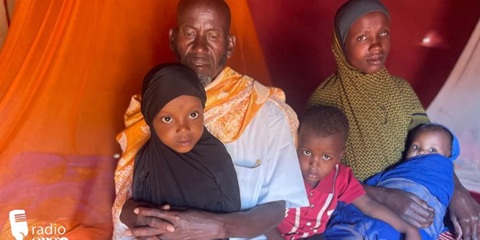
(ERGO) – Families displaced by fighting between Al-Shabaab and Somali government forces in Hiran region are facing food shortages, homelessness and constant uncertainty after fleeing several locations in search of safety.
Many have arrived in Coomaad, near Mataban, with few belongings and little means of supporting themselves.
Nuriya Mohamed Bare, 51, reached Coomaad on 10 October after walking there with her eight children from Hees, which was seized by Al-Shabaab and later recaptured by the Somali National Army.
She said her family had been repeatedly displaced by conflict over the past year and two months and had lost almost everything.
“We fled Moqokori without taking anything. Then I went to Bulo Burde with my children, but we left there too. We moved to Beledweyne, then to Teedaan, and later fled again. We went to Hees, where people collected assistance for us, but we had to flee from there as well. We have fled all these places because of Al-Shabaab,” she said
In Moqokori, Nuriya supported the family through a small restaurant where she prepared meals with pasta, rice and bread. The business earned her more than $10 a day that was enough to meet their basic needs. She is separated from her husband, who doesn’t provide any upkeep for the children.
Having to be on the run has interrupted her children’s education and left the family without a stable income.
Life in Coomaad is hard as the family has no adequate shelter, nor access to adequate food and clean water.
“We do not get food or water regularly. Even when we receive food, we have no cooking utensils. We fled our home and left all our belongings behind, but at the moment hunger is a bigger problem for us than having no house,” Nuriya said.
They receive some assistance from local volunteers collecting food from residents, but the supplies are irregular and insufficient. They share a few donated mats with other displaced families and sleep under acacia trees, exposed to rain and cold weather.
“It is the rainy season, but we have no houses to protect us from the rain. We spend the nights outside under trees,” she said.
The war has not chased them from Coomaad – but people have little sense of permanence due to the constant cycle of attacks and counterattacks.
“If this place remains peaceful, we would like to stay. We need people to provide us with sleeping mats, food and clothes,” she said.
Another mother, Hodan Mohamud Ahmed, who arrived in Coomaad with her three children on 15 October, says she has no relatives in the area to support them.
“Sometimes soldiers bring us food and we share it. At other times, local residents give us something. That is how we survive. We don’t have a particular place where we can stay. We move from one place to another,” she said.
Damage to telecommunications infrastructure has disrupted phone services, making it difficult for Hodan to contact relatives in other towns to request their assistance.
She said hundreds of displaced people were sharing a few houses, forcing many to sleep outside during the rainy season.
“There are about 300 of us, but we have fewer than 10 houses. Between 10 and 20 people share one house. We sometimes enter other people’s houses to shelter from the rain, but at night we sleep outside,” she said.
Hodan initially left Kowthar in Middle Shabelle region and has since moved through more than four locations in search of safety. Her family depended on 26 goats, which they had to abandon. She does not know what happened to the animals.
Coomaad has limited access to basic services, including education and healthcare. Local businesses have suffered as insecurity has reduced movement and trade. Many livestock keepers have moved elsewhere to protect their animals from looting, further shrinking the local economy.
The deputy chairman of Coomaad administration, Abdi Abdullahi Mohamud, said large numbers of people had arrived in this rural locality from conflict-affected areas. The administration had not yet registered the new arrivals to establish their exact number.
He said local authorities and residents were providing limited food and water but lacked the resources to meet the growing needs. The area had not received assistance from government agencies or humanitarian organisations.
“Many people have been displaced to this area from places including Moqokori, Teedaan, Mahas and Hees. These people urgently need humanitarian assistance,” he said.
The security situation in Hiran has remained volatile, with Al-Shabaab making territorial gains and government forces continuing their operations against the group.
Source: Ergo
Leave a Reply