
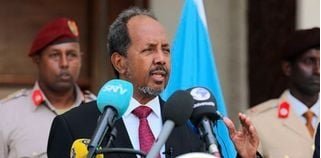
Mogadishu (WDN) — President Hassan Sheikh Mohamud has declared that the time has come for Somalia’s armed forces to assume full responsibility for the country’s security as international troops gradually reduce their presence, presenting the graduation of thousands of newly trained soldiers as evidence of growing national military capacity.
The President made the remarks during a graduation ceremony at the Xananbuure military training center in Galgaduud, where thousands of soldiers who had undergone nearly a year of training graduated.
The Federal Government described the graduating class as the largest single group of Somali troops trained inside the country at this level since the collapse of Somalia’s central government in 1991.
Addressing the recruits, Hassan Sheikh urged them to uphold military discipline, protect national unity and defend Somalia’s sovereignty. “Our time has come. It is time for us to assume responsibility,” the President said.
The declaration comes at a critical moment for Somalia’s security transition. The future of the African Union Support and Stabilization Mission in Somalia (AUSSOM) remains uncertain, while the mission’s current United Nations authorization is due to expire at the end of December 2026. Somalia is therefore under increasing pressure to demonstrate that its own security institutions can assume responsibilities previously carried by international forces.
The Reality Beyond the Graduation Ceremony
The graduation represents an important development for Somalia’s military institutions, but the reality on the ground remains considerably more complicated. Training thousands of soldiers is one thing. Deploying them effectively, supplying them, maintaining discipline, protecting their bases, coordinating intelligence and ensuring that they can hold territory after military operations is another.
Somalia continues to face a determined Al-Shabaab insurgency capable of conducting complex attacks, exploiting weaknesses in government-controlled areas and maintaining influence across parts of the countryside. The central challenge is therefore not simply whether Somalia can produce more soldiers. It is whether the state can build a military institution capable of sustaining operations over time.
Previous military campaigns have demonstrated that government forces can capture territory but have sometimes struggled to consolidate those gains once frontline units move forward or international support is reduced. That makes logistics, command and control, intelligence, local cooperation and post-operation governance just as important as battlefield strength.
The Xananbuure graduates are expected to play an important role in security operations across central Somalia, where government forces and local partners continue to confront Al-Shabaab. Their deployment will provide an early test of whether Somalia’s expanding military training programs are translating into sustainable operational capability.
The government has increasingly emphasized the development of a larger, more professional national army as international forces gradually reduce their role. But the transition carries considerable risks. If newly trained forces are deployed without adequate logistical support, reliable command structures and sufficient intelligence, increased troop numbers alone may not produce the desired security gains.
Conversely, if the government succeeds in combining the new recruits with experienced commanders, effective intelligence networks, community cooperation and sustained financial support, the expanded force could represent an important step toward genuine security self-reliance.
The Moment of Truth
President Hassan Sheikh’s message at Xananbuure reflects an important national aspiration: Somalia wants to become responsible for its own security rather than remain indefinitely dependent on foreign forces. But that ambition will ultimately be judged not at graduation ceremonies, but on the roads, in rural communities and on the front lines.
The real test will be whether these soldiers can protect civilians, hold territory, prevent Al-Shabaab from returning to areas cleared by government forces and maintain security after international troops withdraw.
For Somalia, the countdown has effectively begun. With international military support facing an uncertain future, the country has less time to transform newly trained soldiers into a professional, sustainable and nationally trusted security force. The graduation at Xananbuure may therefore be more than a ceremony.
It may be an early measure of whether Somalia is genuinely ready to stand on its own—or whether the transition from international security assistance to national responsibility will prove more difficult than political speeches suggest.
WardheerNews