
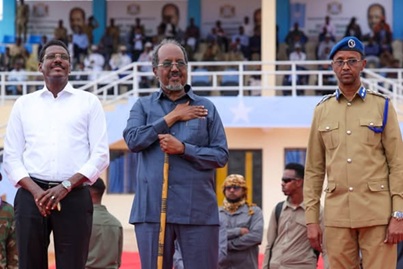
Galkayo (WDN) —President Hassan Sheikh Mohamud’s arrival in Galkayo was presented as a celebration of peace, reconciliation and Somali unity. Yet the symbolism of his visit also exposed one of the most striking realities of Somalia’s political fragmentation: the country’s president can now visit only one half of a city that is physically united but politically divided.
Hassan Sheikh and Galmudug President Ahmed Abdi Kariye “Qoorqoor” arrived in Galkayo from the southern, Galmudug-controlled side after traveling by road from Dhusamareb. They were welcomed at Abdullahi Issa Airport by thousands of residents, politicians, traditional elders, women and young people.
The reception was reportedly warm, and the President used the occasion to praise Galkayo’s residents for overcoming the violence that once divided the city. But behind the celebrations lies a striking political reality.
The President of Somalia did not cross into the Puntland side of Galkayo
That is not simply a matter of geography. It is a reflection of the extraordinary political fragmentation that has developed during Hassan Sheikh’s presidency. Puntland severed political ties with the Federal Government amid deep disagreements over constitutional amendments, federal powers and the electoral process. Jubaland has likewise become embroiled in a bitter political confrontation with Mogadishu.
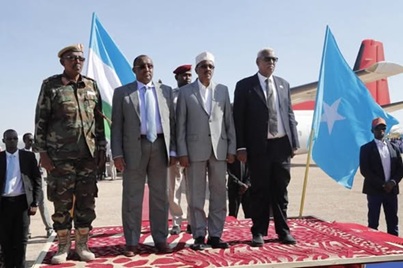
As a result, Somalia’s president now faces a remarkable limitation: two of the country’s most important federal member states remain politically estranged from the government he leads.
The contrast with Hassan Sheikh’s predecessor, former President Mohamed Abdullahi Mohamed “Farmaajo,” could hardly be more striking.
During Farmaajo’s presidency, the former president visited both sides of Galkayo, crossing the administrative divide between Puntland and Galmudug and presenting the city as a symbol of Somali unity despite its political differences.
Today, Hassan Sheikh’s inability to visit the Puntland side of the same city has become a powerful symbol of how far Somalia’s political divisions have deepened.
The physical boundary separating the two administrations may be little more than a line through a city. Politically, however, it increasingly resembles a national fault line. That symbolism has not escaped social media users.
Some posts circulating online have mockingly portrayed Hassan Sheikh as a “Hawiye president,” suggesting that his inability to freely travel across federal territories has reinforced perceptions that his government is identified too closely with particular political or clan constituencies.
Such claims are political opinions rather than established facts, but their circulation illustrates the depth of public frustration over Somalia’s worsening political divisions.
A President Speaking About Unity from One Side of a Divided City
During his address, Hassan Sheikh urged residents to protect the peace that has been achieved in Galkayo and prevent a return to the armed conflicts that once caused deaths, displacement and social fragmentation.
He emphasized the importance of maintaining economic, cultural and social ties between the two sides of the city, arguing that Galkayo could serve as an example of how Somalis can overcome conflict and build lasting peace.
The irony is difficult to ignore. The President was speaking about unity from the Galmudug side of a city whose other half remains under the authority of a federal state that has a deeply strained relationship with his government. The message was therefore both hopeful and revealing. Galkayo’s divisions mirror a much larger problem facing Somalia.
The country has a federal system designed to distribute political authority between the central government and Federal Member States. Yet disagreements over the Constitution, elections, security structures and the balance of power have increasingly transformed that federal arrangement into a source of confrontation.
Puntland’s political estrangement from Mogadishu has made presidential travel particularly sensitive. Jubaland’s confrontation with the Federal Government has created another major political divide.
The result is a Somalia in which the president’s ability to move freely between regions can itself become a measure of national political cohesion. That is an extraordinary development for a country whose leaders routinely speak of national unity.
Galkayo Still Offers a Different Possibility
Yet there is another side to the story. Ordinary residents of Galkayo have continued to demonstrate that communities can maintain relationships even when politicians cannot.
Families cross the divide. Businesses operate across it. Traders move between the two sides. Young people socialize together, and communities continue to share cultural and social ties.
In that sense, Galkayo may still represent the Somalia that politicians have struggled to build: a country where borders are less important than relationships.
Hassan Sheikh’s message that the people of Galkayo must protect their peace is therefore worth taking seriously. But national unity cannot ultimately be built through speeches alone. It requires political leaders who can sit together, negotiate constitutional disagreements and restore trust between Mogadishu and the Federal Member States.
Until that happens, the image of Somalia’s president standing on one side of Galkayo while the other side remains politically out of reach will remain one of the most powerful symbols of the country’s unfinished political journey.
Galkayo is one city. Its people increasingly behave like one community. The tragedy is that Somalia’s political leadership remains divided over who has the right to govern it.
WardheerNews