By Dayib Sh Ahmed
The damage inflicted on Somalia’s fragile state-building project by entrenched political networks is so enormous and wide-ranging that it is hard to fully grasp. It runs the gamut from the hollowing out of public institutions to the erosion of core diplomatic customs, transforming sovereign statecraft into a vehicle for private extraction. In their recent book How States Think, political scientists John Mearsheimer and Sebastian Rosato argue that states generally act rationally and strategically, basing their foreign policy decisions on a careful assessment of threats, opportunities, and balances of power.
Somalia’s Ministry of Foreign Affairs (MFA), however, increasingly operates in a reality that defies this traditional rational calculus. Rather than projecting national security interests abroad, the central apparatus in Mogadishu has allowed its global diplomatic outposts to become unaccountable, personalized fiefdoms where the sovereign assets of the Somali people are bartered away like private commodities. Plato wisely noted when he said that one of the penalties for refusing to participate in politics is that you end up being governed by your inferiors.
As I have argued in earlier columns, including “Somalia’s Foreign Policy: A Spectacle of Incompetence,” the destructive consequences of mismanagement within Somalia’s foreign affairs institutions have been evident for some time. Yet, rather than improving, the situation appears to be deteriorating, with new controversies and governance failures emerging on an almost daily basis. The latest allegations surrounding embassy properties in Nigeria serve as another troubling example of a broader institutional crisis.
One way to bring home the depth of this institutional decay is to look at a specific case. The recently unsealed investigative report by the High Advisory Committee of the MFA dated May 4, 2026 detailing the illicit liquidation of Somali state property in Abuja, Nigeria, is more than just an indictment of a rogue diplomat. It is a devastating exposure of structural collapse at the absolute highest echelons of the Ministry. The committee’s findings read like a corporate raider’s manual rather than a diplomatic briefing. According to the investigation, former Ambassador Jamal Mohamed Barrow unilaterally orchestrated an illicit “swap agreement.” He allegedly exchanged a prime, 3,202.67-square-meter piece of sovereign state property (Plot No. 1191 in Abuja’s prestigious Katampe Extension) for a residential building owned by a private Nigerian citizen located entirely outside the secure diplomatic zone.
Worse still, the former ambassador actively denied the existence of a second, highly valuable tract of state property a 3,027.80-square-meter plot (Plot No. 39 in Guzape II) until the committee confronted him with irrefutable land registration documents. Perhaps most alarming is the revelation that the original sovereign titles to these state lands were handed over to unvetted foreign “facilitators” under the flimsy guise of administrative assistance. This represents an unprecedented, reckless abandonment of sovereign immunity and asset protection. To understand the political mechanics shielding such an audacious heist, one must look beyond the individual and examine the political networks that insulate him.
One diplomat replied to my inquiry about the case by email, writing “Jamaal Barrow, a prominent member of Damujadiid and former Deputy Minister of Foreign Affairs (2013), who also previously served as Somalia’s Ambassador to Nigeria, has been accused of unlawfully appropriating land belonging to the Somali Embassy. According to reports produced by committees within the Ministry of Foreign Affairs and judicial institutions, evidence was reportedly identified indicating that a criminal offense may have occurred. A panel of experts that reviewed the matter allegedly recommended that legal proceedings be initiated.” This is where the true crisis of governance reveals itself. A diplomat does not wake up one morning and decide to liquidate, swap, and conceal thousands of square meters of sovereign national soil unless they are entirely confident that nobody is watching or, more accurately, that their political faction will protect them from consequence.
The profound betrayal engineered in Abuja is the direct byproduct of a culture of impunity nurtured by the incompetency of the current State Minister Ali Omer (AKA) Balcad, For years, the political leadership of the MFA has treated foreign postings as political rewards rather than strategic, highly scrutinized extensions of state authority. By failing to implement basic institutional guardrails, the state Ministry’s leadership has abdicated its foundational constitutional duties. However, despite the existence of official findings and explicit recommendations from internal experts, no visible legal action has been taken to date.
This paralysis raises severe concerns and suspicions that political connections or special interests namely, the enduring influence of factions like Damujadiid may be actively hindering the fair and impartial implementation of justice.
As constitutional scholars and political scientists frequently warn, the longest shadow cast by institutional corruption is the destruction of norms. Norms take decades to develop because they rest on habits of restraint and the expectation that violations will be punished. But they can disappear virtually overnight once it becomes clear that punishment is not coming. When a federal appointee openly defies a high-level investigative committee and faces no judicial reckoning, it teaches every other sitting ambassador a dangerous lesson: state property is yours to plunder, provided you have the right political cover in Mogadishu. The foundation of good governance is the rule of law, and no individual should be above it. If credible evidence and official determinations establish that national property was unlawfully misappropriated, it is essential that the relevant legal measures be carried out transparently.
The current State Minister cannot absolve himself of responsibility by pointing to the complexities of foreign jurisdictions. The Ministry’s leadership bears responsibility for the systemic negligence that made this heist possible. True accountability requires an immediate and comprehensive overhaul of how the Ministry of Foreign Affairs manages its global assets. Until the Ministry’s leadership accepts responsibility for these failures and strips heads of mission of unilateral asset-management authority, the sovereign assets of the Somali people will remain dangerously exposed to the predatory actions of unaccountable officials.
The Architecture of a Bad System
To understand how a scandal of this magnitude unfolds and why it is so rarely punished we must look at the psychology of the individuals the system elevates. In his incisive book Corruptible: Who Gets Power and How It Changes Us, political scientist Brian Klaas observes a grim reality about modern leadership: “Often wrong, never uncertain remains a winning strategy in too much of our world.”
This perfectly encapsulates the sheer audacity of Ambassador Barrow’s defense. When confronted by a six-member panel of senior diplomats, he lacked any written authorization, cabinet memos, or ministerial directives to justify the alienation of state property. He was legally and ethically wrong. Yet, he operated with the unwavering certainty of a man who knew his political faction, Damujadiid, would shield him. He confidently defied the National Auditor General’s federal decree nullifying the illegal property swap, projecting a resolute arrogance that dared Mogadishu to stop him. In a fragile state where institutional authority is weak, this type of weaponized certainty often triumphs over the rule of law.
But the blame does not rest solely on the shoulders of one brazen diplomat. As Klaas further explains: “Corruptible people are drawn to power. They’re often better at getting it. We, as humans, are drawn to following the wrong leaders for irrational reasons linked to our Stone Age brains. Bad systems make everything worse.” Somalia’s Ministry of Foreign Affairs is the textbook definition of a bad system. By treating diplomatic postings as the spoils of political patronage rather than rigorous extensions of statecraft, the Ministry actively attracts the corruptible. When there are no proactive auditing safeguards, no centralized property tracking, and no immediate consequences for defiance, the environment practically begs to be exploited. The administrative vacuum maintained by the State-Minister does not just accidentally allow for the liquidation of state assets; it structurally incentivizes it.
The Abuja embassy scandal is not a localized anomaly; it is the inevitable byproduct of a foreign service that has lost its way. When asked to evaluate the state Ministry’s proposed emergency remedies, one former Somali diplomat characterized the situation to me bluntly. “These represent a desperate exercise in damage control. It is a fire brigade response to a house that has already burned to the ground. Sending a high-level ministerial delegation across the continent to recover stolen land deeds from foreign brokers is a deeply embarrassing spectacle. It serves as a direct challenge to the top leadership.”
Indeed, dispatching a multi-agency delegation to West Africa fails to address the root cause of the rot. If the State Minister claim they are in control of the nation’s foreign footprint, they must prove it by looking inward rather than flying outward. Until the top leadership accepts structural responsibility and entirely dismantles the bad system they oversee stripping individual ambassadors of unilateral property-signing authority and centralizing asset management under an independent Board of Trustees accountability will remain a convenient illusion.
If the government in Mogadishu refuses to implement an urgent systemic reforms, the ghost embassies of Somalia will continue to be quietly sold off, brick by brick, by those drawn to power solely for what they can extract from it.
Dayib Sh. Ahmed
Email: Dayib0658@gmail.com
——
Dayib is a political analyst, WardheerNews contributor. and co-author of forthcoming book- Searching for Meaning, Somalia’s Quest for Good Governance.
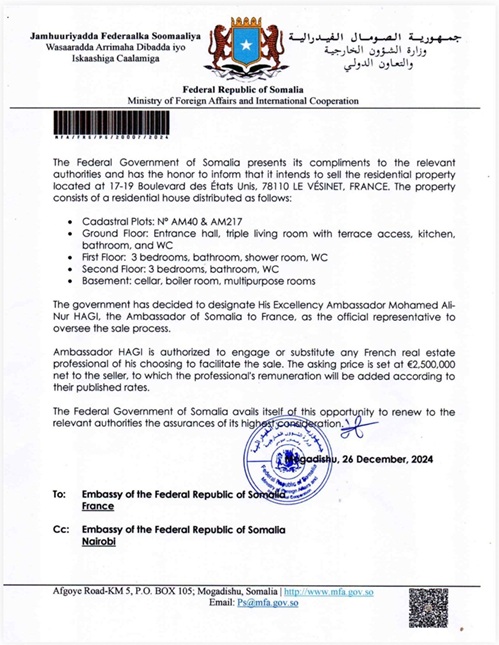
See below the official letter of selling Somalia’s embassy residential property in Nigeria.
_____