
By Abdul Ahmed III
Counterfactuals serve as mental exercises—and perhaps as nostalgia for unrealized, better trajectories—yet they are forgivable when they help us keep faith with those once hailed as brothers-in-arms. I knew several of them as a child, and among my memories is General Omar Osman Diriye Warfaa, commonly known as Omar Anjeeh. I still wonder how Somalia’s history might have unfolded had he survived—if the Fokker F-27 had not broken apart over the town of Balad on that July morning in 1981. I also wonder what kind of man the general’s son, Guled, might have become.
General Omar Anjeeh was a tall, well-built, light-skinned, fluffy-haired man. He was steeped in Somali literature, Arabic, and Russian letters. Blunt in doctrine yet gifted with a commanding personality, he had the kind of easy humor that made children feel respected. To a boy, he spoke with the courtesy of an uncle, reciting proverbs and making one feel momentarily equal among grown officers. When that aircraft fell from the sky, Somalia lost fifty souls. But it also lost a commander who, I believe, could have positively influenced the military and politics of the day.
Back in the early days of the 1977 Ogaden War, he was appointed to command Sector 60 in Bay Region. His appointments were at times over peers and even his seniors. He accepted the responsibility with composure and led with distinction. Anjeeh was more than a soldier. He understood policy, engaged the Somali Socialist Party elders, as well as embraced officers the regime mistrusted. Above all, he served the army and the fraternity that many called brothers-in-arms. His leadership earned him the respect of fellow officers and non-commissioned officers alike, not only for his command but for the camaraderie and fairness he extended to all ranks.
Baidoa, seat of the Southern Command, reflected his touch. Where Beledweyne’s and Sector 21 cantonments felt brittle and doctrinaire, Baidoa carried a calmer air. The city was the HQ of Sector 60 and three divisions, though only one had fully materialized by the mid-1970s. The city was both strategic and symbolic, a command post and a community. Its moderate elevation gave it natural defensive advantages, and its roads tied it intimately to Mogadishu, Afgoye, and the broader southwest.
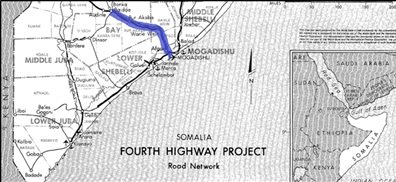
It was a southern hub in the 1970s, a bustling commodities market under the regulatory regime of the time. The Baidoa road project and the Balidogle airfield capture Somalia’s dual logic in the 1970s: one, driven by economic development, aimed to move grain and commerce; the other, forged in Cold War calculus, promised air cover. Together, they shaped every logistics calculation in the 1977 Ogaden push.
Mogadishu, Baidoa, and Balidogle formed a triad of policy infrastructure: the coast for command, the ridge for control, and the runway for reach and repetition. Each dawn, Baidoa’s lawn filled with Somali lieutenants, Chinese surveyors and engineers, and a shrinking cadre of Soviet avionics men awaiting trucks to the growing air detachment at Baledogle.
Baidoa measured its pulse by the mess-hall stove. On ordinary Fridays, a few senior officers—and the occasional Russian—roasted a goat or two. But when delegations arrived, the ritual swelled: trays of camel stew, a variety of dishes and beverages, and every brother-in-arms within convoy range found a seat. Those visits served more than ceremonial ends. They were moments of unity, planning, and affirmation—occasions when politics briefly receded and loyalty came to the fore. Even though politics was always the elephant in the room.
Among the frequent guests were senior figures who shaped the tempo and tenor of the southern command. These included General Omar Haji Massale, Deputy Commander for Military Policy, who had a commanding presence and brought insight from Mogadishu’s shifting corridors. General Mohamed Nuur Galaal, then Deputy Commander of Central Command for Planning, was a party man, often alone and opinionated. Colonel Ahmed Hassan Muse, regarded by many as one of Somalia’s most respected officers, also made regular appearances. Colonel Abdullahi Irro, who served as Deputy Head of Sector 60 and also commanded Division 60, was another key figure. Colonel Abukar Aftooje, head of Central Command’s Planning and Logistics Directorate, and Colonel Ahmed Haji Mahmoud Terso, who commanded the Hudur Brigade Group under Sector 60, ensured that plans translated into reality. Finally, Colonel Abdullahi Yusuf, newly assigned to lead the southern fronts of Bali and Sidamo, brought urgency and strategic perspective.
Occasionally, party liaisons arranged courtesy calls from across the border—Somali Abo and WSLF officers. Over dense coffee, they swapped lighter flints and admitted that desert scrub devours both barrels and men faster than any doctrine allows. These informal exchanges, conducted quietly and sometimes under a pretext, became the unrecorded diplomacy of officers who understood war’s limits.
Sector 60 and the entire Southern Command weathered the abrupt Soviet-Cuban turn more successfully than many expected. The officers mentioned above, and many other junior and middle-ranking officers who kept the machinery running, ensured early battlefield successes and the safe withdrawal of troops. But in retrospect, I believe it was the caliber of these officers—and especially the personality of Omar Anjeeh—that kept Baidoa and the wider Southern Command intact. Anjeeh had the rare ability to manage opposing political and military views with respect.
By early 1977, Baidoa oversaw the full southern arsenal—overlapping belts of artillery and low-level air defense potent enough to earn Baledogle’s pilots’ respect. The Ogaden campaign seemed poised on a knife’s edge. Yet by October, the sky stiffened: Soviet-piloted MiG-23s roamed above Somali-controlled territories; Cuban T-62s began appearing in battles. Many Somali officers held firm, and chief among them was General Omar Anjeeh. He played a central role in retrieving Somali personnel and equipment from southern Ethiopia, directly assisting the Southern Command Zone under Col. Abdullahi Yusuf’s six brigades in evacuating the southern zone. Even in the midst of it all, Omar Anjeeh still chalked lines of Pushkin and Sayid Mohamed Abdulle poems on the board.
By April 9, 1978, gunfire cracked in Mogadishu, and the Baidoa–Mogadishu road—the artery of military and economic activity—turned into a series of checkpoints and choke points. I remember our departure from Baidoa on Wednesday, April 13, heading to Mogadishu. I remember the farewell General Omar Anjeeh gave our family after his brief successor was arrested on April 10th, 1978. Anjeeh had been summoned to Mogadishu; the Defense Chief wanted him there. But after the coup attempt on April 9, he was reinstated in Baidoa. Rumors swirled about which brigades might join the coup, but no evidence emerged. Anjeeh, who returned the day of the coup, formally confirmed to Mogadishu that “Sector 60 remains at post.”
Omar Anjeeh became a general in the late 1970s and continued to serve. During that same period, morale across the Somali Army began to falter. While Somali nationalism held firm, trust among officers thinned. In the mess hall, there was no more goat roasting; the brothers smoked in silence. Loyalty, they agreed, sometimes whispers. Respect remained, but politics had begun to encroach on the institution they had once served with such clarity.
It is said that Omar Anjeeh had the capacity to sit down and satisfy divergent views, to respect, to advise, and to chat without condescension. But like all Somalis of his time, some viewed those characteristics with suspicion, especially given his closeness to party leaders and his unabashed revolutionary streak and deep nationalism, likely drawn from his roots in the western regions of the Somali Horn. Omar Anjeeh was an inspiring figure—and, inevitably, that made him a threat to some.
In 1981, he was appointed to lead the Northern Command and Sector 26, a position of immense responsibility at a fragile moment in Somalia’s history. But he never took up the post. That summer, he perished in the tragic plane crash that claimed his life.
I find myself returning to the same counterfactual: had Omar Anjeeh survived, might the political and military crisis of the 1980s in the north have been averted? Could the chain of events that ultimately led to the 1988 civil war have taken a different course?. He was, after all, not just a commander, but a soldier, a traditionalist, a northerner, and a man of letters and Somali oral poetry, a senior officer who quoted Pushkin and believed in the power of dialogue. One wonders: if anyone could have defused the tensions before they ignited, would it have been Omar Anjeeh?
Abdul Ahmed III
Email: drahmed0604@gmail.com
———————–
Abdul Ahmed III is the Chief Research Officer and President of Foresight Labs at the Horn of Africa Institute. A former employee of international financial institutions in Washington, D.C., he is a strategist, military scholar, economist, and expert in institutional evolution. He holds advanced degrees from multiple U.S. institutions.