
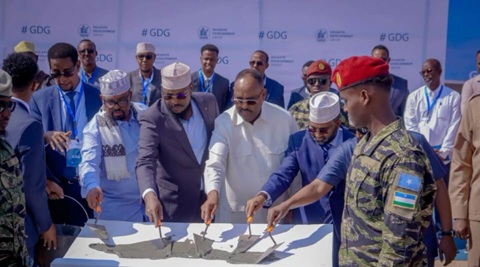
Puntland President Said Abdullahi Deni has finally laid the foundation stone for the long-delayed modernisation of Abdullahi Yusuf International Airport in Gaalkacyo. But the $22 million project is attracting scrutiny over its three-year delay, alleged demands for political shareholdings and the commercial arrangements linking the investment to the Puntland presidency
GALKACYO (WDN) – Nearly three years after the airport modernisation project was reportedly launched, Puntland President Said Abdullahi Deni on 25 November 2026 finally laid the foundation stone for the reconstruction and expansion of Abdullahi Yusuf International Airport in Gaalkacyo.
The ceremony was presented as a major milestone in Puntland’s infrastructure development. Yet the occasion also revived questions about why a project of such strategic importance took so long to reach the groundbreaking stage, what commercial disagreements delayed its implementation and whether senior government officials have secured personal financial interests in the company undertaking the investment.
The project, reportedly valued at $22 million and financed by private business interests, is expected to include a 3.5-kilometre runway, a modern passenger terminal, an air-navigation control tower, administrative buildings, firefighting and emergency facilities, a hotel and perimeter security infrastructure. The terminal is reported to have a capacity of up to 1,000 passengers, although the precise operational basis of that figure has not been publicly explained.
Speaking at the ceremony, Deni described investment in airports, seaports and roads as essential to Puntland’s economic development and self-sufficiency. He portrayed the project as the beginning of a new era of aviation services in Galkacyo, with facilities intended to meet international standards.
The event attracted senior Puntland officials, representatives of the Mudug regional and Galkacyo district administrations, security officers, traditional elders, businesspeople and members of the local community. There is little dispute that Galkacyo needs a modern airport. What remains difficult to explain is why the project required nearly three years to reach this stage and whether political bargaining over the commercial arrangements contributed to the prolonged delay.
Three years of delay and unanswered questions
The timeline deserves particular scrutiny. Galkayo Development Group (GDG) PLC, the company associated with the airport development, identifies 2023 as the year of its incorporation and lists 2024 as the year in which the airport project was launched. Yet the public groundbreaking ceremony did not take place until November 2026.
The company’s own project history and development information therefore provide an important reference point against which the government’s account of the project’s progress should be examined. Further questions emerge from the company’s procurement documentation. In June 2026, GDG issued a tender for lead consultancy services covering airport master planning, technical investigations, detailed engineering design and tender documentation. The original submission deadline of 1 July was subsequently extended to 15 July 2026.
This is significant because such consultancy work is normally part of the preparatory process preceding detailed construction procurement. It raises legitimate questions about the project’s technical readiness, the sequencing of its implementation and what exactly had been achieved during the preceding years. The company’s June 2026 terms of reference provide further details of this process.
The public deserves a clear explanation of the time elapsed between the reported 2024 project launch, the subsequent development and consultancy arrangements, and the eventual groundbreaking.
Allegations of political share allocations
More troubling are allegations that disagreements over the ownership structure and the distribution of company shares contributed to the project’s prolonged delay. According to claims circulating around the project, the commercial arrangements were held up by demands for equity participation from senior members of the Puntland political leadership.
The alleged allocations are particularly striking: President Deni is reported to have secured a 10 per cent shareholding, the Puntland Vice-President 2 per cent and the Minister of Education 1 per cent in the company associated with the project. If these figures are accurate, they raise fundamental questions about the distinction between public responsibilities and private commercial interests.
On what basis were these shares allocated? Were the individuals concerned genuine private investors contributing capital, or were the alleged stakes offered in recognition of their positions within the government? Were the arrangements negotiated before or after the government entered into the airport development agreement?
These are not minor administrative questions. They go directly to the integrity of public institutions and the credibility of Puntland’s investment environment.
A president, vice-president or minister is not automatically prohibited from having private commercial interests. However, any such interests involving a government-regulated investment, public infrastructure concession or contract awarded by the administration require transparent disclosure, proper conflict-of-interest safeguards and independent scrutiny.
The reported share allocations have not been independently established through publicly available shareholder records or signed agreements. The Puntland Government and GDG should therefore publish the relevant documentation and clarify whether the allegations are accurate. Silence will only deepen public suspicion.
Who owns the airport investment, and on what terms?
The ownership and financing arrangements deserve particular attention because the project is not described simply as a conventional private construction contract.
GDG’s own website presents the airport development as a Build–Operate–Transfer (BOT) arrangement with the Puntland Government. Under the company’s published description, GDG is expected to finance, develop and operate the modernised airport before transferring ownership to the government at the end of the concession period. The company identifies the arrangement as a 30-year concession.
That is a substantial commercial commitment, potentially giving the private operator considerable control over the airport’s management, revenue streams and commercial activities for decades.
The GDG project description also advertises an investment range of $17 million to $30 million, while its wider project presentation refers to a $30 million capital expenditure. This creates another discrepancy requiring clarification. Recent reporting has put the project cost at $22 million, while earlier reporting in December 2025 referred to an investment of approximately $17 million.
Are these different estimates of the same project, different implementation phases or revised investment commitments?
More importantly, what does the BOT agreement provide regarding airport charges, passenger fees, landing fees, cargo handling, commercial leases, operating costs, revenue sharing and the eventual transfer of ownership?
A 30-year concession over a strategic public asset should never be treated as a routine commercial arrangement. Its terms have implications for generations of Puntland taxpayers, businesses and travellers. The government should disclose the concession agreement, the company’s beneficial ownership, the identity of its principal investors, the financing commitments and the safeguards protecting the public interest.
The wider problem of political influence over commercial opportunities
The Galkacyo airport controversy also raises a broader question about the relationship between political power and private business in Puntland. Critics have increasingly questioned whether access to major commercial opportunities, government contracts and strategic investments is determined by transparent competition or by proximity to the presidency and its political circle.
The concern is not that politicians should be excluded from legitimate private investment. It is that public office must never become a gateway to preferential commercial treatment, privileged access to government contracts or undisclosed financial benefits.
When senior officials are alleged to have personal equity interests in companies benefiting from government concessions, the burden of transparency becomes particularly important. The problem is compounded when the government presents a project as a public development achievement without adequately explaining the commercial arrangements underpinning it.
Puntland needs domestic and international investors. But investors also need predictable regulations, transparent procurement, independent oversight and confidence that commercial success will depend on merit rather than political connections.
An investment environment in which political proximity appears to determine access to opportunities risks discouraging precisely the independent investors Puntland needs to attract.
Development announcements are not the same as development
President Deni’s administration has repeatedly emphasised infrastructure development as a pillar of Puntland’s economic transformation. Airports, seaports, roads and other strategic facilities are essential to expanding trade, improving mobility and strengthening regional economic integration.
However, laying a foundation stone is not the same as delivering a functioning international-standard airport. The real test will be whether the project is completed on schedule, whether its financing is secured, whether construction meets international aviation safety requirements and whether the resulting facility operates efficiently and transparently.
The government must also explain whether the reported $22 million covers the entire development or only the initial construction phase. It should publish a realistic implementation timetable, identify the construction contractor, disclose the project’s technical specifications and establish independent mechanisms for monitoring expenditure and progress.
There must also be clarity over the respective responsibilities of the Puntland Ministry of Civil Aviation, the government and the private concessionaire.
Without these safeguards, the public risks being presented with another ambitious infrastructure announcement whose commercial benefits remain concentrated among a relatively small group of politically connected interests.
Galkacyo deserves an airport, not another political controversy
The economic case for modernising Abdullahi Yusuf International Airport is compelling. A longer runway and improved passenger facilities could strengthen connectivity between central Somalia and regional aviation networks, facilitate humanitarian operations, support business travel and encourage investment in Mudug.
The project could also create employment, stimulate the hospitality sector and strengthen Galkacyo’s position as a commercial centre connecting Puntland with the rest of Somalia. None of these potential benefits, however, absolves the government of its responsibility to ensure that the investment is properly structured and administered.
The citizens of Puntland deserve to know who owns the company, who supplied the capital, how the concession was negotiated, how much the government stands to gain and whether any public officials have personal financial interests in the undertaking. They also deserve to know why a project reportedly launched in 2024 took until November 2026 to reach its formal groundbreaking.
The government should publish the relevant agreements and answer the allegations surrounding the reported share allocations. If the allegations are false, documentary disclosure would provide the most effective way of putting them to rest. If they are true, the public deserves to know the circumstances under which the shares were acquired and what conflict-of-interest safeguards were applied.
Puntland needs development, not development announcements wrapped in political ceremony. It needs investment, not a system in which access to strategic commercial opportunities appears to depend on proximity to those holding public office. An airport is a public economic asset, even when its construction is privately financed. Its benefits must serve the people of Puntland, not become an exclusive financial opportunity for those entrusted with governing them.
WardheerNews
Leave a Reply