

By Abdirahman A. Issa
Note: The article is based on extensive research, including field visits and in-depth interviews with dozens of youth leaders who were instrumental in the revolution between May and June 2024. It offers firsthand accounts of the revolution from activists. It also explains how the clan was mobilized through digital platforms, transforming spontaneous protests into a coordinated movement known as the “Blue Revolution.” To understand the Laascaanood revolution, one must trace the role digital platforms played at every stage: raising consciousness, coordinating protest, mobilizing for war, and reshaping power dynamics on the ground.
Introduction
On December 26, 2022, Abdifitah Abdullahi Abdi, known as Hadraawi Sangub, a member of Somaliland’s Waddani Party in the Sool region was assassinated in Laascaanood. Although he was affiliated with a party officially registered in Somaliland, the general sentiment in Laascaanood was one of opposition to Somaliland’s secession. This tragic event was not an isolated incident; it was the latest in a series of targeted killings that had begun in 2009, following Somaliland’s takeover of the town from Puntland. In the aftermath of his burial, the youth took to the streets to protest against the ongoing assassinations and to demand accountability from the Somaliland government.
After two days of spontaneous protests, the situation evolved dramatically. Tech-savvy youth residing outside the city began to organize the protesters, transforming what had started as a Spontaneous protest into a coordinated movement known as the “Blue Revolution.” Protesters raised the Somali flag in public places across the city, expressing their desire for a united Somalia and the formation of their own administration. Previous protests had faltered due to a lack of leadership and direction, but this time, the youth were guided with purpose. Each neighborhood in Laascaanood was assigned a leader who coordinated actions via WhatsApp groups, connecting participants in real time.
Prior to the revolution, closed WhatsApp groups had already united like-minded youth, facilitating discussions about liberating their territory from Somaliland and raising awareness within their community. When the protests began, these groups became the organizational backbone of the movement, expanding their membership to encourage broader participation. WhatsApp was instrumental in scheduling protests and disseminating videos and images from the demonstrations.
Social media acted as a catalyst for mobilizing youth to take to the streets and sustain protest momentum. In response to the escalating protests, Somaliland troops resorted to violence, which led to the deaths of 20 protesters and injuries to 30 others. Yet the youth refused to be silenced. Abdishakuur Ahmed Salad, a protester, poignantly wrote on his Facebook on December 27, 2022: “Better to die with dignity than to live with humiliation and indignity.”
Tragically, Abdishakuur was killed the following day, an act that, rather than extinguishing the movement, only deepened the youth’s resolve. They continued to share images and videos of the protests on social media, amplifying public outrage far beyond the city’s borders. Recognizing that social media was the lifeblood of the movement’s coordination, Somaliland authorities blocked internet access on January 1, 2023. The revolution’s dynamics shifted decisively when a civilian named Mohamoud Ali Saadle was killed. His clansmen retaliated against Somaliland forces, igniting an armed conflict that would ultimately compel Somaliland to retreat to the outskirts of the city.
Roots of Revolt: Identity, History, and Collective Consciousness
To understand the depth of the uprising, one must recognize the political awakening processes that had been unfolding in the years leading up to the first shot. Social media has played a significant role in raising political awareness and fostering a collective consciousness among Dhulbahante youth long before December 2022. It became a platform for discussions and the sharing of information about their history, particularly the Daraawiish movement and the anti-colonial struggle waged by their forefathers against the British Empire. This rich history served as a constant point of reference and pride.
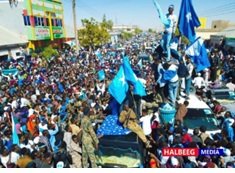
Prior to the “blue revolution”, the Dhulbahante clan had experienced a noticeable division along sub-clan and administrative lines. The formation of the Somaliland (1991) and Puntland (1998) administrations had resulted in a political split, with some clans aligning with Puntland while others associated with Somaliland. This division came at the expense of their unity and solidarity. Conflicts within the Dhulbahante clan became prevalent, and it was widely alleged that the Somaliland administration played a role in fuelling them to weaken opposition. In late 2007 Lasanod was occupied by Somaliland forces. Subsequently, armed resistance groups emerged in the area around Laascaanood and Buuhoodle. But those groups did not manage to unite the clan for collective action due to prevailing mistrust and suspicion.
However, a significant turning point occurred in December 2022, when youth embraced social media to foster trust and dismantle barriers to unity. The mistrust that had long divided the Dhulbahante crumbled as tribal chiefs and politicians, who had perpetuated it, witnessed a rising consciousness, especially among young people, online. Individuals who had been quietly seeking financial support from Somaliland found themselves publicly exposed and shamed on social media. Consequently, no one dared openly oppose the people’s wishes, and those who had previously collaborated with Somaliland were coerced into joining the revolution.
On social media platforms, the Dhulbahante youth used their voices to challenge the prevailing notion of their subjugation and to assert their determination to unite. They drew upon their proud history of resistance against British colonialism to question a painful paradox: why had their ancestors confronted a global empire, yet their own generation seemed hesitant to confront
Somaliland, dominated by the Isaaq clan? Many of these youth were born or grew up during Somaliland’s rule of Laascaanood. They did not find a sense of belonging within the national myth of Somaliland, as its history, symbols, and memorials revolved primarily around the Isaaq struggle and SNM heroism. Social media became the arena where these competing historical narratives collided. The Isaaq often portrayed the Daraawiish as religious extremists, while the Dhulbahante accused the Isaaq of collaboration with colonial powers. These debates, however charged, were the arena in which a new generation forged its political identity.
Adding to this sense of urgency, the Dhulbahante youth observed their peers from other clans celebrating the founding of their own federal administrations on social media. Mocked for lacking their own state while remaining under Isaaq control, the Dhulbahante youth were propelled by a mixture of bitterness, pride, and a determination to achieve territorial liberation. The defunct Khatumo State, which had emerged in resistance to Somaliland 2012-2015, though politically unsuccessful, had left behind a crucial legacy: a distinctive flag that youth displayed on social media to assert their unique identity and collective purpose.
From Protest to War: Digital Mobilization on the Battlefield
On February 6, 2023, a day scheduled for clan elders to issue a self-determination statement, war broke out unexpectedly in the early morning. One month of digital organizing now gave way to armed conflict, yet social media did not retreat from its central role; it simply shifted its purpose from coordinating protests to mobilizing fighters. The Dhulbahante sub-clans swiftly organized to recruit fighters and procure arms. Through WhatsApp groups, youth from each sub-clan coordinated with their clansmen both inside and outside the country, urging them to actively participate in the liberation of their land. This level of unified participation from all Dhulbahante sub-clans was unprecedented in their history.
Initially, their Harti brethren, including the Majeerteen and Warsangali clans, were skeptical, having witnessed previous short-lived conflicts initiated by the Dhulbahante. However, after 20 days of relentless fighting, during which Dhulbahante forces proved their seriousness by driving out Mahad Canbaashe, a top Somaliland commander from the Jaamac Siyaad sub-clan of Dhulbahante, and his ca. 200 men force from Laascaanood, the sentiment shifted.
Youth then took to social media to express their disappointment at the lack of support from their Harti brethren, warning that history would not be kind to those who did not stand with them. The appeal worked. Gradually, the Majeerteen and Warsangali clans responded, sending troops to join the war.
A YouTuber named Kabtan Ayuub, residing in Germany, played a notable role in mobilizing the Majeerteen clans. He used ridicule and derogatory language to ignite their clan pride and stir them to action. This approach proved effective; every other day, a sub-clan would send reinforcements, which were warmly welcomed in Laascaanood by the Garaads (clan leaders).
These arrivals were broadcast on social media, showcasing the fighters’ determination and further boosting morale. The highly publicized arrival of external Harti sub-clan contingents in March and April created the psychological impression of an ever-growing force to instill fear among Somaliland troops.
Social media also played a critical role in emotional mobilization by documenting and exposing the atrocities committed by Somaliland forces. Activists provided daily updates from the ground, documenting killings and injuries during the suppression of protests and throughout the conflict.
Posts tagged to foreign embassies raised international awareness of the humanitarian situation. GPS coordinates authenticated the locations where bombs were dropped, with images of bomb remains being widely shared. Adding to the outrage, Somaliland troops themselves recorded videos of bombardments while making genocidal statements, content that spread rapidly online and shattered the sympathy that many Somalis had previously held for Somaliland.
The Dhulbahante also skilfully leveraged their clan identity to rally the wider Harti community worldwide. The Harti diaspora organized fundraising activities, made possible by coordinated social media campaigns.
Winning the Narrative: Propaganda and Information Warfare
The armed conflict was simultaneously fought on two fronts: the battlefield and the information space. The Dhulbahante’s proactive strategy in crafting their war narrative enabled them to win the propaganda war on social media against Somaliland, which traditionally relied on conventional media. Somaliland was consistently reactive to the Dhulbahante claims. The Dhulbahante effectively used social media trolls to spread morale-boosting content and misinformation. They falsely posted images of military equipment claiming to have captured them from Somaliland troops, reported defections in the Somaliland army, and repeatedly claimed that enemy troops had abandoned their weapons and fled.
They employed a divide-and-conquer strategy, propagating the notion that they were fighting particular sub-clans within the Isaaq supporting Somaliland (i.e., the Habar Jeclo) while others (i.e. Habar Yoonis) were not much involved. This was an attempt to fracture the cohesion of the Somaliland forces. The Dhulbahante posted live videos from the frontline, claiming advances, and exaggerated enemy casualties while minimizing their own. The other side, of course, did the same. But Dhulbahante did this additionally with the spirit of those fighting for their survival against an overly powerful aggressor.
On the diplomatic front, the Dhulbahante’s aggressive engagement garnered significant international attention. Their narrative, portraying their clan as victims of massacre/genocide (Somali: xasuuq), proved persuasive. The World Health Organization director publicly condemned the shelling of hospitals; human rights organizations issued reports documenting atrocities; and the United Nations Security Council convened to discuss the matter, calling for an urgent ceasefire and the withdrawal of Somaliland troops.
On August 25, 2023, after seven months of intense fighting, Dhulbahante and their Harti allies secured a decisive victory, overrunning Somaliland military bases on the outskirts of Laascaanood, capturing hundreds of prisoners, and seizing a large number of weapons. It was the culmination of a struggle that had begun not with guns, but with WhatsApp messages and Facebook posts.
Conclusion: The Transformation of Power Dynamics in Social Media Use
The revolution not only reshaped the relationship between the Dhulbahante and Somaliland but also fundamentally transformed the internal power dynamics of the Dhulbahante community itself. Social media provided the youth with a platform to express themselves, mobilize, and hold traditional power holders accountable in ways that had simply not been possible before.
What began as a spontaneous protest evolved into an organized movement. This transformation did not happen by accident. It was driven, shaped, and sustained by social media, ultimately overturning the political order in Laascaanood, leading to the expulsion of Somaliland forces and the establishment of a new administration called the Northern Eastern State.
Abdirahman A. Issa
Email: Cadced99@gmail.com