
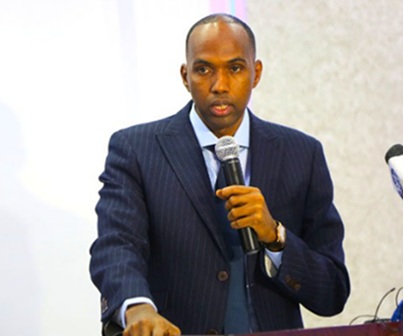
Mogadishu (WDN) – Former Somali Prime Minister Hassan Ali Khayre has publicly addressed the prolonged armed confrontation that unfolded around his residence in Mogadishu’s Barmuuda neighborhood, describing the incident as a dangerous escalation of the country’s political tensions while reaffirming his commitment to peaceful political engagement and consensus-based elections.
Speaking at a press conference, Khayre accused federal security forces of carrying out an operation targeting him and other political figures gathered at his residence. According to Khayre, the incident began while he was meeting with traditional elders from the Murusade community, led by Ugaas Abdirisaaq Ugaas Abdullahi Ugaas Hashi, to discuss the country’s political situation and preparations for a planned public demonstration.
Initially, Khayre said those present believed the military movements and gunfire in the area were routine security activities. However, as the situation intensified, they concluded that government forces were advancing directly toward the residence where the meeting was taking place.
Khayre stated that more than 70 people were inside the compound at the time, including politicians, members of parliament, traditional elders, and civilians. He said all those present were placed at risk as the confrontation escalated.
The former prime minister noted that respected community leaders, including senior traditional figures and mediators, later arrived at the scene in an effort to prevent further violence. According to Khayre, the mediation team drafted a framework for de-escalation that both sides appeared willing to consider. However, he claimed that fighting resumed before the understanding could be fully implemented.
“For 15 consecutive hours, we were under attack,” Khayre said. “We did not use heavy weapons. Mortar rounds were fired, and the attack appeared intended to eliminate those gathered at the residence.”
Khayre alleged that the operation was an attempt to target not only him but all those present at the meeting. He described the incident as one of the most alarming political and security developments Somalia has witnessed in recent years. “It is deeply troubling,” he said, “that individuals sent as mediators could find themselves caught in violence while attempting to facilitate dialogue.”
Turning to the broader political crisis, Khayre accused President Hassan Sheikh Mohamud’s administration of relying on security institutions to suppress political dissent. He also expressed concern over reports of security operations near the residence of former President Sharif Sheikh Ahmed, warning that any escalation could further deepen the country’s political divisions.
Khayre directed criticism at security officials he alleged were involved in the operation, stating that those responsible should remain accountable for their actions and avoid allowing state institutions to become instruments of political confrontation.
Despite the tensions, the former prime minister emphasized that he and other opposition figures remain committed to pursuing political solutions through peaceful means. “We will not abandon our constitutional right to advocate for an inclusive and consensual electoral process,” Khayre said. “We will continue our efforts to ensure that Somalia holds an election accepted by all stakeholders. We cannot be intimidated into abandoning that objective.”
He argued that Somalia’s future depends on dialogue, compromise, and respect for democratic principles rather than coercion and political exclusion. Khayre also rejected allegations circulated by state-affiliated media that opposition leaders were organizing armed militias. He insisted that the meetings held at his residence were political in nature and focused on peaceful civic activities, including public demonstrations and political consultations.
His remarks come at a time of growing political and security tensions in Mogadishu, where concerns are mounting over the risk of further confrontation between the federal government and opposition groups.
While the federal government has yet to issue a detailed response to the allegations made during Khayre’s press conference, domestic and international actors continue to encourage restraint, dialogue, and a peaceful resolution to the ongoing political dispute.
As Somalia faces a critical political moment, many observers argue that the path forward lies not in military confrontation but in renewed negotiations that can restore trust, preserve stability, and safeguard the country’s democratic future.
WardheerNews