
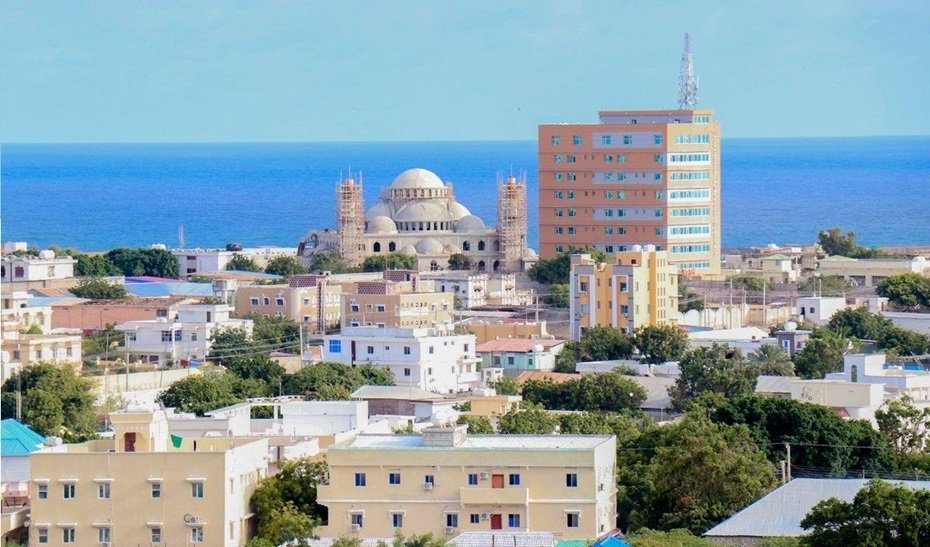
Mogadishu (WDN)- In a wide-ranging interview, presidential candidate Abdulkadir Cosoble portrayed Mogadishu as both Somalia’s most inclusive city and the financial backbone of the federal government. But while his remarks on the capital’s social openness resonate with many, his claims about its fiscal dominance do not withstand scrutiny.
Cosoble argued that taxes collected in Mogadishu are the primary source sustaining the federal government, even suggesting they cover the full spectrum of public expenditures, including salaries for civil servants and security forces.
That assertion is misleading. Even under generous estimates, revenues generated from Mogadishu’s key economic assets—particularly the seaport and airport—fall far short of financing the state. After the mandated 15% allocation to the Benadir Regional Administration, the remaining income contributes, at most, around 30% of the national budget.
The rest—by a significant margin 70% —is financed by the international community. This is not a marginal detail; it is the central reality of Somalia’s public finances.
For over a decade, Somalia’s budget has been heavily dependent on external support, with international partners underwriting the majority of government spending, including security sector costs and institutional operations. To present Mogadishu as the sole financial engine of the state is to overlook this structural dependency.
Where Cosoble’s argument carries more weight is in his characterization of Mogadishu as a uniquely open city. He described it as the only place in Somalia where citizens from all clans can live without feeling excluded—a sentiment widely echoed in public discourse.
Yet even this point sits within a broader political context.Cosoble has previously advocated for granting Mogadishu a federal member state status similar to other regions—an idea that remains deeply contested. Framing the capital as both economically indispensable and socially inclusive strengthens that political case, but it also risks oversimplifying complex fiscal and constitutional realities.
In the end, the issue is not whether Mogadishu matters—it clearly does. The issue is accuracy. At a time when Somalia faces profound political, constitutional and economic uncertainty, public debate cannot afford to drift into exaggeration. The country’s fiscal survival still depends not on a single city, but on a fragile combination of domestic revenue and sustained international support.
Anything else is not analysis. It is politics.
WardheerNews