
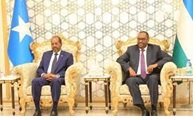
Garowe (WDN)- The political fault line between the Federal Government of Somalia and Puntland is no longer a simmering dispute, it is fast becoming a full-blown national crisis, with rhetoric hardening, positions entrenching, and the specter of armed confrontation moving from possibility to probability.
At the center of the escalation is a growing sense of abandonment and defiance. Prime Minister Hamza Abdi Barre has raised the stakes dramatically. His directive to federal forces to confront any opposition to the government’s electoral plan signals a shift from political contestation to coercive enforcement. In a country with a fragile federal balance, such language is not just provocative, it is dangerous.
Puntland’s response was swift and unequivocal. Senior officials dismissed the Prime Minister’s remarks as reckless and unlawful, warning that the use of national forces as a political tool crosses a red line. The message from Garowe is clear: any attempt at military pressure will be met with resistance.
Puntland’s Interior Minister, Abdi Hirsi Ali, also did not mince words when addressing residents in Burtinle. His message was blunt: Puntland can no longer rely on Mogadishu and must chart its own course.
“We cannot continue waiting for nothing,” he declared—a statement that captures the deepening rupture between Garowe and the federal center. This is not routine political disagreement. It is a breakdown of trust.
That resistance is already taking shape. President Said Abdullahi Deni has placed Puntland’s forces on full combat alert, ordering commanders to prepare for the defense of their territory. This is no longer political signaling—it is operational readiness.
Meanwhile, developments on the ground are reinforcing the sense of impending crisis. Federal displays of military force in Baidoa have sent shockwaves through the federal member states, raising fears that Somalia may be sliding toward internal confrontation under the guise of enforcing political order.
The pattern is unmistakable: escalating rhetoric, mobilizing forces, and collapsing political dialogue.
Somalia is entering a perilous phase where political disputes are no longer confined to conference rooms but are spilling into the security arena. The consequences of such a shift are well known—and deeply troubling. Once political disagreements are militarized, they become exponentially harder to contain.
What makes this moment particularly alarming is the absence of meaningful de-escalation. There is no visible mediation, no credible dialogue framework, and no indication that either side is prepared to step back.
Instead, Somalia appears to be drifting toward a collision course. If this trajectory continues, the outcome is unlikely to be a negotiated settlement. It will be fragmentation, confrontation, and a further weakening of an already fragile state structure. The warning signs are no longer subtle.
Somalia is not just facing a political crisis—it is staring down the possibility of internal conflict, driven not by external threats, but by the breakdown of its own federal compact.
WardheerNews