
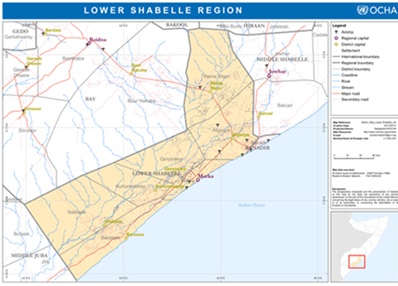
Mogadishu (WDN) – Fresh clan tensions are escalating in Somalia’s Lower Shabelle region, raising fears of another round of intercommunal violence in a country where local clan conflicts have increasingly become a recurring feature of the security landscape—even as areas under Al-Shabaab control remain largely free from comparable internal clan warfare.
Reports from Lower Shabelle indicate growing tensions in the areas of Janaale, Baqal, Xawaaloow, and Lambar 60, where members of the Biyomaal clan are at odds with sections of the Hiraab clan family, particularly the Abgaal and Habar Gidir communities.
The dispute reportedly centers on competing claims over local administration, land ownership, and control of territories recently recovered from Al-Shabaab. Both sides are said to be mobilizing armed supporters, stockpiling weapons, and convening clan meetings as they prepare for a possible confrontation, each insisting it is defending its legitimate rights and interests.
The Biyomaal community has announced a campaign to reclaim areas it says were taken from it and has unveiled plans to establish a new local administrative entity it calls “Koonfur Bari.” Meanwhile, elders from the Hawiye (Abgaal and Habar Gidir) communities have vowed to defend what they describe as their ancestral territories against any attempts to alter the current balance of control.
The tensions have already begun to inflict economic damage. Local reports say a commercial farm in Janaale was deliberately set ablaze last week, causing losses estimated at more than $200,000. The farm’s owner has appealed to both the Federal Government of Somalia and the South West State administration to intervene urgently before the dispute erupts into full-scale armed conflict.
Neither the Federal Government nor the South West State administration has issued an official statement on the latest developments, despite the region remaining a key theater in ongoing military operations against Al-Shabaab.
The latest crisis highlights a troubling pattern that has become increasingly common across Somalia. Only recently, Middle Shabelle witnessed deadly clan clashes. Before that, similar violence erupted in other regions as local communities fought over land, political representation, grazing rights, and control of territory.
Observers note a striking paradox: while government-controlled and recently liberated areas repeatedly descend into clan-based violence, comparable inter-clan fighting is rarely reported in territories that remain under Al-Shabaab’s rule.
Security analysts argue that the militant group maintains strict centralized control over the areas it governs, suppressing local disputes through coercion and fear. Others suggest that the absence of open clan conflict in Al-Shabaab-held territory underscores the group’s ability to impose order—albeit through intimidation and violence—while exposing the Somali state’s continuing struggle to establish effective governance and dispute-resolution mechanisms in areas it controls.
The recurring cycle presents a significant challenge for Somalia’s stabilization efforts. Military victories against Al-Shabaab risk proving temporary if liberated areas quickly become engulfed in clan rivalries, undermining efforts to establish lasting peace and functioning local administrations.
As Somalia continues its campaign to recover territory from Al-Shabaab, many analysts argue that preventing clan conflict may prove just as important as defeating the insurgency itself. Without effective reconciliation, inclusive governance, and credible local institutions, newly liberated communities risk exchanging one form of insecurity for another.
WardheerNews
Leave a Reply