
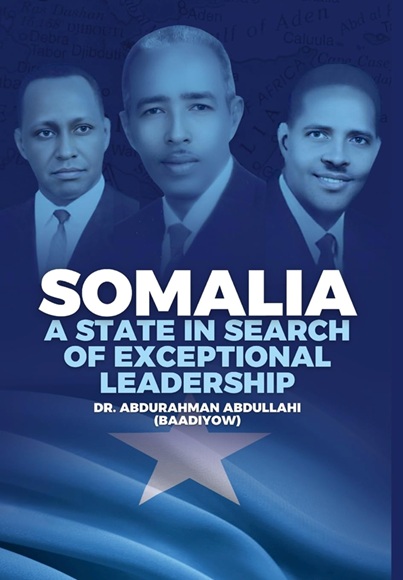
Reviewed By: Dr. Abdulkadir Osman Farah
Author: Dr Abdurahman Abdullahi (Baadiyow)
Publisher:Looh Press, England, UK
Year: 2025
Pages: 386 pages
Wise leadership
Once, Garaad Xirsi Faarax Xirsi (Wiilwaal), a traditional Somali leader, challenged his people, as he often did. He asked them to identify the core element that shapes social and political organisation among disputing men—and occasionally women. He instructed them to bring him a piece of meat from their livestock: a part that symbolised either togetherness and collaboration, or the opposite—destructive division. Most men returned with a fine cut of fresh meat. Meanwhile, a young girl approached her nervous father at home. He seemed anxious as he tried to decide what to present to the uncompromising leader. Calmly, she advised him to deliver the gullet (“throat”)—hunguriga—of the animal. Astonished, the father hesitated, but she persuaded him: “What passes through the gullet (hunguri) can either satisfy and establish peace among men or unleash greed and perpetual conflict.” Soon after, the sceptical father reluctantly delivered the piece to the assembled men. As he inspected the offerings, the leader asked, “Who brought this?” The shaking father stepped forward: “I did—following my daughter’s idea.” The leader later summoned the wise young woman and eventually married her.
This classic Somali narrative teaches principles that can lead people either toward cooperation and coexistence or toward fragmentation and shared ruin. It also suggests that wise leadership can come from multiple sources, including from those regarded as subordinates—people whose capacity for wisdom and direction society often underestimates.
Dr Baadiyow’s book adds a further perspective to this traditional lesson. People do not struggle only—egoistically and superficially—over access to material resources. Principled people also compete in the ongoing search for a purposeful life, legitimate causes, and just public priorities. Identifying and elevating such balanced “exceptional leaders” requires Somalis to move away from the familiar clannish practice of madax tiris—counting people as “xoolo” (a herd). Instead, society should distinguish between those who genuinely contribute to the nation and those who contribute less. Beneficial leaders include, for example, mothers raising children, teachers educating the young, farmers producing food, medical professionals relieving suffering, and others—often invisible, yet industrious pillars of society.
The “Hoggaan” Concept
The concept of “hoggaan” (leadership) originates in ancient nomadic terminology. In his dictionary, Professor Saalax Xaashi Carab defines hoggaan as: “Xadhig inta awrta surka lagaga xidho oo lagu keeneeyo, lagu wado—lagu jiido,” meaning “a rope tied around a camel’s neck so it can be led—driven and pulled along.” In other words, it implies leading and controlling—driving livestock (camels) forward. The question is whether leading livestock (xoolo) is comparable to leadership among humans. Some might say “yes,” particularly where people abandon integrity, dialogue, ethics, and authenticity. It is even worse when people assume that whatever a leader dictates is necessarily noble and valid, regardless of sincerity, truthfulness, or practical viability.
As children in elementary school in Xamar (Mogadishu), during our rare visits to the principal’s office, we saw a large, colourful painting hanging high on the wall. It depicted President Mohamed Siad Barre in traditional Somali dress, pointing forward while holding a hoggaan (a lead rope) attached to a camel. Behind him, a mixture of urban, nomadic, and agrarian people followed enthusiastically. The caption read: “Moving the nation away from drought and hardship towards abundance, peace and prosperity.”
Knowing your leaders
In everyday life, Somalis—across different lifestyles and experiences—already know what kinds of leaders they prefer and might eventually support. This may partly explain why, over the past four decades, no single Somali leader has secured broad national approval. Evidence suggests Somalis not regarding current leaders as genuinely patriotic. Rather than following disgraced figures, people often invest instead in smaller-scale leaders within their own constituencies and regions—so‑called provincial leaders whom people see as providing temporary relief while the country transitions toward serious national leadership.
This complicates Dr Baadiyow’s state-centred assumption that there exists “a Somali state in search of an exceptional leadership.” Empirically, it is Somali society—individually and collectively—that remains in search of a viable state and leadership. Somalis seek hoggaan in multiple contexts: in families, workplaces, schools, and universities. Others look to leaders in sports and cultural life. Some find partial forms of leadership within military structures. In the worst cases, people may end up seeking “exceptional leadership” in criminal gangs and deceptive networks. The problem, then, is not the absence of leadership, but what designated leaders do—and how they shape and transform society, both generally and in specific contexts.
Rather than the state “searching” for leadership, we might emphasise that Somalis, in their diverse communities, are constantly seeking—and practising—leadership. Students, for example, look for leaders who can improve schools and educational standards. Somali mothers search for leadership in their households, neighbourhoods, towns, regions, and the country at large. When surrounding institutions fail them, mothers often assume leadership themselves—for their families and, in practice, for wider society. A brief visit to Somali markets (suuq) reveals such “exceptional” forms of leadership. Economically poor yet morally resilient mothers working long hours, often until sunset, under prevailing and unsustainable socio‑political and economic conditions.
Integrity, Organization and Balancing
In the book, Dr Baadiyow highlights three themes related to the formation of “exceptional leadership”: (1) the importance of leaders with tested ethics and integrity; (2) the idea that leaders emerge through the organisation and reorganisation of Somali society in ways that enable leadership to succeed; and (3) the need for leaders with a clear vision and capabilities who—together with society—can balance Somalis’ internal trajectories with external demands and pressures.
However, leadership with integrity is less about the emergence of a detached heroic figure than about relationships of trust within society. A leader is not someone operating above others. Leaders remain as vulnerable as anyone else. What distinguishes them is the public trust (amaanah) placed in them. When a leader exploits and abuses that trust, they fall below the average person. When they honour public responsibilities, they may deserve the label of an “exceptional leader.” Thus, the issue is not the person per se, but the “public space” in which public policy can appear and flourish. Where there is no public space—no shared “publicity” (danwadaag, dan guud)—people’s aim shift toward informal arrangements, doubtful private deals, and narrow enterprises. As this common life declines, society risks moral and ethical purposelessness. Extreme uncertainty follows, and the institutions that sustain collective life may decline and disappear.
For example, a student once asked: “Macallin, ma jirtaa meel, degmo and gobol Soomaaliya ka tirsan oo aan shaqsi/muwaadin ahaan u tagi karo, ayadoo aan reer/beel/koox gaar ah aysan isbaaro ii dhiganeynin oo aysan i weydiineyn—halkee ka timid? halkee u socotaa? maxaa rabtay iwm.?” (Teacher, is there any town, district, or region in Somalia where I can go, stay, or work as a citizen without a particular clan or group setting up roadblocks and interrogating me—where are you from, where are you going, and for what purpose?). It is a bewildering rhetorical question, but also a deeply insightful one. Over the past four decades, public spaces—spaces of shared ownership and collective dialogue—have gradually disappeared. Private companies quickly filled the gap, causing significant social, political, and economic deficiencies.
Somalis produce leaders continually
Somali society produces diverse leaders through cultural, social, and political dynamics. According to Dr Baadiyow, Somalis once produced ethically grounded and responsible leadership. Over time, however, neo-colonial, and post-colonial priorities and pressures sidelined these leaders. Ending up for these leaders managing the preferences of external patrons, entrenching imported bureaucratic models, and performing foreign forms of “statehood” while neglecting to build and protect a Somali-owned public space.
In other words, they failed to draw water from ceelka biyaha (the well of the nation/society). The late poet and artist Aweys Geedow referred to one such leader as “Ciyow,” while naming the nation/society as “Caasho.” Disappointed by the negligence and corruption of Somali leaders in the 1960s, Caasho laments: “Ciyow biyaha keen ciddaa oomanee caweys iyo cayaar dhafaa ceelka soo jiidee. Meel cagaar buuxoo, cawska soo muuqdo, caano waa yaallaan looma ciishodee.” Speaking on behalf of society, Caasho warns leaders not to flirt with externally assigned, colonial roles. Instead, she urges them to focus on people’s needs by fostering, producing, distributing, and preserving the nation’s human and natural wealth. In reply, the frustrated leader Ciyow—feeling trapped between national and colonial/neo-colonial priorities—responds: “Ceelka jiidowgiisaan la caatoobee, caawinaan waayee, Caasho waa noogee.” (I feel exhausted and trapped between irreconcilable visions and perspectives.) Although the independent leaders of the 1960s comparably appear better than succeeding leaders, they failed to become “transformative leaders” like their counterparts in parts of Asia and elsewhere in Africa. Back in early 1960s, Somalia’s gross domestic product (GDP) exceeded that of several Asian and African nations, such as Korea, Malasia, and Ghana. When the military seized power in 1969, the democratically elected authorities were already facing widespread corruption, maladministration, and violence.
Leadership emerges through joint, collective work within society. Leaders do not simply descend from the top; society produces them through the interaction of ordinary people’s priorities, civil-society efforts, warlords, factions, and even external proxies. For example, Dr Baadiyow documents how, in recent decades, armed militia groups—supported by foreign hegemonies—have oppressed and sidelined promising, patriotic civil-society leaders. Such interventions have hindered the formation of a Somali nation and state with an autonomous, Somali-owned public order and public space.
Three exceptional Somali leaders
Dr Baadiyow highlights three Somali leaders—President Aden Abdulle Osman; Minister and Ambassador Abdullahi Ciise; and Prime Minister and Ambassador Abdirisaq Haji Hussien—as “exceptional leaders.” He argues that all three came from humble backgrounds with limited formal education yet played paramount roles in building an independent Somali nation-state widely respected across Africa and beyond. He further notes that they left office without accumulating personal wealth from public positions.
President Mohamed Siyad Barre, though a military ruler and less democratic than these three leaders, also built a strong Somali state, mobilised society, and expanded education and opportunity for millions of Somalis. Barre fled to Kenya, but reportedly refused a lucrative refuge, citing Kenya’s illegal occupation of Somali land allocated by the British colonial administration. He argued that accepting asylum there would set a bad example for future Somali generations. Later, Nigerian authorities granted him refuge. They were astonished to find out that Barre was penniless. The Nigerians assumed and imagined that all African leaders rob the wealth of their societies.
Balancing tradition with modernity
Finally, Dr Baadiyow calls for balancing tradition with modernity: rebuilding legitimacy by crafting governance from indigenous continuities rather than importing superficial models. He is not urging a nostalgic return to the past. Rather, he calls for rediscovering Somali history that colonialism sidelined. History shows that Somalis across the region once governed themselves effectively. In around 1331, Ibn Battuta visited Somali city-states such as Mogadishu and noted multilingual populations, plentiful of food, robust international trade, effective administration, and support for students and scholars.
If the Somali nation and society where for example a ship built and sailed for safely—with the crew (leaders) and passengers (society) on-board—then building such a ship requires blending tested Somali values with proven, beneficial modern socio-political arrangements. Furthermore, it is not only how to balance the ship’s load, but also from where it should sail, to where, and with whom.
In conclusion, for thoughtful observers, it is clear that “exceptional Somali leadership” does not precede society. Such leadership emerges from the existence—and protection—of a Somali “public space” A dynamic shared civic sphere that no individuals or groups can unilaterally monopolise as private property.
Dr Baadiyow is right to call for a balance between tradition and modernity. Yet the current reality shifts to the opposite direction. As Somalis increasingly became transnational—and, at times, globalised—the search for a viable Somali nation, state, and leadership unfolds across the world. Somalis will therefore need to move beyond national/transnational “madax tiris” and gradually embrace an authentic, sincere pursuit of “madax dheeraad”—not only to strengthen the Somali nation and state, but also to contribute positively to global wellbeing and humanity at large.
Dr. Abdulkadir Osman Farah
Email: osmanfaraha@gmail.com
————-
Dr Abdulkadir is a vvisiting Research Professor, Somali National University ; Associate Aalborg University, Denmark-Migrant Solidarity and Hospitality in Global Perspective; Research and Innovation Associate, Tshwane University of Technology, Pretoria, South Africa.