
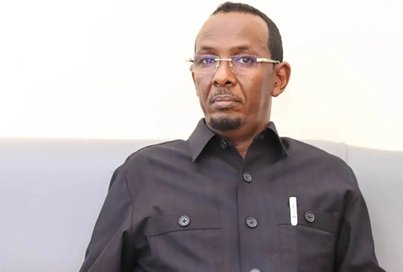
Mogadishu (WDN) — In a striking and unexpected reversal, former intelligence chief Abdullahi Mohamed Ali Sanbaloolshe has publicly turned on the administration of President Hassan Sheikh Mohamud—delivering a scathing critique that is as surprising as it is controversial.
Sanbaloolshe accused the government of presiding over a weakened state, pointing to declining security, entrenched patronage networks, and alleged land seizures in Mogadishu. He claimed the national army has been eroded since 2022 and that the government’s effective control barely stretches beyond limited areas of the capital.
But the real surprise is not the content of the accusations, it is the source.
For much of this period, Sanbaloolshe was not a distant observer. He was part of the system, operating within the very security establishment he now describes as failing. His long silence during these developments has prompted immediate questions about complicity and timing.
“To hear this now, after the fact, is what shocks people,” a political analyst told WardheerNews. “He wasn’t outside the system, he was inside it.”
The sudden public rebuke of a president widely seen as a political ally has reinforced a long-held view of Sanbaloolshe as an unpredictable actor—one who shifts positions as alliances change. In political circles, his latest intervention is being read less as a rupture of principle and more as a familiar pattern.
“Today he speaks out; yesterday he was aligned,” a commentator noted. “That contrast is hard to ignore.”
Sanbaloolshe also broadened his criticism beyond security, accusing the administration of nepotism and mismanagement, and warning that governance has been overshadowed by private interests. He painted a picture of a state struggling to function beyond narrow corridors of control.
Yet his claims come with a built-in contradiction: if the system has deteriorated to the extent he describes, then those who led its key institutions including himself cannot be entirely removed from that outcome.
The presidency has not yet responded, but the reaction is already unfolding across Somalia’s political landscape. Supporters are questioning his credibility, while critics are seizing on his remarks as insider confirmation of deeper problems.
For now, one thing is clear: Sanbaloolshe’s has injected a new—and unexpected—twist into an already tense political moment. And in doing so, it has turned the spotlight not only on the government—but back onto the man now challenging it.
WardheerNews