
Mogadishu (WDN) – At a time when Somalia is grappling with one of its most serious political crises in recent years, the arrival of another foreign police contingent under the African Union mission has raised fresh questions about the effectiveness of international stabilization efforts that have now spanned nearly two decades.
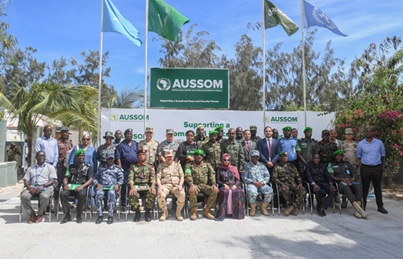
The African Union Support and Stabilization Mission in Somalia (AUSSOM) formally welcomed a new Ghanaian police contingent, known as GFPU-5, which has been deployed to Mogadishu, Baidoa, and Beledweyne to support the Somali Police Force.
According to AUSSOM, the unit will participate in joint security operations, specialized training programs, and advisory initiatives aimed at strengthening the capacity of Somali police institutions. The Ghanaian contingent replaces the outgoing GFPU-4 unit, which completed its deployment after working alongside Somali security forces.
On paper, the deployment appears routine. In reality, however, it arrives of a country facing profound political uncertainty, constitutional disputes, and growing concerns over state legitimacy. For many observers, the question is becoming increasingly difficult to ignore: What difference can another foreign police unit make when Somalia’s crisis is no longer primarily a security problem, but a political one?
Mogadishu today is not merely confronting threats from insurgents. The capital has become the center of an escalating confrontation over constitutional amendments, election models, power-sharing arrangements, and the future structure of the Somali state.
Opposition leaders continue to challenge the federal government’s political direction, while disputes over electoral processes and constitutional changes have created deep divisions between Villa Somalia and key political stakeholders.
Somalia’s most urgent challenge is not the absence of foreign security advisers or additional police trainers. Rather, they contend that the country lacks a broad political consensus capable of restoring confidence in state institutions and preventing further fragmentation.
The arrival of the Ghanaian unit has therefore generated a degree of skepticism among many Somalis and political analysts.
For nearly twenty years, Somalia has hosted multiple international military and police missions under different names and mandates—from African Union Mission in Somalia (AMISOM) to African Union Transition Mission in Somalia (ATMIS) and now AUSSOM. Thousands of foreign troops, police officers, advisers, trainers, and consultants have rotated through the country.
Yet despite these efforts, Somalia remains mired in recurring political crises.
Supporters of the mission argue that foreign police units continue to play a vital role in professionalizing Somali security institutions and preventing a complete collapse of public order. They point to training programs, mentoring initiatives, and operational support as important contributions to long-term stability.
However, critics counter that no amount of police training can resolve disputes over governance, constitutional legitimacy, or political power. “Security forces can maintain order,” one political observer noted, “but they cannot manufacture political consensus.”
Indeed, the challenge facing Somalia today appears far more complex than the traditional security threats that originally justified large-scale international intervention.
The country’s political elite remain sharply divided over the constitutional framework, electoral arrangements, and the balance of power between the federal government and regional administrations. These disagreements have repeatedly stalled national reconciliation efforts and fueled cycles of political confrontation.
Against this backdrop, the deployment of another foreign police contingent risks appearing less like a solution and more like a reminder of how long Somalia’s stabilization project has remained unfinished. AUSSOM Police Coordinator ACP Dr. Samuel Asiedu Okanta urged the newly deployed officers to uphold the highest standards of professionalism and conduct while supporting Somalia’s peace and stabilization efforts.
Yet the broader reality remains difficult to escape. While international missions continue to rotate personnel and renew mandates, Somalia’s underlying political disputes remain unresolved. Foreign police officers can train, mentor, and advise. They can help secure installations and support law enforcement operations.
What they cannot do is negotiate political compromises, rebuild trust between rival factions, or resolve disputes over legitimacy and governance. As Somalia enters another uncertain chapter, many citizens are increasingly asking whether the country needs more foreign security deployments—or a genuine political settlement capable of addressing the root causes of instability.
Until that question is answered, the arrival of each new contingent may serve as a symbol not only of international commitment, but also of how elusive a lasting political solution has become.
WardheerNews