
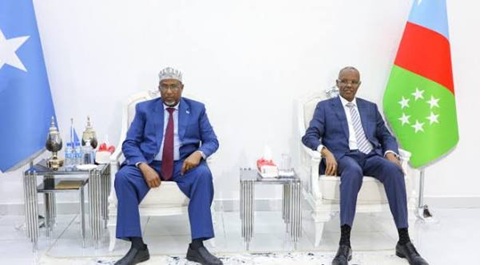
MOGADISHU (WDN) — Senior Somali political figures are now scrambling to find a negotiated settlement to the escalating crisis in South West State, following territorial gains by forces loyal to former regional president Abdiaziz Hassan Mohamed Laftagareen. But the late diplomatic push raises a fundamental question: can those who helped create the crisis now repair the damage inflicted on the people they claim to represent?
Speaker of the House of the People, Abdikadir Mohamed Nur (Jama), has met a self-appointed peace committee comprising businesspeople, religious leaders and members of the Somali diaspora seeking a way out of the confrontation. Meanwhile, Adan Mohamed Nur, known as Adan Madoobe, who is currently in Mogadishu, has held separate consultations with federal officials and political figures from South West State.
The meetings come as the region faces deepening political divisions and military confrontations between forces aligned with Laftagareen and those supporting the administration in Baidoa, which has backing from the Federal Government of Somalia.
For residents of South West State, the consequences are no longer confined to political arguments in Mogadishu or Baidoa. The struggle has expanded into a contest over territory, security and the authority to govern communities already burdened by years of instability.
Diplomacy After the Damage
During his meeting with the peace committee, Speaker Jama reportedly heard proposals concerning state-building, reconciliation, social cohesion and the restoration of peace and stability. He praised the involvement of community representatives in efforts to resolve the crisis. Federal lawmakers also attended the meeting.
Adan Madoobe, meanwhile, met on Tuesday the former Southwest State president Sharif Hassan Sheikh Aden to discuss the worsening political and security situation. Their talks reportedly covered reconciliation, political stability, security and efforts to regain districts captured by forces loyal to Laftagareen.
The consultations reflect growing concern over the military and political consequences of the confrontation. Reports indicate that Laftagareen-aligned forces have taken control of Qansax Dheere, Bardale, Buurhakaba and Diinsoor, all in Bay region. The administration in Baidoa is reportedly considering a military campaign to recover the areas.
The reported territorial changes have increased pressure on political leaders to find a settlement before the confrontation causes further displacement, civilian suffering and institutional breakdown.
Yet the timing of the negotiations is striking. Political consultations are intensifying only after the balance of power on the ground has shifted and the crisis has become harder to contain.
The Political Responsibility Question
For critics of President Hassan Sheikh Mohamud’s approach to federal relations, the Southwest crisis represents a consequence of a broader strategy of political intervention in the affairs of federal member states. They argue that federal power has been used to influence regional leadership disputes rather than build a consensus-based federal system.
Within this interpretation, Jama and Adan Madoobe are not simply neutral intermediaries attempting to resolve a crisis. Critics regard them as political actors whose involvement in the confrontation helped undermine Southwest State’s stability, and who are now seeking negotiations after the consequences have become increasingly difficult to manage.
These are contested political accusations, and the precise responsibilities of individual leaders must be assessed against documented decisions and actions. Nevertheless, the central question remains legitimate: what responsibility should political leaders bear when their choices contribute to a conflict that later requires emergency negotiations to contain?
Negotiation is necessary, but it cannot by itself erase the consequences of earlier decisions. A durable settlement would require more than meetings among senior politicians. It would need credible guarantees for civilians, an end to military escalation, meaningful participation by affected communities and agreement on the political arrangements governing the region.
A Crisis That Cannot Be Solved by Force Alone
The confrontation exposes the fragility of Southwest State’s political institutions. When competing factions seek to settle disputes through military pressure, the authority of regional institutions weakens, and ordinary residents bear the greatest cost.
A military operation to recover lost districts could deepen the crisis if it is launched without credible efforts to prevent civilian harm and establish a political framework for the aftermath. Conversely, a negotiated settlement that merely accommodates the interests of rival elites, without addressing the grievances and fears of local communities, risks postponing rather than resolving the conflict.
The Federal Government also faces a test of its commitment to federalism. If Mogadishu is perceived as a partisan participant rather than an impartial facilitator, its ability to mediate will be questioned. Any credible process must therefore include the relevant regional actors and communities, with clear commitments to de-escalation and a political settlement.
Accountability Must Follow Reconciliation
The latest meetings suggest that political leaders recognize the need to contain the Southwest crisis. But the people of the region have reason to demand more than expressions of concern after violence and territorial losses have already occurred.
Jama and Adan Madoobe may now be seeking a negotiated way forward, but the credibility of their efforts will depend on whether they help secure a genuine settlement, protect civilians and address the political decisions that brought the region to this point.
Reconciliation should not become a convenient substitute for accountability. Those who exercised political power and influenced the course of the confrontation must be prepared to explain their decisions and face legitimate public scrutiny for their consequences.
The people of Southwest State should not be expected to absorb the costs of political maneuvering while those responsible move from confrontation to negotiations without answering difficult questions.
The immediate priority is to prevent further bloodshed and restore stability. But lasting peace will require a broader reckoning with how the crisis developed, whose interests were served and how Southwest State can be protected from future political interference.
The time for accountability may come through public scrutiny, political processes and lawful institutions. For now, the test is whether these late negotiations can deliver a settlement that serves the people of Southwest State rather than simply rescuing the political fortunes of the leaders involved.
WardheerNews
Leave a Reply