
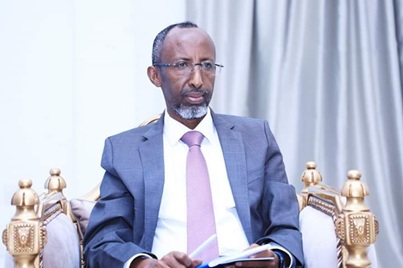
Mogadishu (WDN)- The Minister of Education, Farah Sheikh Abdulkadir, widely viewed as a close political ally of President Hassan Sheikh Mohamud has delivered a politically charged speech that has intensified debate over Somalia’s already fragile electoral process.
Speaking at a large public gathering in Mogadishu, the minister moved beyond his official education portfolio and directly addressed the country’s deepening political tensions, directing pointed remarks at opposition groups and framing their stance as an obstacle to national progress.
At the center of his remarks was Somalia’s disputed electoral roadmap. The minister defended the push for a one-person, one-vote system, insisting it represents the only legitimate democratic path forward and should not be subjected to further political bargaining.
The minister firmly rejected the continuation of indirect elections, despite having himself entered parliament through that very system on three separate occasions. He argued that Somalia must now move beyond the indirect model entirely, presenting direct universal suffrage not as an option for negotiation, but as an essential national necessity.
“The opposition must come forward with proposals that support the continuity of state-building,” he said, a statement critics interpret as aligning closely with the presidency’s political messaging rather than maintaining ministerial neutrality.
His comments come amid heightened political sensitivity over the structure and timing of upcoming elections, with opposition figures warning that unilateral decisions risk deepening mistrust and institutional division.
The most controversial moment in his speech came when he suggested that the current administration could remain in office for an additional two years. The remark sparked immediate surprise among attendees and has since fueled speculation about possible attempts to extend political timelines beyond expected constitutional limits.
Analysts note that such statements are particularly significant given Somalia’s fragile political environment and ongoing disputes over electoral legitimacy. Critics also question the feasibility of the proposed one-person, one-vote system, pointing to the fact that the current electoral commission was formed without broad consensus, raising concerns about its independence. They further highlight persistent insecurity across parts of the country, where armed groups such as Al-Shabaab continue to limit state control and complicate nationwide electoral planning.
Opposition voices argue that little meaningful institutional preparation has been undertaken over the past four years to support such an ambitious electoral transition. Farah Sheikh Abdulkadir, widely regarded as a close ally and key confidant of President Hassan Sheikh Mohamud, by stipulating one- or two-year extension comes from his understanding of the illegitimate constitution villa Somalia rewritten without consultation. My 10, 2026 government agenda is akin to the words of the minister and to that end it will be unproductive as the previous reconciliation meetings.
Taken together, the minister’s remarks have deepened political divisions and reinforced perceptions of a widening gap between the government and opposition camps. As Somalia moves closer to its next electoral cycle, the struggle over legitimacy, process, and timing appears increasingly central to the country’s political future.
WardheerNews