

By Abdiqani Haji Abdi
Somalia is entering one of its most delicate political moments in recent years. With the presidential term nearing its conclusion, the familiar warning signs of a contested transition are reappearing—fractured dialogue, hardened positions, and growing anxiety among political actors and traditional leaders alike. What sets this moment apart, however, is not merely the tension itself, but the striking absence of compromise at the highest level of government.
At the center of the unfolding standoff is President Hassan Sheikh Mohamud, whose firm refusal to negotiate on key political issues has triggered concern across Somalia’s political and social landscape. His stance has now been tested in multiple forums—by opposition leaders, by influential clan figures, and by traditional elders—and in each case, the response has remained unchanged.
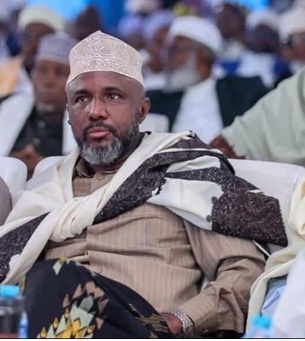
The most recent warning came from Garad Jama Garad Ali, the traditional leader of the Dhulbahante clan, who addressed a gathering between the president and Somali elders in Mogadishu. His message was measured but unmistakable: Somalia must avoid drifting into conflict as the political calendar tightens.
Garad Jama urged the president to open political space and embrace inclusive decision-making, warning that the cost of intransigence could be renewed instability. He called for power-sharing and consensus-building before tensions escalate beyond control—an appeal rooted not in politics alone, but in the traditional authority’s long-standing role as a stabilizing force in Somali society.
Yet even as such calls grow louder, they appear to be colliding with a presidency that has drawn clear red lines.
According to participants and political insiders, a prior meeting between the president and an umbrella group of opposition figures ended without progress. The opposition had come prepared to negotiate on three core issues: the legitimacy of a constitutional process they argue was driven unilaterally from Villa Somalia without adequate consultation; the composition of an electoral commission formed, they claim, without consensus; and the structure of the proposed electoral model.
What they encountered instead was a firm rejection of compromise. “I am not compromising on the three points mentioned,” the president reportedly told the delegation.
For many in the room, the statement marked a turning point. Negotiations, by their nature, depend on flexibility. The absence of it—particularly on foundational issues—left little room for dialogue to continue.
In a separate but equally telling development, a group of Hawiye political figures sought to intervene. Sharing clan ties with the president, they approached the meeting with cautious optimism, hoping that internal dialogue might succeed where formal opposition channels had failed. Their aim, according to sources, was to “save the day”—to find a middle ground that could prevent a broader political rupture. But their efforts yielded the same result.
Despite what insiders describe as constructive engagement and appeal for moderation, the president maintained his position. There would be no shift, no recalibration, no concession. The repetition of that message across different audiences—opposition leaders, clan figures, and traditional elders—has reinforced a growing perception: that the current political trajectory is being defined not by negotiation, but by resolve.
Publicly, President Hassan has framed his stance as a matter of principle. Addressing traditional elders gathered in Mogadishu for the inauguration of a Mursade clan Ugaas, he defended his push for one-person, one-vote elections as a constitutional imperative. “We cannot abandon the Somali people’s constitutional right to elect the leadership they want after 57 years,” he said, adding that Somalia’s past reliance on indirect elections had yielded little but political dysfunction.
The argument resonates with a broad segment of the population. Universal suffrage remains a widely shared aspiration—a symbol of sovereignty, legitimacy, and democratic progress. Yet the path to achieving it remains fraught with practical and political challenges, particularly in a country still grappling with insecurity, fragmented authority, and institutional weakness. It is within this gap—between aspiration and feasibility—that the current crisis is taking shape.
Critics do not necessarily reject the principle of one-person, one-vote elections. Rather, they question the process by which it is being pursued. They argue that without consensus on the rules of the game—the constitution, the electoral body, and the framework itself—the outcome risks lacking legitimacy, regardless of its democratic intent.
Supporters of the president although the best left his camp, on the other hand, view the resistance as an attempt to preserve a flawed status quo—one that has long enabled elite bargaining at the expense of popular participation. From this perspective, compromise is not always virtuous; sometimes, it is a mechanism for perpetuating dysfunction. Caught between these competing narratives is a political system under strain.
The stakes are high. Somalia’s recent history offers ample reminders of how quickly political disagreements can escalate when dialogue breaks down. The role of traditional leaders, such as Garaad Jama Ali, underscores this reality. Their interventions are often last attempts to bridge divides before tensions spill over into instability. So far, those interventions have not shifted the trajectory.
The question now facing Somalia is not simply whether one-person, one-vote elections should take place, but whether they can be implemented in a manner that commands broad-based acceptance. Without that acceptance, even well-intentioned reforms risk becoming flashpoints rather than foundations.
As the political clock continues to tick, the space for compromise appears to be narrowing. The president’s message is clear. The opposition’s concerns remain unresolved. Traditional leaders are sounding alarms.
And the country, once again, finds itself at a familiar crossroads—where the difference between stability and crisis may hinge on whether dialogue can still find a way forward.
Abdiqani Haji Abdi
Email: Hajiabdi0128@gmail.com