
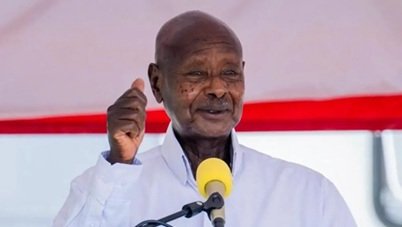
KAMPALA (WDN) — Uganda President Yoweri Tibuhaburwa Kaguta Museveni has turned an old personal name into a fresh subject of political curiosity after Tibuhaburwa featured prominently in his official name during his latest presidential swearing-in.
But despite the renewed attention, the name is not a recent invention—and Museveni did not add it to his name in 2026.
The legal change dates back to October 2020, when Museveni executed a legal deed poll, formally establishing Yoweri Tibuhaburwa Kaguta Museveni as the name he would use on official documents.
The name has since appeared in Uganda’s official records and was used during his swearing-in for another five-year term in 2026.
A Name with a History
According to reporting by Uganda’s Daily Monitor at the time, Museveni said he was born in September 1944 and was given the name Yoweri Tibuhaburwa Kaguta.
For years, however, his name appeared in different forms across official and personal documents, including Yoweri Museveni, Yoweri Kaguta Museveni and Yoweri Tibuhaburwa Museveni.
The 2020 deed poll was intended to settle the discrepancy. Museveni formally declared that Yoweri Tibuhaburwa Kaguta Museveni would be his official name for future documentation. Tibuhaburwa comes from Runyankore, one of the languages spoken in western Uganda.
Why the Name Became Political
The renewed fascination with the name is partly linguistic and partly political. Tibuhaburwa has been interpreted as referring to someone who is not easily persuaded, advised or corrected. That interpretation has inevitably attracted political commentary in a country where Museveni has remained in power since 1986.
Some Ugandans regard the word simply as a traditional childhood name with no particular political significance. Others have treated its meaning humorously, suggesting that it is remarkably appropriate for a president who has governed Uganda for four decades and has repeatedly resisted calls to leave office.
The political interpretation, however, should not be confused with the legal history of the name. There is no established evidence that Museveni adopted “Tibuhaburwa” for a new political purpose. The documented record shows that it was a name associated with him from childhood and was formally incorporated into his legal name in 2020.
Why 2020 Matters
The timing of the legal change is significant. Museveni completed the deed poll in October 2020, only months before Uganda’s 2021 presidential election. At the time, Ugandan electoral and administrative requirements placed considerable importance on ensuring that candidates’ names matched across identity, educational and other official records.
Daily Monitor reported that hundreds of politicians were undertaking similar legal name adjustments to reconcile discrepancies in their documentation.
Uganda’s National Identification and Registration Authority, or NIRA, also requires a legally registered deed poll and supporting documentation when an individual seeks to add, remove or alter a name. The change was therefore not, in itself, an extraordinary political act. It was a formal legal procedure.
The name became especially visible again in 2026. When Museveni was sworn in on May 12, 2026, for what was described as his seventh presidential term, the official name used during the ceremony was Yoweri Tibuhaburwa Kaguta Museveni. Reuters also recorded Museveni beginning his presidential oath using the name.
Uganda’s Supreme Court likewise used a version of the full name in its ruling concerning the 2026 presidential election, referring to him as Yoweri Kaguta Museveni Tibuhaburwa and recognizing him as the lawfully elected president.
The variations in ordering do not alter the central point: Tibuhaburwa is now firmly incorporated into the president’s official legal identity.
Four Decades in Power
The fascination with the name cannot be separated entirely from Museveni’s political longevity.
He has ruled Uganda since 1986, making him one of Africa’s longest-serving heads of state. His seventh consecutive presidential term has inevitably intensified public discussion about his leadership style, political longevity and resistance to calls for political transition.
Against that background, the meaning attributed to Tibuhaburwa has taken on an almost symbolic quality. For some Ugandans, it is simply an old Runyankore name.
For others, its popular interpretation—someone who does not readily accept advice or correction—has become an irresistible source of political jokes and commentary.
Social media users have also questioned why such a seemingly technical matter has generated so much public attention, particularly when Museveni has an extensive political, legal and administrative apparatus around him. Yet the legal explanation is considerably less dramatic.
Tibuhaburwa was not suddenly added to Museveni’s name in 2026. It was legally formalized six years earlier, in 2020, as part of an effort to establish consistency across his official documents.
What changed in 2026 was not the name itself, but its visibility. As Museveni entered another five-year presidential term, Yoweri Tibuhaburwa Kaguta Museveni became the name appearing on the presidential oath, government documents and other official records.
The name may have become a political talking point, but its legal journey is much simpler: an old personal name was formally regularized in 2020 and is now fully embedded in the identity of Uganda’s long-serving president.
WardheerNews