
By Osman A. Hassan
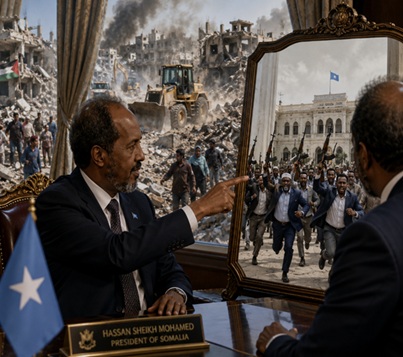
Every morning there is a ritual known only to those who live inside power too long. Before advisers arrive, before guards clear the corridors, before ministers rehearse their praises, before citizens line up with their grievances, there is the mirror. The mirror hangs quietly on the wall, but it is more dangerous than an army and more deceptive than a conspiracy. It does not speak with a voice, yet it whispers. It does not vote, yet it influences decisions. It does not hold office, yet it shapes the mind of the ruler. In that mirror former President Hassan Sheikh sees not glass, not silver, not his own aging face, but confirmation. He sees himself as the only pillar still standing in a collapsing house. He sees himself as the irreplaceable center of a nation of shifting circles. He sees his reflection as destiny, while all others appear distorted, reduced, suspicious, and hungry.
This is the oldest trap of leadership: when a leader stops seeing reality and starts seeing only reflections. The mirror tells him he is still strong, still beloved, still feared, still necessary. It tells him that the crowd outside is confused but loyal. It tells him the constitution bends where history requires it. It tells him that critics are merely jealous, rivals merely impatient, opponents merely enemies of progress. And because the mirror flatters, he listens. Yet mirrors are imperfect servants. They reverse direction. They enlarge vanity. They hide what stands behind the viewer. They can only show the front, never the back. They cannot display the wounds of the nation, the lack of service delivery the anger in distant villages, the exhaustion of soldiers, the bitterness of unpaid workers, the frustration of youth, the distrust among clans, the silence of disappointed supporters, or the slow ticking of time.
A mirror cannot show tomorrow. It only repeats today. In the morning reflection, Hassan Sheikh himself, alone on the stand, the sole survivor among lesser politicians. Others appear to him like migraine mirages, circling vultures waiting to snatch what he holds. Their ambitions seem predatory, their smiles rehearsed, their alliances temporary. He suspects every handshake hides a knife, every meeting hides a plot, every criticism hides a campaign. This mindset is common in leaders who have spent too long in competitive politics. They no longer distinguish between legitimate opposition and sabotage. Everyone outside their circle becomes a scavenger. Everyone inside their circle becomes an echo. But the tragedy of this vision is that sometimes the vultures are not circling because of greed. Sometimes they circle because they smell weakness. Sometimes they gather because the throne itself has become unstable. Sometimes the danger to a leader is not conspiracy but decline. When a term nears its end, when promises remain incomplete, when institutions remain fragile, when alliances grow transactional, the political sky fills with wings.
The former president may not know, or may refuse to know that five years in office can become a dead end long before the final month arrives. A term can die while still breathing. It dies when reform becomes slogan. It dies when security victories become temporary headlines. It dies when constitutional progress stalls into endless negotiation. It dies when federal relationships become personal feuds. It dies when public hope turns into private sarcasm. It dies when citizens begin to ask not what has been built, but what has been consumed. Yet every morning the mirror says otherwise. It says, “Your stand is firm.” It says, “History still waits for your final chapter.” It says, “The people are with you, though they complain.” It says, “The rivals are weak, though they gather.” It says, “The law is flexible, though written.” It says, “Delay is strategy.” It says, “Control is governance.” It says, “Possession is leadership.”
This is where refraction enters. Reflection shows the self. Refraction bends the image of everything else. Through the political glass of self-interest, reality changes shape. Failures look like sabotage. Corruption looks like necessity. Hassan Sheikh’s patronage looks like coalition-building. Land grabbing looks like development. Centralization looks like coordination. Micromanagement looks like discipline. Offshore wealth looks like insurance. The former president Hassan sees, commercializing the nation looks like modernization. When the lens bends enough, even greed can resemble policy.
There is an old disease in Somalia, particular at the present time where public office becomes private harvest. National land becomes negotiable paper, the ports become bargaining chips. Airspace becomes revenue language and security becomes donor vocabulary. The country’s Ministries become markets of appointments. Public contracts become family trees. Foreign relations become currency exchange. The nation becomes something to be managed for extraction rather than nurtured for transformation. If one glances toward Swiss accounts, hidden properties, or unexplained fortunes, one sees not only one man or one presidency but a wider pattern. Too many Somali politicians and leaders look into the mirror and see themselves as temporary owners of permanent nations. They know time is short, so they gather quickly. They know accountability is weak, so they move boldly. They know memory fades, so they rename theft as progress. They know the poor are busy surviving, so they proceed.
The former President Hassan’s domestic land grabbing becomes quiet scandal of his family and business enterprises. As the city expands and suddenly every empty space has a claimant. Public land disappears behind fences, Historical commons become luxury compounds, Beaches become private gates and Roads narrow beside new walls. And the citizens are told development is happening, yet development rarely includes them. They become tenants in the capital of their ancestors. Likewise, as the former president micromanagement tightens and deepens the illusion of control refracts from the mirror. And instead of building institutions that function without constant intervention, the former president centralizes signatures, approvals, appointments, permissions, and decisions. Files wait for one hand. Careers depend on one mood. Projects stall for one nod. In his systems, the former president feel powerful because everything passes through him, while the nation suffocate when every artery narrows into one vein.
Meanwhile the constitution ages on the shelf. It was meant to be a compass, but becomes a prop. Its days seem over whenever convenience demands improvisation. Deadlines pass, provisions remain disputed. Federal boundaries remain politicized, power-sharing remains selective. The legislative and Judiciary remain vulnerable. While citizens hear speeches about democracy while elites negotiate exceptions in private rooms. Still, the morning mirror insists: “Your stand is firm.” The most dangerous sentence in politics is not spoken by enemies but by flattering surfaces. When a leader believes permanence during impermanence, he becomes reckless. He mistakes tolerance for support, silence for consent, fear for loyalty, ceremony for legitimacy, and delay for victory. He forgets that clocks do not negotiate. The migraine mirage of vultures then grows stronger. He sees rivals everywhere because insecurity multiplies shadows. He glances toward the future and finds it blurred. Successors emerge.
Regional leaders resist. International partners become impatient. Citizens compare promises with outcomes. Youth ask harder questions. Former allies reposition themselves. The room grows colder. He returns to the mirror for reassurance. But now the mirror itself trembles. The face looking back is more tired. The smile requires effort. The certainty must be rehearsed. The reflection still flatters, but less convincingly. Even glass cannot fully hide fatigue. Even vanity cannot erase arithmetic. Months shrink. Options narrow. The circle of praise becomes more desperate, more theatrical, more expensive. This is the hour when wise president change course. They step away from the mirror and toward the window. A mirror shows oneself; a window shows the country. Through the window one sees displaced families, uncertain farmers, restless youth, armed checkpoints, market resilience, women carrying households, diaspora investments, teachers without salaries, entrepreneurs blocked by corruption, and citizens who ask for little beyond fairness and order. Through the window one sees that the nation is larger than the presidency.
If the former president looked through the window, he might understand that legacy is not preserved by clinging but by releasing. He might understand that constitutions outlive personalities. He might understand that succession handled honorably can strengthen reputation more than extension pursued desperately. He might understand that opponents are not all vultures; some are alternatives produced by democracy. He might understand that criticism is often diagnosis, not hostility. But if he remains before the mirror, then the final month becomes symbolic. It is no longer about dates. It is about whether a leader exits reality before office exits him. Some rulers lose power first in the mind, refusing to recognize the changed landscape. They continue issuing confidence from shrinking ground. They speak as if tomorrow owes them continuity. They blame storms for tides. The nation, however, watches quietly. The citizens are often more perceptive than rulers assume. They know when language has become repetitive. They know when ceremonies replace results. They know when loyalty is rented. They know when officials enrich themselves. They know when fear replaces respect. They know when a term has spiritually ended before legally concluding.
And so the image closes where it began: in the morning room, before the mirror. The former president straightens his collar, adjusts his posture, and searches for assurance. The reflection tells him he is singular, strong, central, and secure. It tells him rivals are mirages, scavengers, noise. It tells him the stand is firm. It tells him the future can be commanded. Yet outside the room, history is already moving furniture. The corridors are changing footsteps. The whispers are changing direction. The alliances are changing shape. The people are changing patience into judgment. The calendar is changing privilege into memory. The nation is preparing to continue with or without the man before the glass. For no mirror, however polished, can stop the end of a term. No reflection can vote. No refraction can bend time forever. No morning ritual can reverse sunset. And when the room finally empties, the mirror remains on the wall, silent again, waiting for the next ruler who mistakes reflection for reality.
Osman A. Hassan
Email: abayounis1968@gmail.com
———–
Osman is WardheerNews contributor who writes about East Africa and Horn of Africa affairs