
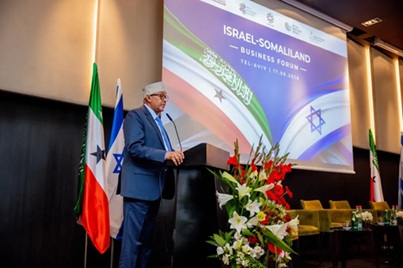
Hargeisa (WDN) — Somaliland President Abdirahman Mohamed Abdullahi “Irro” has said there are currently no Israeli or U.S. military bases in Somaliland, but indicated that his administration would be willing to host military facilities for either country in Berbera if they expressed interest.
The remarks, reported by The Economist, signal how Somaliland is increasingly seeking to leverage its strategic location on the Gulf of Aden to deepen ties with major powers—and potentially advance its long-standing campaign for international recognition.
Irro reportedly told the magazine that neither Israel nor the United States currently maintains a military presence in Somaliland, rejecting speculation that foreign bases already exist in the territory. However, he made clear that Hargeisa would consider granting access to Berbera should Washington or Tel Aviv seek a military foothold there.
The proposal is significant because of Berbera’s strategic location near the Gulf of Aden and Bab al-Mandab, one of the world’s most important maritime chokepoints linking the Red Sea with the Indian Ocean.
For the United States, a military presence in Berbera could provide an advantageous location for monitoring developments in Yemen, the Red Sea and surrounding maritime routes. For Israel, proximity to Bab al-Mandab could offer strategic advantages in monitoring threats emanating from Yemen, particularly amid continuing tensions involving the Houthis.
Berbera’s Strategic Value
Somaliland’s interest in foreign military partnerships comes as the Red Sea and Horn of Africa have become increasingly contested by global and regional powers.
The United Arab Emirates already has a significant strategic presence in the region and has been involved in the development of major ports, including Berbera and Bosaso. Turkey, China and other powers have likewise expanded their economic, diplomatic or security interests around the Red Sea and Gulf of Aden.
A permanent U.S. or Israeli military facility in Berbera would therefore have implications extending well beyond Somaliland. It could alter the regional security balance, attract competing foreign interests and provoke strong opposition from Somalia’s Federal Government, which regards Somaliland as part of the Somali Republic.
For Somaliland, the potential strategic value of Berbera is closely connected to a much larger political objective: international recognition. Hargeisa declared independence from Somalia in 1991 but has yet to secure broad international recognition as a sovereign state.
President Irro has reportedly expressed hope that the United States could eventually recognize Somaliland and that at least one additional country could do so before the end of the year.
He has also indicated plans to visit Washington, where he hopes to engage directly with U.S. officials, potentially including President Donald Trump. A high-level meeting with Washington would represent a major diplomatic opportunity for Hargeisa as it seeks to transform its strategic importance into political recognition.
Somaliland’s willingness to offer Berbera to major military powers represents a potentially consequential strategic calculation. Hargeisa possesses something highly valuable: geography.
Berbera sits close to one of the world’s most important maritime corridors, while its port and road links toward Ethiopia give the city additional commercial significance. But turning geography into geopolitical leverage carries risks.
A foreign military presence could provoke Somalia’s Federal Government, complicate relations with neighboring states and intensify competition among regional powers. For now, there is no confirmed agreement establishing a U.S. or Israeli military base in Berbera, and Irro’s remarks should not be interpreted as evidence that such a deal has been concluded.
What his comments do demonstrate, however, is that Somaliland is increasingly prepared to place its strategic geography at the center of its diplomatic strategy. As competition intensifies around the Red Sea, Bab al-Mandab and the Gulf of Aden, Berbera may become more than a commercial port.
It could become one of the most strategically contested locations in the Horn of Africa—and potentially one of Somaliland’s most powerful diplomatic cards in its decades-long quest for recognition.
WardheerNews