
By Bashir M. Sheikh Ali
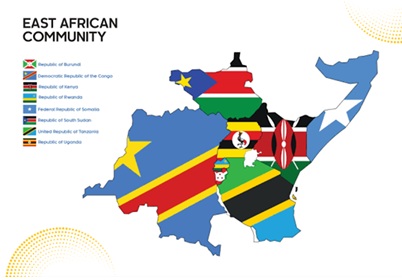
Somalia acceded to the East African Community (EAC) in December 2023 and deposited its instrument of ratification in March 2024, becoming the bloc’s eighth Partner State. The accession was received with genuine optimism in Mogadishu. President Hassan Sheikh Mohamud had pursued membership energetically since his return to office in 2022.
The EAC is at its core an economic and trade pact. Its benefits accrue only to Partner States that integrate into the community. Those benefits are accessed through a structured integration process the treaty prescribes precisely. The question for Somalia is not whether it belongs to the EAC. It is whether it is integrating into it.
This essay argues that membership is not integration and that the legal and territorial conditions for integration do not exist. Although technical groundwork within Mogadishu has advanced in recent years, the structural obstacles to the EAC Treaty implementation are political, territorial, and fiscal, and they are not resolving.
The EAC Integration Sequence
The EAC Treaty prescribes a four-stage integration sequence: (1) a Customs Union, (2) a Common Market, (3) a Monetary Union, and ultimately (4) a Political Federation. Article 6 of the Common Market Protocol provides that free movement of goods between Partner States is governed by the customs law established under the Customs Union Protocol. The Common Market adds the legal framework for movement of persons labour, services, and capital but creates no new framework for goods. A Partner State that has not implemented the Customs Union has not laid the foundation on which the Common Market is built. There is no shortcut between the two stages.
The EAC is best understood as a house: the Customs Union is the foundation, the Common Market the walls, the Monetary Union and Political Federation the roof and finishing. The EAC is modelled on the European Union, but differs from it in one important respect. The EU built each stage organically, with each step negotiated from the experience of the last. The EAC prescribed the entire architecture in advance through protocols. A Partner State that is unable or unwilling to meet specific commitments within a milestone may rely on the principle of variable geometry, which allows Partner States to move at different speeds on particular obligations. But variable geometry is an implementation strategy within a milestone, not a mechanism for bypassing one. It does not authorize a Partner State to skip the Customs Union and claim the benefits that belong to the Common Market.
What the Customs Union Requires
The Customs Union is the first and foundational milestone of EAC integration, established by the Protocol on the Establishment of the East African Community Customs Union, signed in 2004 and operational from January 2005. The protocol creates a single customs territory with two defining characteristics: a Common External Tariff applied uniformly to all goods entering the community from outside, and movement of community goods between Partner States at a prescribed tariff, often duty-free. Both require the same underlying condition: a Partner State that controls every point through which goods enter its territory and applies the same rules at each of them.
The CET operates through three interlocking instruments. The first is the Harmonized Commodity Classification System, under which every product is assigned an HS code that determines its classification. The classification is not random or discretionary: a specific product receives the same HS code regardless of which port it enters through. The second is the Rules of Origin, which provides criteria for whether a product originates within the EAC (i.e., it is a community good) and is therefore exempt from the CET. A product that does not meet the Rule of Origin criteria is a non-community good subject to the full external tariff. The third is the CET rate schedule, which sets four tariff bands: zero percent for raw materials, ten percent for intermediate goods, twenty-five percent for finished goods not otherwise available in the community, and thirty-five percent for finished goods that are available in the community. The three instruments are only as effective as the weakest link among them. If anyone fails, the CET does not function as intended. The CET functions as a system or it does not function at all.
Enforcing the CET requires genuine territorial reach. An uncontrolled port is an open bypass of the entire system. Goods entering through a port not integrated into the EAC’s electronic cargo tracking system enter the community without paying the external tariff and without the traceability that would allow destination-based collection to catch them, moving freely within the community, gaining an unfair competitive advantage over goods that entered through compliant ports and paid the full external tariff.
What Somalia Has Built
A country that meets these requirements in some locations has made progress toward a Customs Union. It has not implemented one. Somalia is an example.
Somalia’s federal government (FGS) has made genuine and documented progress in building customs administration infrastructure, but almost entirely within Mogadishu. The central instrument is the Somalia Customs Automated System, SOMCAS, developed under Somalia’s HIPC debt relief program as a structural benchmark. The system incorporates harmonized tariff codes, HS classification codes, and harmonized item descriptions, enabling electronic declaration processing and automated duty calculation. It is fully operational at Mogadishu seaport and airport.
Somalia also enacted an ad valorem tariff schedule, replacing a prior system of fixed charges per bag, carton, or litre that bore no reliable relationship to the value of goods. Customs valuation regulations followed, establishing transaction value as the basis for duty assessment. The FGS convened a Customs High-Level Dialogue bringing together the federal revenue authority and all five federal member states (FMSs) and produced agreement on a national tariff schedule. Rules of Origin legislation has been drafted, and the EAC Secretariat conducted a benchmarking mission for Somali customs officers on One Stop Border Post operations in February 2025.
The inventory represents progress that is real, documented, and consequential for Somalia’s domestic revenue administration. It does not represent a Customs Union, or the foundation of one, in the EAC sense.
The reason is territorial. SOMCAS has been partially implemented at Kismayo but a common valuation table between Mogadishu and Kismayo has not been agreed, meaning identical goods attract different duties depending on port of entry. {EN1] Implementation has been paused in Puntland due to political conditions. Berbera, the most commercially developed port in the Somali territories and the primary logistics corridor for landlocked Ethiopia, operates entirely outside federal customs authority under Somaliland’s administration through a long-term concession with DP World. A Customs Union that does not cover these ports is not a Customs Union. It is a customs administration in one city.
The FMS administrations controlling the major ports depend on port revenues for fiscal survival. Somaliland derives approximately 41 percent of its government budget from import tariffs and a further 8 percent from export taxes and port duties. Jubbaland’s port revenues from Kismayo are earmarked directly for its service delivery and security budget. Puntland’s fiscal situation is comparable. CET compliance would require each administration to cede control over tariff-setting and revenue collection to the FGS. That is the structural resistance to harmonization. {EN1]
The Problem of Unfinished Federalism
The FGS controls Mogadishu’s port. It does not control Berbera, Bosaso, or Kismayo. A Customs Union that requires uniform enforcement across all ports cannot be built on that foundation. A different approach is needed.
The FGS and the FMSs could negotiate a revenue-sharing compact under which each FMS port administration collects the CET at its own ports, retains an agreed share, and remits the balance to the FGS. The EAC does not prescribe how Somalia distributes customs revenues internally. What it prescribes is that the CET be applied uniformly, that all ports use the HS classification system, and that they participate in the Single Customs Territory’s electronic cargo tracking infrastructure. Tariff-setting authority under the Customs Union rests with the EAC Council, not with individual administrations. Free movement of goods across internal administrative boundaries would need to be part of the same compact. The informal checkpoints that add cost and friction to internal transit are Somalia’s law enforcement problem, not a customs design problem, but their elimination is a practical requirement for the single customs territory to function.
The deeper obstacle is operational. Regardless of the legal framework, the federal government does not in practice control Bosaso or Kismayo. A compact that guarantees collection of CET at all ports under a common framework has not been established.
The Somaliland Problem
The compact leaves Somaliland entirely unresolved. Somalia maintains legal sovereignty over the territory it calls Somaliland. Hargeisa asserts independent statehood over the same territory and has done so since 1991. The two claims are irreconcilable. Mogadishu has three options, none workable. It can wait for a political resolution that has not materialized in over thirty years. In those three decades Somaliland has governed itself, held elections, and built institutions. It has shown no disposition toward reunification with the federal state. The second option is to use force to bring Somaliland under federal authority. That option is not on the table — Somalia lacks the military capacity, the international community would not support it, and there is no domestic appetite for armed confrontation with a people most Somalis regard as kin. The third option is to collect the CET at the administrative boundary between FGS and Somaliland, which would close the customs gap in practical terms but treat that boundary as a customs frontier, functionally equivalent to recognizing Somaliland as a separate jurisdiction. That is a position Mogadishu cannot take without undermining its own sovereignty claim. Berbera remains the hard limit of what any domestic arrangement can achieve.
The EAC treaty does not address what happens when a Partner State cannot extend its customs territory to its full recognized boundaries. That question falls to the Summit, which has shown willingness to accommodate new members facing difficult circumstances. But accommodation has limits. Somalia must first demonstrate a functioning customs arrangement for the territory it does control. Without that, there is nothing for the Summit to accommodate.
The Shortcut to Common Market Entitlements
The Common Market builds on the Customs Union’s free movement of goods by adding free movement of persons, labour, services, and capital. Under Articles 7 and 9 of the Common Market Protocol, both the passport and the visa-free movement it facilitates are Common Market entitlements. The Summit can agree that a Partner State may issue an EAC-format passport as it has already done for Somalia. What it cannot do is oblige other Partner States to extend visa-free entry to Somali nationals before Somalia integrates into the Common Market. Tanzania’s immigration authority confirms this: Somali nationals must obtain advance visa approval to enter, unlike nationals of other EAC Partner States. The Summit can provide the document. It cannot provide what the document is supposed to unlock.
Somali interest in the EAC passport is driven by a practical reality: the Somali national passport is severely restricted within the very region Somalia has joined. That interest is legitimate. But obtaining an EAC passport does not advance integration. It reflects the same state fragility that prevents integration. A country whose passport works within the region has no urgent need for the EAC travel document. Somalia’s need for it is a measure of how far it remains from the community it has joined.
Conclusion
Somalia is a member of the EAC in name. The FGS has built genuine customs administration instruments within Mogadishu. But the Customs Union requires a single customs territory, and Somalia is not one. The ports that matter are controlled by administrations that resist not higher tariffs but federal consolidation of the authority to set, collect, and retain customs revenue.
A path exists for the territory Somalia governs, but it requires a federal compact that has not been negotiated and a Somaliland question that thirty years and three unworkable options have left unanswered. The EAC will not compel either. The South Sudan experience shows the community neither enforces deadlines nor removes members who miss them. Somalia will continue to participate in EAC summits and benefit from whatever the Summit extends politically. None of that is integration. The house cannot be built from the roof down.
Bashir M. Sheikh Ali
Email: bsali@yahoo.com
____________
The author is a Somali-American lawyer based in Nairobi. The views expressed in this analysis are his own and do not reflect those of any organization with which he may be affiliated.
————
Endnotes
[EN1] The fiscal dependency compounds a separate competitive dynamic. Because effective tariff rates at Kismayo are lower than Mogadishu’s, traders routing goods to southern Somalia find it more profitable to import through Kismayo. This creates pressure on port administrations to reduce rates further to capture additional trade flows, producing a race to the bottom at rates already far below what the CET requires